
I remember the first time I came across the name Vanar. It wasn’t loud. It wasn’t everywhere. It was just another name in a long list of blockchain projects.
But something about it made me pause. I’m reading about it slowly, and the more I read, the more I realized this project was not trying to be just another chain. It was trying to solve a quiet problem that has existed in blockchain for years.
That problem is simple. Technology has moved forward, but ordinary people still find blockchain confusing.
Wallets feel complicated. Fees are unpredictable. And many applications feel like they were built for developers, not for everyday users.
Vanar seemed to begin exactly from that point.
Not from hype. Not from speculation. From the idea that blockchain should feel natural to use.
To understand how this idea formed, I had to go back to the beginning.
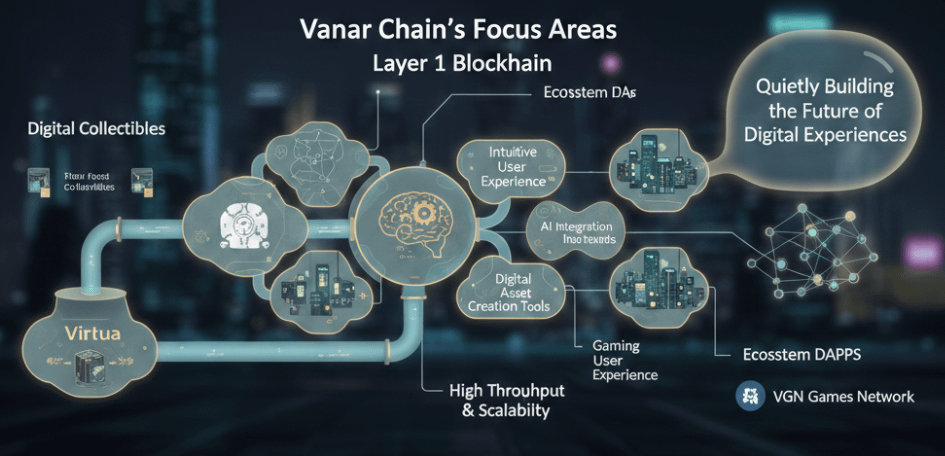
Before Vanar existed, there was a project called Virtua. It started as a metaverse and digital collectibles platform, created to give people immersive experiences across web, mobile, and virtual environments.
This platform allowed people to interact with digital items, explore virtual spaces, and experience entertainment in new ways. But over time, the team realized something important.
If you are building worlds where millions of small interactions happen, you cannot depend on infrastructure that was designed mainly for finance. You need a blockchain built specifically for those experiences.
So the project evolved. Virtua expanded and rebranded, and the infrastructure behind it became what we now know as Vanar Chain.
When I learned this, the story started to make sense. This was not a sudden invention. It was a slow transformation.
The people behind the project also explain a lot about its direction. The founders, Jawad Ashraf and Gary Bracey, came from backgrounds connected to gaming, business, and digital media, not just cryptocurrency.
That matters more than it first appears.
Because when people who understand games and entertainment design a blockchain, they think differently. They think about users who are not technical. They think about experiences, not just transactions.
Vanar itself is a Layer 1 blockchain, meaning it runs on its own network and infrastructure rather than relying on another chain.
It supports smart contracts, decentralized applications, and digital assets, and it focuses on fast transactions and scalability so that applications like games and virtual environments can run smoothly.
I started to imagine what that means in practice.
In a game, thousands of small actions happen constantly. Buying items, trading assets, moving characters, unlocking rewards. Each of these actions may involve a transaction. If the system is slow or expensive, the experience breaks instantly.
So performance here is not just a technical detail. It becomes part of the user experience itself.
Vanar also integrates tools and features related to gaming, AI, and digital asset creation, allowing developers to build entire environments, marketplaces, and experiences on top of the chain.
That’s when I realized something important.
This project is not only infrastructure. It is infrastructure designed for specific kinds of worlds.
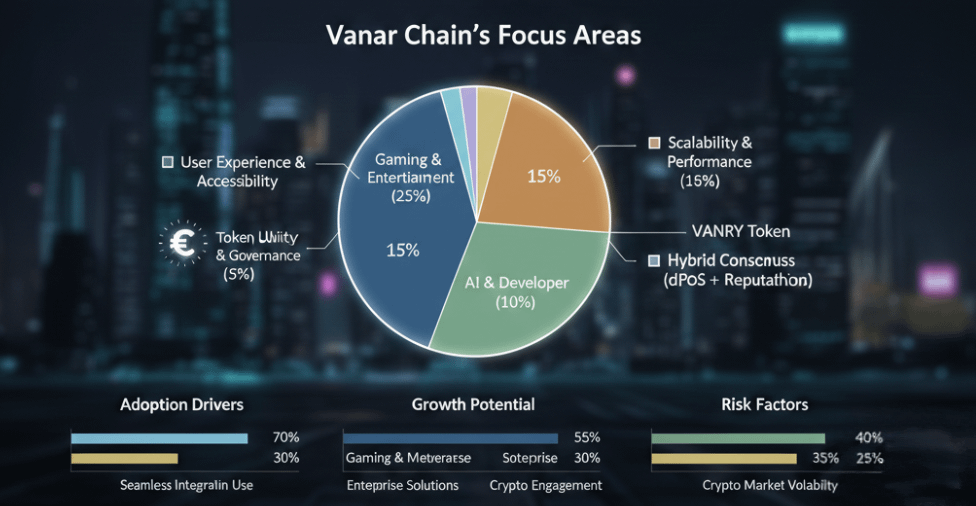
At the center of the ecosystem is the VANRY token. It is used to pay transaction fees, run smart contracts, and interact with applications built on the network.
People can also stake the token to support the network and earn rewards, and in the future it may play a role in governance decisions that shape the system.
When I think about this, I see how the token connects everything together. It becomes fuel for the network, but also part of the economies inside applications.
If it becomes widely used in games or virtual environments, people may use it without thinking of it as cryptocurrency at all. It may simply feel like part of the environment they are in.
The way the network is secured is also interesting. Vanar uses a hybrid consensus approach that includes delegated proof of stake and reputation based mechanisms, allowing participants to vote for validators while also considering credibility and trust.
This approach tries to balance decentralization with reliability.
We’re seeing many networks experiment with governance and consensus, but each one is searching for a balance between security, efficiency, and participation.
One of the strongest signs of a blockchain’s direction is the ecosystem built on top of it. Vanar powers platforms like the Virtua Metaverse and the VGN games network, blending gaming, entertainment, and blockchain into unified environments.
These platforms allow real time interaction, ownership of digital assets, and seamless microtransactions inside immersive spaces.
When I picture that, I realize something.
Adoption may not come from people deciding to use blockchain. It may come from people playing games, exploring virtual worlds, or interacting with digital content, while blockchain quietly works in the background.
There are also partnerships and collaborations helping the ecosystem grow, including work with technology and gaming companies that support development and innovation.
That suggests the project is trying to build long term foundations rather than short term excitement.
But no honest story about a blockchain is complete without talking about risks.
The space is crowded. Many Layer 1 networks are competing for developers and users. Technology alone does not guarantee adoption. People must actually use the applications built on top of it.
Gaming and metaverse platforms depend heavily on engagement. If users lose interest, growth slows.
And the crypto market itself is unpredictable. Prices rise and fall quickly, often for reasons that have little to do with the underlying technology.
These realities don’t disappear just because a project has a strong vision.
Still, when I step back and think about everything I’ve learned, Vanar feels like part of a larger shift happening in technology.
In the past, blockchain was mostly about money. Now it is slowly becoming about experiences, ownership, and digital life.
We’re seeing early signs of this change across the industry, but it still feels like the beginning of a much longer journey.
Sometimes I sit and think about how the internet once felt complicated and unfamiliar. Only a small number of people understood it. Most people didn’t see how it would change everyday life.
Then slowly, almost quietly, it became part of everything.
Maybe blockchain is moving along that same path right now.
And maybe the projects that matter most will not be the ones that shout the loudest, but the ones that quietly build systems that people use every day without even realizing what is happening underneath.
