
The first time I started learning about blockchain seriously, I thought I understood the space. There were networks, tokens, exchanges, and applications. Everything looked fast on the surface. Prices moved quickly. News spread instantly.
But the more I paid attention, the more I felt something was not fully right.
Markets were fast, yet the infrastructure behind many decentralized systems still struggled with speed and execution. Transactions sometimes lagged behind price movements. Traders reacted in seconds while networks processed in longer intervals.
I’m watching a world that wants real time finance, but the technology was still catching up to that idea.
That quiet gap is what slowly led me to discover Fogo.
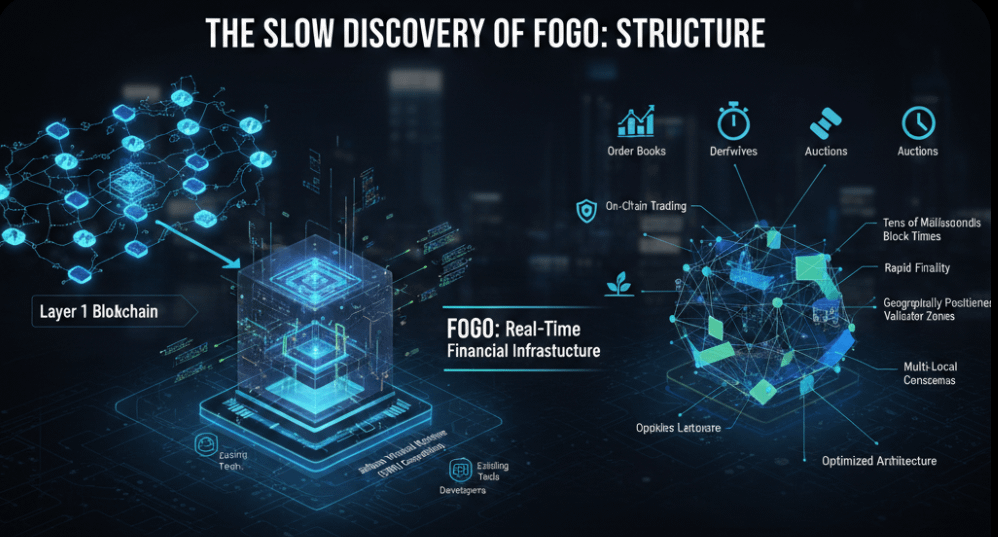
At first, it seemed like just another Layer 1 blockchain. But as I kept reading, I realized it was built for a very specific reason. Fogo was designed from the beginning as infrastructure for on chain trading and real time financial activity rather than a general purpose blockchain trying to do everything at once.
That single decision changed how I saw it.
Instead of chasing every use case, the project focused on one area where performance truly matters. Trading demands speed, fairness, and predictability. Without those things, markets feel unstable.
I started to understand why the idea existed in the first place.
The builders behind Fogo were not only engineers. Some of them came from trading and financial backgrounds, which meant they understood execution speed, latency, and infrastructure in a practical way rather than just theoretical terms.
That perspective shaped the entire design.
The goal was not just to build a blockchain. The goal was to build an execution environment that could support real time financial systems, something closer to professional trading infrastructure than traditional decentralized networks.
When I realized that, the project began to feel less like technology and more like a response to a real world need.
Then I began to look deeper into how it actually works.
Fogo runs on the Solana Virtual Machine, which means applications and tools built for that ecosystem can often run on Fogo without major changes.
That choice is more important than it sounds.
Developers usually avoid platforms that require learning everything again. Compatibility lowers friction. It allows an ecosystem to grow faster because builders can reuse what already exists.
But the real difference appears in performance.
Fogo uses a Firedancer based validator client and optimized architecture designed to reduce latency and increase throughput.
Reports describe block times measured in tens of milliseconds and very fast finality, performance levels aimed at supporting real time trading and latency sensitive applications.
They’re not chasing speed for marketing. They’re trying to make certain kinds of applications possible, on chain order books, derivatives, auctions, and systems where execution timing matters deeply.
I remember the moment this finally made sense to me.
Infrastructure shapes behavior.
When systems become faster, people build things that were impossible before.
As I kept learning, I discovered that the architecture goes beyond software. Some designs involve geographically positioned validator zones and multi local consensus models that reduce network delay and improve execution consistency.
That detail stayed in my mind.
They’re not only thinking about code. They’re thinking about physics, distance, and how information moves across the world.
That level of thinking made the project feel grounded in reality.
Then I started wondering about the token itself.
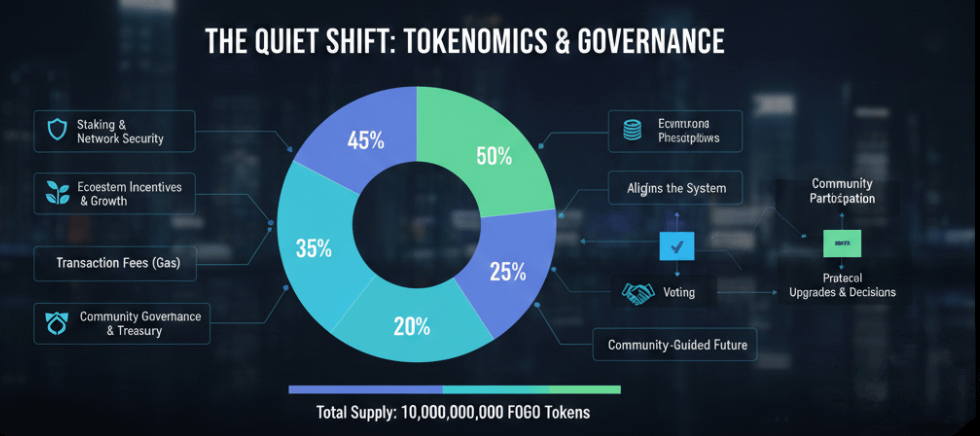
The FOGO token is used for transaction fees, staking, governance, and incentives that support the ecosystem and secure the network.
Its total supply is about ten billion tokens, designed to support long term growth and participation.
At first, tokenomics always feels repetitive across projects. But when I thought about it more deeply, I realized something simple.
A token is not just a currency inside a blockchain. It is also the mechanism that aligns incentives, secures the system, and allows the community to guide its future.
And that brought me to governance.
Like many decentralized networks, Fogo is designed so that participation and staking can influence upgrades and decisions over time.
We’re seeing a slow shift in how infrastructure evolves. Systems that were once controlled by small teams are gradually becoming shaped by communities and stakeholders.
It is not perfect. It is still evolving. But the direction is clear.
A blockchain is not only software. It is also a group of people agreeing on shared rules.
As I kept exploring, I began to think about ecosystems.
Every new network begins quietly. A few developers experimenting. A few early users. A handful of applications testing the limits of the system.
Because Fogo is compatible with existing tools and built for performance sensitive applications, it is positioned to support advanced financial systems that depend on speed and precise execution.
That does not guarantee success.
And this is something I think about often.
Every ambitious system carries risks.
Some architectural choices that improve speed, such as curated validator sets or complex high performance clients, introduce tradeoffs and technical challenges.
Competition among high speed networks is also intense. Adoption takes time. Technology must prove itself under real world pressure.
Understanding these risks does not weaken the story. It makes it honest.
And honesty is important when thinking about the future.
Sometimes I try to imagine what the world might look like if networks like this succeed.
Financial markets that run entirely on open infrastructure. Systems that settle transactions in real time. Platforms where anyone in the world can participate without barriers.
If it becomes normal to trade, borrow, and exchange value on networks that are fast, transparent, and global, the boundary between traditional finance and decentralized systems may slowly fade.
They’re not trying to replace everything overnight. They’re trying to improve one layer at a time, execution, speed, and reliability.
And sometimes improving one layer changes everything above it.
When I step back and think about all of this, one thought stays with me.
Most technologies that reshape the world do not feel dramatic at the beginning. The internet once felt slow and limited. Mobile phones once seemed unnecessary. Even electricity once looked like a strange experiment.
I’m still learning. They’re still building. And We’re seeing only the early chapters of a much longer story.
Sometimes the biggest changes arrive quietly.
They arrive slowly, step by step, until one day we look around and realize the world feels different, and we cannot even remember when the shift began.