
Most Layer 1 debates start from the same assumption the blockchain is an abstract machine, and everything outside of it is noise. Latency is treated as a minor inconvenience. Geography is considered irrelevant. Hardware differences are politely ignored.
Fogo flips that assumption. It treats the real world as the constraint. Distance matters. Routing paths matter. Validator hardware matters. And the thing that actually breaks real-time on-chain systems is rarely the average block time. It is the tail the ugly edge cases where confirmations slow down ordering gets messy, and every protocol stacked on top starts adding defensive padding just to stay safe.
That is where Fogo positions its edge.
Yes, it runs on the Solana Virtual Machine. But that is not the headline. SVM compatibility is a strategic decision, not a brag. The value is not that contracts compile. The value is that a mature ecosystem already exists tooling, developer workflows account models and performance expectations shaped by years of SVM iteration. Fogo inherits that foundation and then focuses on what most chains leave untouched: how consensus behaves when the network is under real stress, across real geography.
The Zone Design: Localizing Consensus
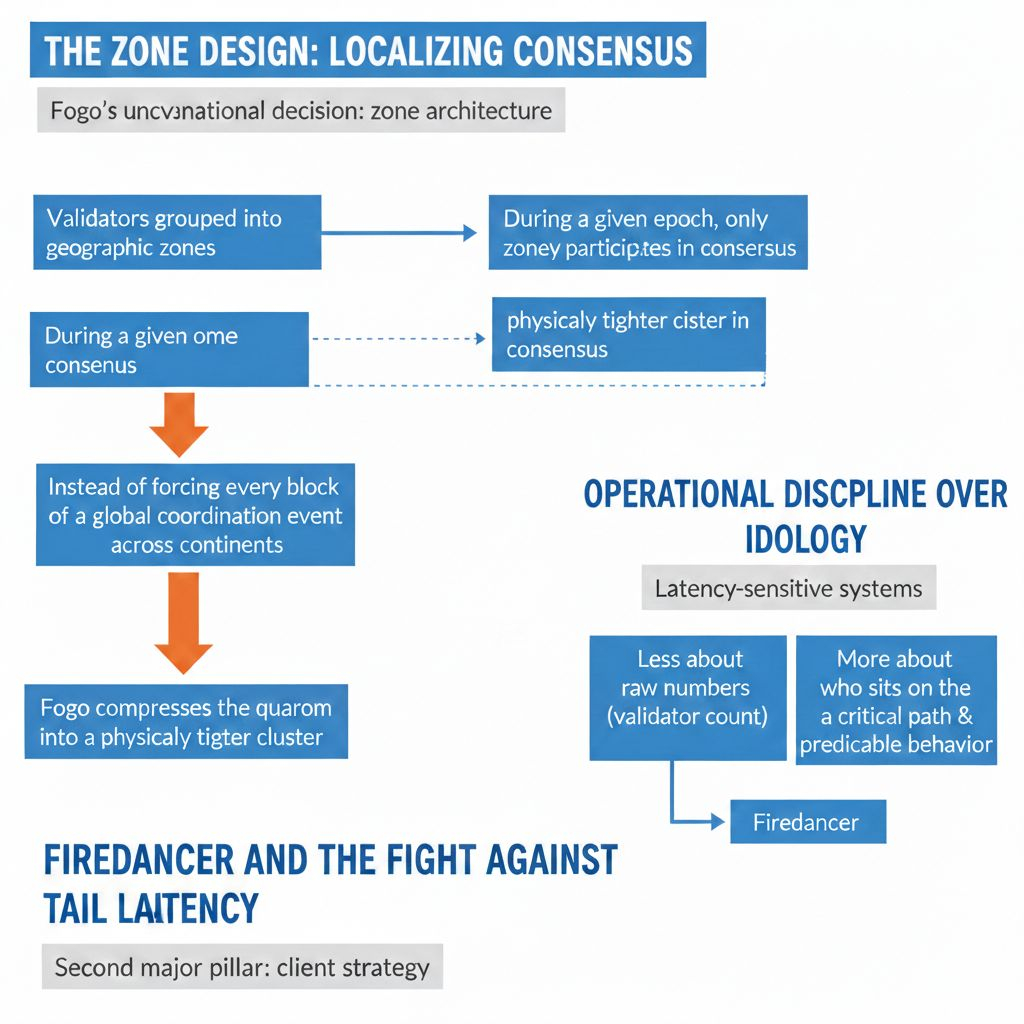
Fogo’s most unconventional decision is its zone architecture.
Validators are grouped into geographic zones. During a given epoch only one zone actively participates in consensus. Instead of forcing every block to be a global coordination event across continents, Fogo compresses the quorum into a physically tighter cluster.
Then over time the responsibility rotates.
This is not a cosmetic tweak. It is a philosophical shift.
By localizing consensus, Fogo reduces propagation distance and variance within an epoch. Lower variance means tighter timing behavior. Tighter timing behavior means applications can assume more consistency. But this design also introduces a deliberate tradeoff: influence is temporarily concentrated in the active zone.
Rotation becomes the balancing mechanism.
Decentralization, in this model, is not measured in a single snapshot. It is measured across time. Over multiple epochs, different regions carry the responsibility. The system distributes influence temporally rather than uniformly at every moment.
That changes the security conversation entirely.
In globally mixed validator sets, exposure is always diffuse. In a zone system, exposure concentrates. If a weak or poorly distributed zone becomes active, the chain is not just slower it is structurally more fragile for that window. That makes zone eligibility rules, stake distribution, and operational standards critical parts of the protocol’s health.
Zone quality is no longer an abstract metric. It is a live risk surface.
Operational Discipline Over Ideology
Many chains advertise decentralization through validator count alone. But latency-sensitive systems care less about raw numbers and more about who sits on the critical path and how predictable their behavior is.
Fogo’s design suggests something uncomfortable but honest: if you want on-chain systems to behave like serious financial venues, you need operational discipline. Permissionless ideals alone do not solve jitter, queue buildup, or unpredictable confirmation delays.
This is not about excluding participants. It is about acknowledging that performance in distributed systems is shaped by the slowest links and the noisiest nodes. By compressing quorum geographically, Fogo is effectively saying that real-world infrastructure realities cannot be abstracted away.
Firedancer and the Fight Against Tail Latency
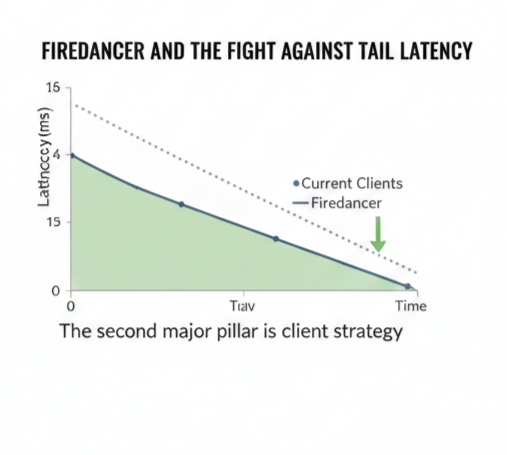
The second major pillar is client strategy. Fogo leans heavily into Firedancer, using a hybrid Frankendancer approach where high-impact components networking, block production, packet handling are optimized through Firedancer while maintaining compatibility with broader SVM-derived infrastructure.
Why does this matter?
Because tail latency rarely comes from smart contract execution alone. It comes from packet propagation delays, leader bottlenecks, scheduling inefficiencies, and networking overhead. When queues build up, jitter increases. When jitter increases, markets widen spreads, keepers add buffers, and risk parameters inflate.
Reducing that jitter is not glamorous engineering. But it directly shapes liquidation races, auction fairness, and order matching integrity.
In practical terms, faster packet movement and more deterministic scheduling can have a larger impact on real-world outcomes than shaving microseconds off compute execution.
Markets Are Timing Machines
Fogo’s architecture makes more sense when you view its target clearly: market mechanics.
Not all DeFi is equally sensitive to timing. Lending markets tolerate small variance. Simple swaps absorb minor delays. But order books, auctions, and liquidation engines are timing machines. Their outcomes are ordering problems.
When confirmation cadence fluctuates unpredictably, protocols compensate defensively. They widen spreads. They increase buffers. They move logic off chain. Every one of those responses reduces capital efficiency.
Fogo’s thesis is that if you make timing behavior consistent enough not just fast, but predictable builders can tighten parameters. They can rely less on defensive assumptions. They can keep more logic on chain.
The goal is not raw speed. It is confidence in cadence.
MEV Is Reshaped, Not Removed
Any conversation about timing eventually touches MEV.
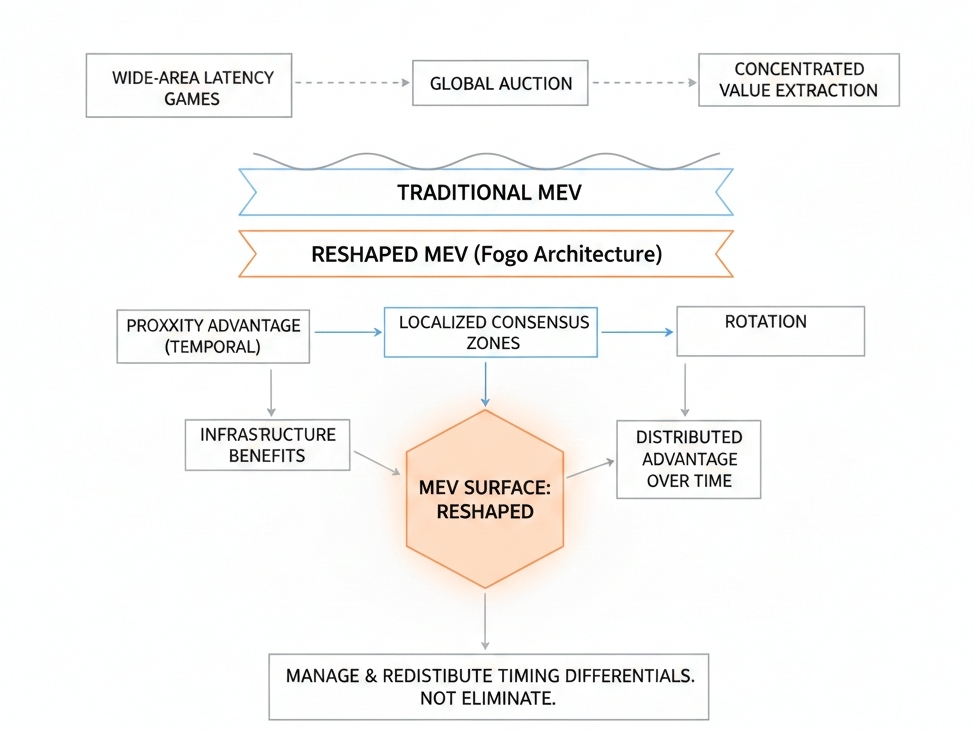
Localized consensus can reduce certain wide-area latency games, but it also introduces new dynamics. During a given epoch, the active zone may have proximity advantages. Infrastructure near that zone can experience structural timing benefits.
Rotation distributes this advantage over time. But in any single window, geography still shapes opportunity.
The MEV surface is not erased. It is reshaped.
This is an important distinction. Rather than claiming to eliminate extractable value, Fogo implicitly acknowledges that timing differentials are inherent to distributed systems. The architecture attempts to manage and redistribute them rather than pretend they disappear.
Cadence as Product
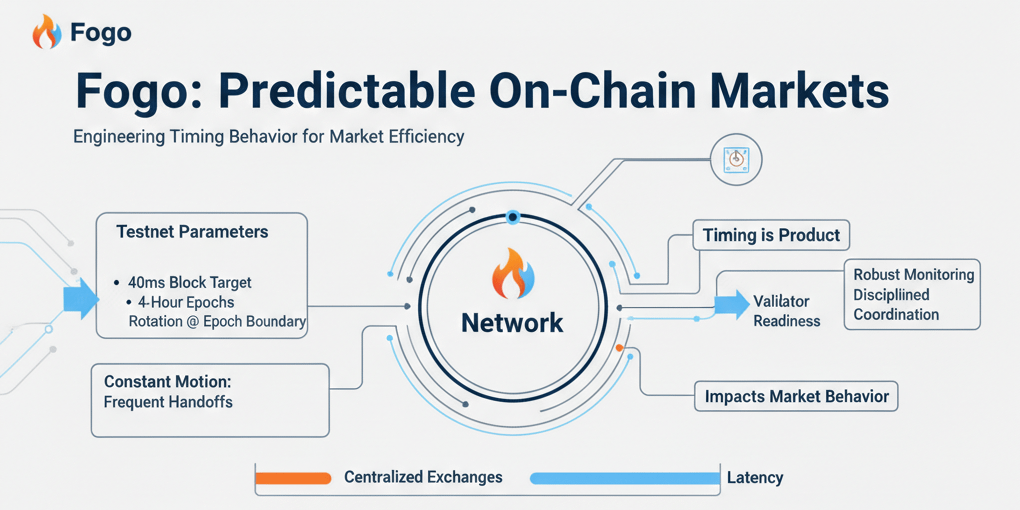
The testnet parameters push aggressively: a 40 millisecond block target, one-hour epochs, and rotation at each epoch boundary.
That implies constant motion.
Frequent handoffs of consensus locality require robust monitoring, validator readiness, and disciplined coordination. In this design, operations are not background maintenance. They are part of the product itself.
A slow zone rotation or a poorly prepared epoch boundary is not just an inconvenience. It directly impacts market behavior.
Builders Must Think Geographically
An unusual implication emerges for application designers.
If zone locality rotates on a schedule, latency contours rotate too. Oracle propagation speed may shift. Arbitrage timing may shift. Keeper incentives may subtly rebalance.
Many applications assume network conditions are stationary. Fogo encourages a mindset closer to global trading infrastructure, where routing, region, and time windows shape system dynamics.
Developers may need to consider where the quorum sits during a given epoch and how that affects critical flows.
This introduces complexity but also transparency. Instead of hidden latency variation, the system makes locality explicit.
Economics: Familiar by Design
On the tokenomics side, Fogo remains intentionally legible. A fixed 2 percent annual inflation rate distributed to validators and delegators, alongside fee mechanics inspired by SVM models, keeps economic experimentation minimal.
That restraint appears strategic.
When testing a systems-level thesis about latency and consensus locality, adding novel economic mechanisms would muddy attribution. If performance improves, it should be clear why.
However, the zone system introduces second-order incentive effects. Since only the active zone participates in consensus during an epoch, stake may gradually migrate toward zones perceived as more profitable or stable. That could create imbalances.
Zone management therefore becomes incentive engineering. The topology of the network is not static it responds to economic signals.
UX as Infrastructure: Fogo Sessions
Fogo Sessions might look like a small feature, but strategically it is aligned with the broader thesis. Scoped permissions and reduced signature fatigue enable smoother, gas-sponsored style experiences.
This is not just UX polish. It lowers friction for onboarding mainstream users into SVM-style environments. Cleaner permission models reduce cognitive overhead. Fee sponsorship enables more predictable first interactions.
If Fogo wants tightly engineered on-chain markets, it cannot ignore the human layer. Friction at entry distorts participation just as much as latency variance distorts ordering.
Regulatory Signaling
The publication of a MiCA-oriented crypto asset white paper sends another signal. Regardless of one’s regulatory stance, it suggests structured disclosure and infrastructure-level seriousness.
For a chain pitching itself as market infrastructure rather than experimental playground regulatory readiness may become a differentiator. Markets thrive on predictability not only in timing, but in governance posture.
The Open Question
The cleanest description of Fogo is not faster chain or next chain. It is a chain attempting to make timing behavior predictable enough that on-chain markets can be engineered more tightly.
SVM is the tool.
Zones and validator discipline are the thesis.
Firedancer acceleration is the leverage.
The unresolved question is whether the system can maintain healthy zones balanced stake distribution and high operator standards while avoiding drift into a tightly controlled club.
That tension between performance discipline and open participation will determine whether Fogo becomes a new category of infrastructure or remains a compelling experiment.
Speed gets attention.
Predictability shapes outcomes.
