Let me be honest with you. Speed alone doesn’t impress me anymore. I’ve seen too many chains promise lightning and deliver lag. So when someone says “high-performance L1 using the Solana Virtual Machine,” I don’t nod. I lean back. I ask questions.
Because performance is easy to claim. Hard to sustain.
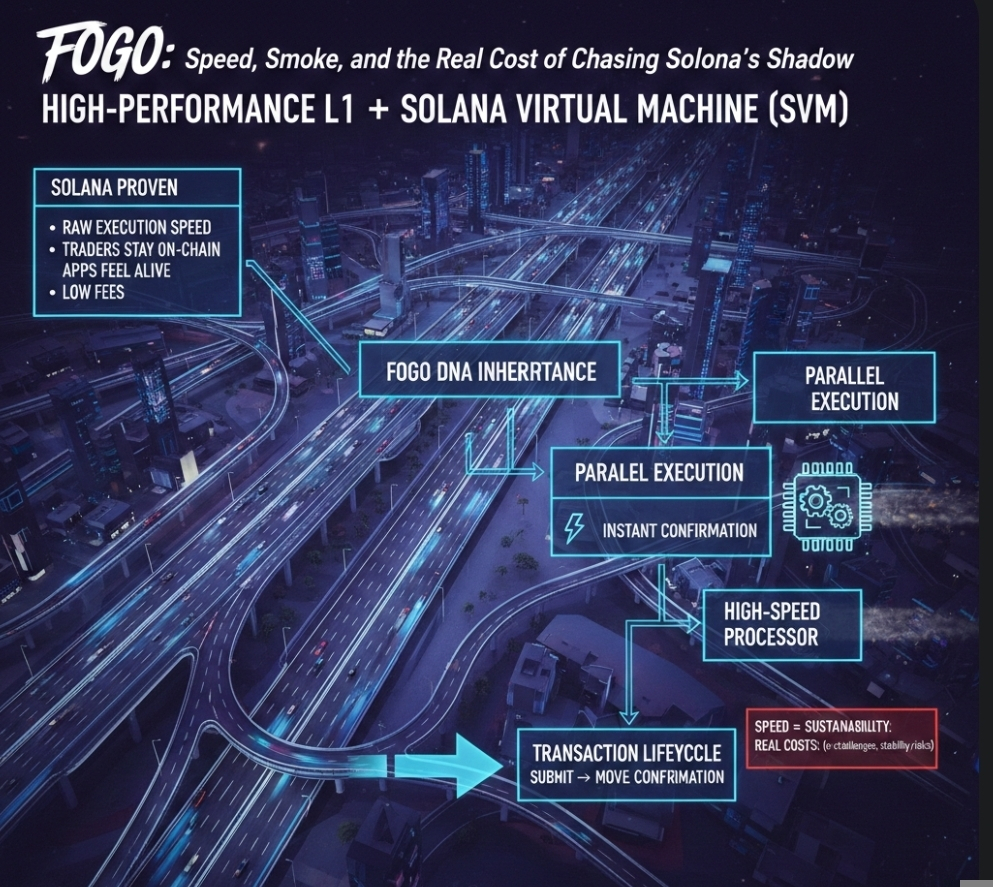
You and I both know why SVM matters. Solana proved one thing brutally well raw execution speed changes behavior. Traders stay on-chain. Apps feel alive. Fees stop being a psychological tax. Now Fogo steps in, borrowing that same execution engine, and the pitch sounds simple: take what works, push it harder, make it cleaner. Sounds good over coffee. But systems aren’t built in slogans.
Here’s how I see it.
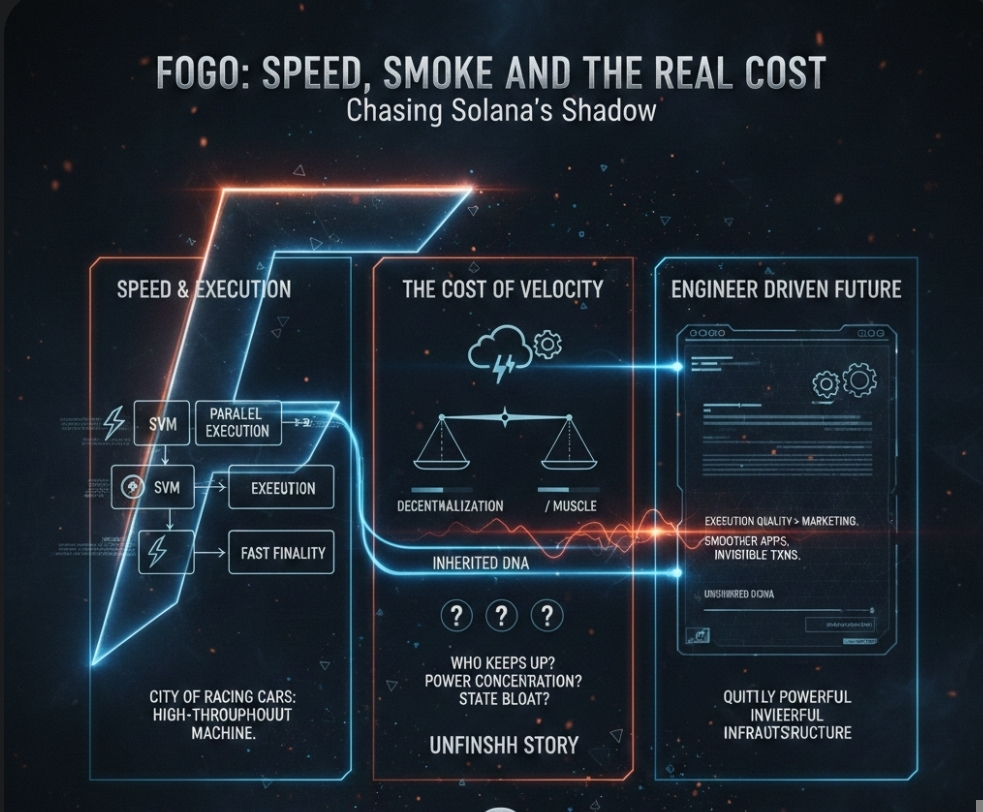
Imagine a city built for racing cars instead of pedestrians. Wide roads. No traffic lights. Everything optimized for motion. That’s what SVM chains try to be machines for throughput, not philosophy. Fogo inherits that DNA. Parallel execution. Fast finality. The idea that the network should feel less like a slow committee and more like a high-speed processor. You submit a transaction and it doesn’t wait. It moves. Instantly, almost aggressively.
Nice feeling. Addictive, even.
But here’s the thing. Speed shifts the burden elsewhere. When blocks fly fast, coordination gets harder. State grows heavy. Validators need muscle, not just ideology. Suddenly decentralization isn’t a slogan anymore it’s a hardware question. Who can keep up? Who drops out? Who quietly gains influence because they own better machines? These are the questions that decide whether a chain becomes infrastructure… or just another fast experiment.
And that’s where Fogo becomes interesting, not obvious.
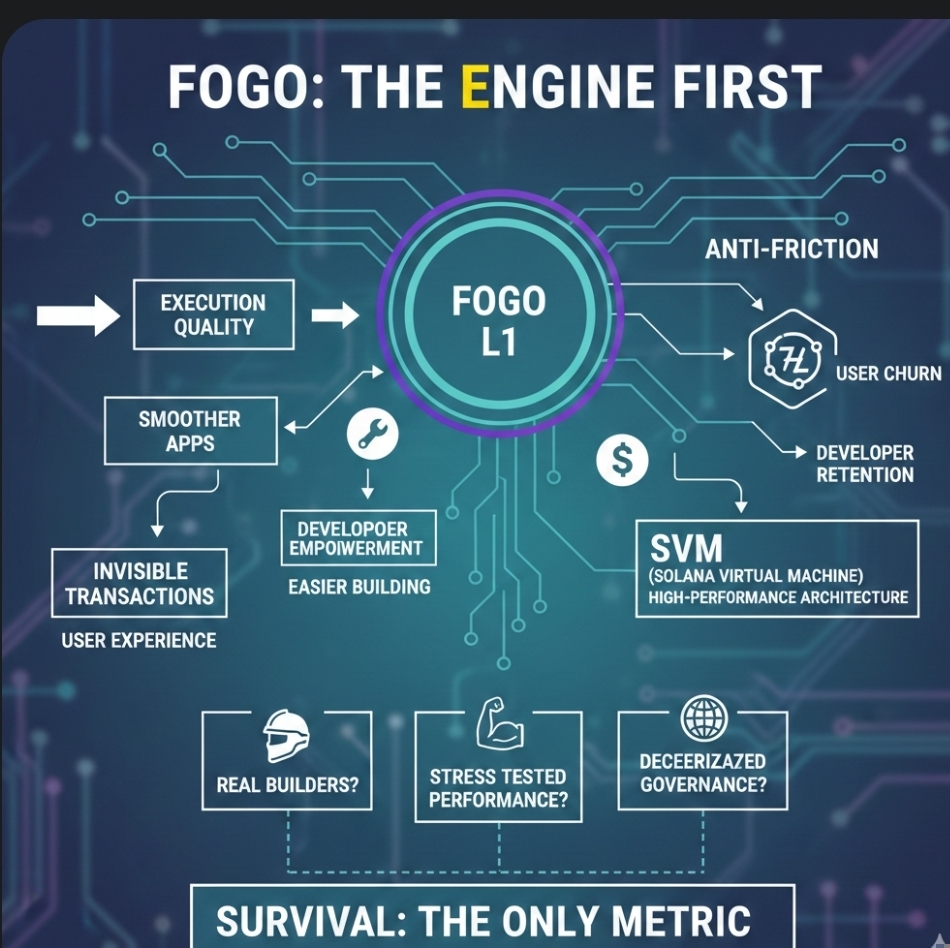
You’re not just looking at another L1. You’re watching a design choice. Fogo is betting that execution quality not marketing, not token noise will decide the next wave of chains. If users feel friction, they leave. If developers fight the system, they stop building. So Fogo focuses on the engine first. Everything else later. It’s a very engineer-driven mindset. Almost stubborn.
Why does this matter?
Because history in crypto is weirdly predictable. Ethereum won minds. Solana won speed. The next winners will blur those lines. If Fogo succeeds, you won’t notice it through headlines. You’ll notice it when apps feel smoother, when transactions feel invisible, when users stop talking about “which chain” they’re on. The best infrastructure disappears. Quietly powerful.
But I’ll tell you what I’m still watching.
Can it attract real builders, not just speculators chasing incentives? Can it keep performance under stress, not just in perfect lab conditions? Can it stay open enough that power doesn’t concentrate behind the scenes? These are slow questions. Boring questions. The ones that actually decide survival.
So when someone tells me, “Fogo is a high-performance L1 using SVM,” I don’t hear hype. I hear an unfinished story. A fast machine trying to prove it deserves to exist.
And in this industry, survival is the only metric that counts.