
In the early days of blockchain the focus was simple move value without intermediaries. Speed decentralization and security were the benchmarks. But as artificial intelligence matures and autonomous agents begin to act on our behalf a deeper question emerges what happens when machines not only move money but also remember reason and transact continuously?
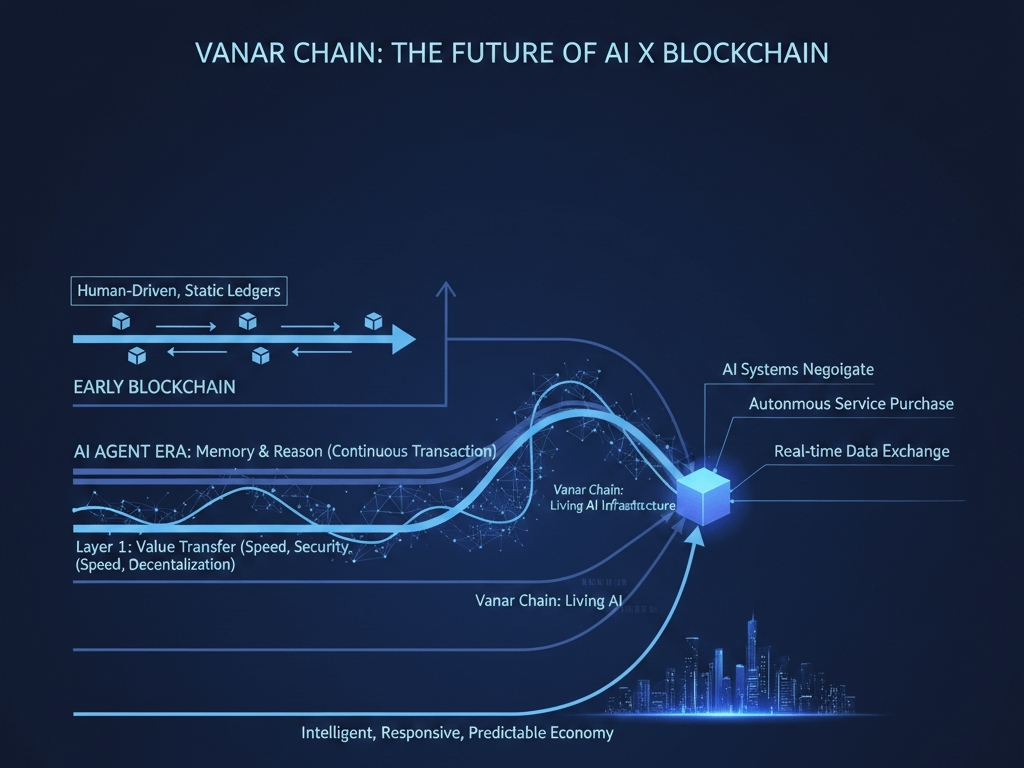
Vanar Chain positions itself at the center of this transition.
It is not presenting itself merely as another Layer 1 network competing on throughput or gas fees. Instead it frames its infrastructure as a living stack built to support memory driven AI agents and micro transaction economies that operate in real time. In a world where AI systems negotiate contracts pay for data purchase services and update knowledge bases autonomously infrastructure must evolve beyond static ledgers. It must become intelligent responsive and economically predictable.
A Life Infrastructure Built on Memory and Micro Payments
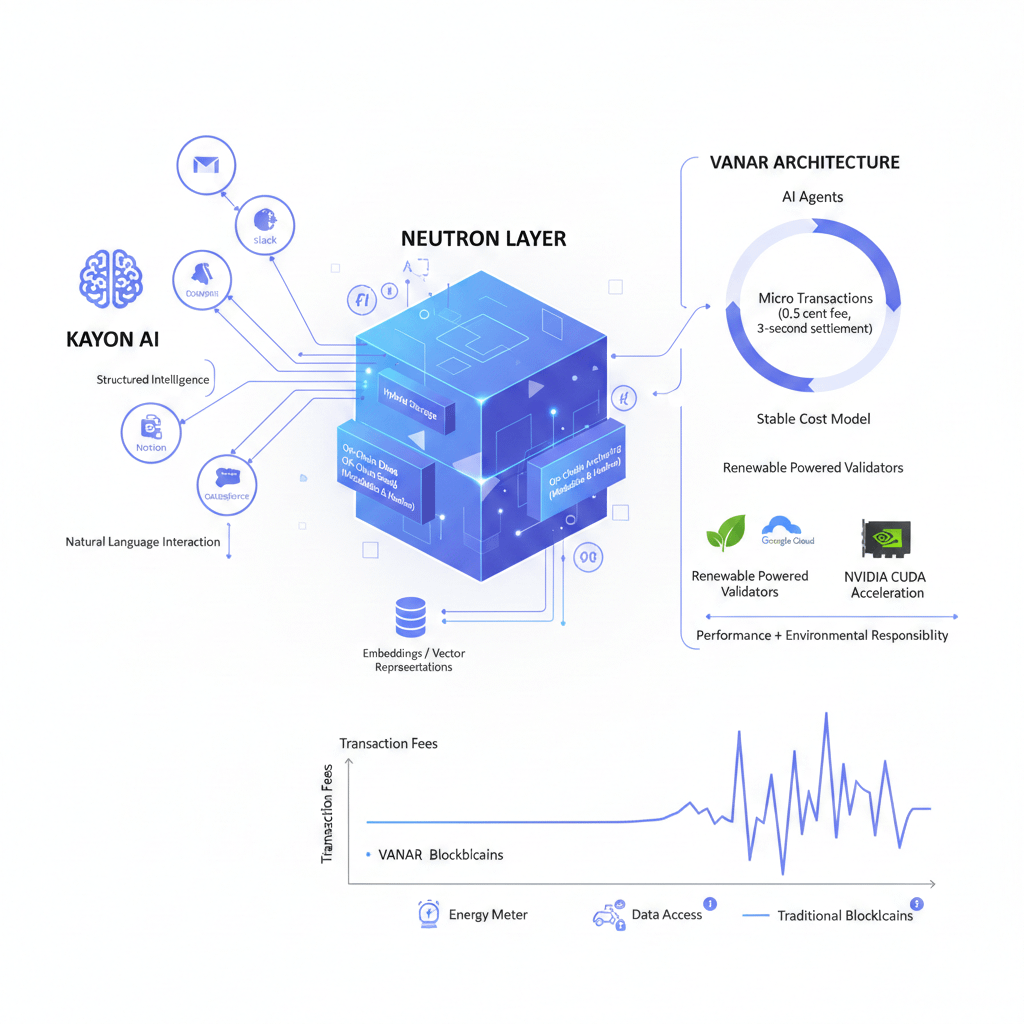
At the core of Vanar’s architecture lies a simple but powerful idea: if AI agents are going to participate in the economy transactions must be instant inexpensive and stable in cost. The network settles transactions in roughly three seconds with a fixed fee model that remains around half a cent. Importantly that fee does not spike dramatically during periods of congestion.
Why does this matter? Because micro payments only work when they are predictable. Imagine a smart energy meter paying for electricity one second at a time. Imagine an AI purchasing access to datasets in small increments based on real time usage. Imagine autonomous vehicles paying tolls dynamically. These systems cannot operate if transaction fees fluctuate wildly. Vanar’s fixed fee structure is designed to make such continuous economic interactions viable.
The infrastructure also acknowledges sustainability concerns. Validator nodes operate in collaboration with renewable powered environments including infrastructure support from Google Cloud. The network offsets emissions and builds its high performance computing layer around acceleration from NVIDIA using CUDA based AI stacks. The message is clear performance and environmental responsibility are not mutually exclusive. For enterprises and regulators increasingly sensitive to carbon footprints this positioning carries weight.
The Hybrid Storage Model: Speed Without Sacrificing Ownership
Traditional blockchains are optimized for immutability but not for large scale dynamic data storage. Vanar introduces what it calls a hybrid storage design within its Neutron layer. By default large data seeds are stored off chain for efficiency. However users can anchor these seeds on chain preserving cryptographic proofs of ownership and integrity.
When anchored only immutable metadata and encrypted file hashes are stored on chain. The actual content remains private accessible solely through the owner’s decryption keys. This approach attempts to strike a balance between performance and sovereignty. Sensitive information stays confidential yet verifiable.
What makes this design particularly relevant in the AI era is that embeddings vector representations used for semantic search are treated as seeds. This means AI systems can query information by meaning rather than by file name. The blockchain becomes more than a ledger it becomes a memory layer capable of structured retrieval and reasoning support. Instead of static documentation the system evolves into an active knowledge substrate on which agents can operate.
Kayon AI: Turning Fragmented Data Into Structured Intelligence
If Neutron provides the memory layer Kayon AI acts as the cognitive interface. Kayon integrates with widely used enterprise tools such as Gmail Google Drive Slack Notion and Salesforce to transform scattered documents conversations and spreadsheets into a unified knowledge base.
Users choose what to connect. Data remains encrypted. Integrations can be revoked at any time. Control remains in the hands of the owner. Once connected Kayon enables natural language interaction across all sources. A user might ask: Find all documents related to our Q3 roadmap or Summarize the last client discussion. The responses are structured cited and contextual.
For developers Kayon provides APIs that allow applications to build on top of this structured intelligence. Over time integrations are expected to expand toward tools like Jira HubSpot and Stripe. If successful Kayon could function as a universal AI backend for productivity and enterprise workflows with blockchain anchoring ensuring auditability and ownership.
MyNeutron and the Rise of Personal AI Agents
Vanar introduced MyNeutron a system designed to extend this intelligence to individuals.
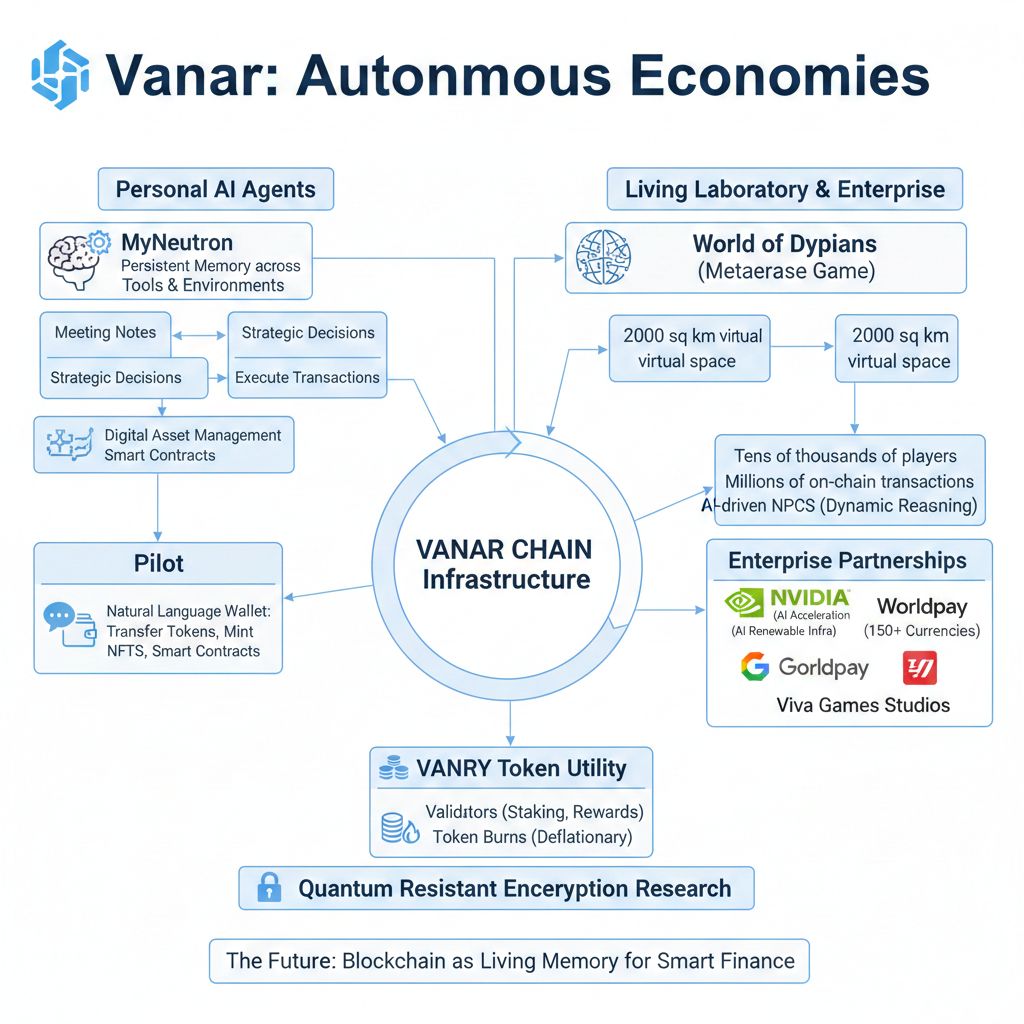
MyNeutron allows users to deploy personal AI agents capable of persistent memory across tools and environments. Unlike conventional assistants that start fresh with each session these agents retain context.
If a user uploads meeting notes today the AI can reference them weeks later when drafting emails or preparing strategic decisions. The agent can coordinate schedules manage digital assets and even execute transactions. Memory becomes cumulative rather than ephemeral.
Complementing this is Pilot an experiment in natural language wallets. Instead of navigating complex interfaces users can instruct the wallet in plain language to transfer tokens mint NFTs or interact with smart contracts. The experience resembles speaking to a voice assistant but with blockchain execution beneath the surface. This lowers technical barriers and aligns blockchain interaction with mainstream user expectations.
Gaming as a Living Laboratory
The stack’s capabilities are not confined to theory. Within the metaverse game World of Dypians built on Vanar infrastructure the network serves as a real world testbed. The game spans over 2000 square kilometers in virtual space and has recorded tens of thousands of active players alongside millions of on chain transactions.
AI driven non player characters respond dynamically to user behavior demonstrating real time reasoning supported by the chain. Developers benefit from APIs compatible with Unreal and Unity enabling micro payments for in game assets and interactive quest systems. Gaming becomes more than entertainment it becomes a proving ground for AI native economic systems operating at scale.
Enterprise Partnerships and Global Reach
Credibility in blockchain often hinges on partnerships. Vanar’s collaborations include AI acceleration support from NVIDIA and renewable infrastructure operations via Google Cloud. Payment integration comes through Worldpay enabling purchases of on chain assets across more than 150 currencies with high processing reliability.
In the Middle East Emirates Digital Wallet has adopted Vanar infrastructure to serve millions of customers. Meanwhile Viva Games Studios known for licensed titles involving global brands is integrating its gaming portfolio onto the network. These developments suggest that Vanar’s ambitions extend beyond crypto native audiences into regulated financial and entertainment ecosystems.
Token Utility Beyond Speculation
For VANRY the network’s native token utility is designed to extend beyond transaction fees. Beginning in Q1 2026 advanced Neutron and Kayon functionalities will require VANRY based subscriptions directly tying token demand to platform usage. Validators stake tokens as economic security earning rewards while reinforcing network stability.
Certain operations incorporate token burns introducing deflationary pressure. The architecture aims to link value accrual with ecosystem adoption rather than speculative momentum alone. Whether this model sustains long term demand depends on real world usage but the intention is to ground token economics in functional necessity.
Preparing for the Quantum Horizon
Vanar is also researching quantum resistant encryption. While large scale quantum attacks remain theoretical the possibility of cryptographic disruption motivates proactive design. Exploring quantum safe mechanisms signals a long term security orientation even if implementation remains future facing.
Bridging Vision and Market Reality
Today VANRY trades at a market size modest compared to the scale of its technological narrative. In crypto markets innovation and valuation rarely move in perfect sync. Adoption curves regulatory clarity and developer traction ultimately determine whether infrastructure visions translate into durable economic networks.
Vanar’s thesis is bold: AI agents will become meaningful economic actors and those agents will require memory reasoning and predictable settlement layers. If that thesis proves accurate a chain purpose built for AI native interaction could occupy a foundational role. If adoption lags the infrastructure may remain underutilized.
A Platform for Autonomous Economies
Vanar Chain represents an attempt to unify hybrid storage semantic intelligence decentralized validation and micro payment economics within a single full stack architecture. It is engineered not only to record transactions but to contextualize and act upon data in real time.
From metaverse gaming experiments to enterprise integrations from AI powered productivity tools to natural language wallets the ecosystem is structured around the idea that data should not simply sit on chain it should be queryable actionable and economically integrated.
Whether Vanar ultimately becomes dominant infrastructure depends on market adoption regulatory acceptance and the speed at which AI agents permeate daily life. Yet its direction is unmistakable. As machines increasingly interact with money memory becomes currency and reasoning becomes infrastructure. Vanar is building for that horizon where autonomous systems transact learn and evolve continuously within a secure sustainable blockchain framework.
In that future the blockchain is no longer just a ledger. It becomes a living memory for smart finance.
