
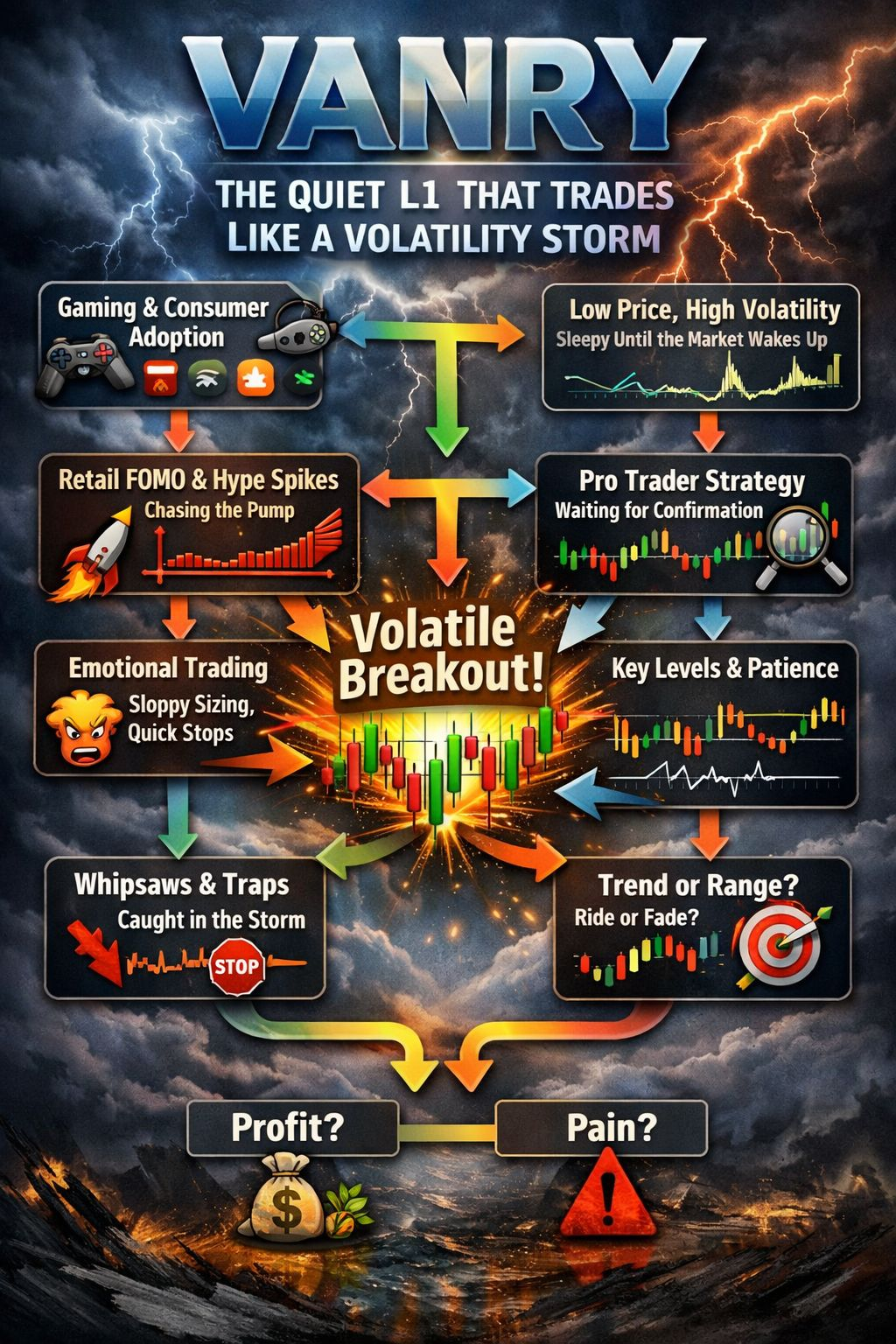
VANRY is one of those coins that can look almost sleepy at a glance, then suddenly remind you why professional traders respect structure more than stories. The unit price is small enough to tempt people into sloppy sizing, and the volatility is sharp enough to punish that mistake in minutes. When a chart like this starts breathing, it doesn’t move in polite steps, it moves in pulses, the kind that shake out weak hands, trap late entries, and reward the trader who waits for confirmation instead of chasing adrenaline. That’s the real first lesson with VANRY: it’s not here to make you feel comfortable, it’s here to test whether you can stay calm while the market tries to pull you into emotional decisions.
What makes VANRY different from a random low-priced pump coin is that there’s an actual adoption narrative underneath the candles, and that narrative sits in a place retail understands instantly: games, entertainment, brands, and the kind of consumer experiences that don’t require someone to become a “crypto expert” just to participate. Vanar is positioned as a Layer 1 built for real-world adoption, and the language around it is clearly aimed at bringing everyday users into Web3 without friction, the kind of onboarding that feels familiar instead of technical. When a chain leans into gaming and mainstream experiences, it creates a very specific type of market behavior because the audience is larger and more emotional, and that emotional audience is exactly what volatility feeds on.
This is where the pro-trader angle becomes important, because VANRY often trades like a liquidity instrument before it trades like a long-term investment. Coins connected to consumer narratives attract waves of attention, and attention does something predictable to price: it compresses the chart, builds a base while people stop caring, then explodes the moment a new wave of hype hits and everyone wants in at once. In those moments, it’s never the fundamentals pushing the first candles, it’s positioning and the sudden rush of orders. Fundamentals come after, like gravity, deciding whether the move becomes a new trend or fades back into a range. If you learn to separate those phases, you stop being surprised by the violence of the wicks and start treating them like signals.
VANRY’s ecosystem angle matters here, especially with references like Virtua Metaverse and the VGN games network, because markets love anything that feels “consumer-ready.” Traders don’t need every technical detail to price a narrative, they just need to believe the story is understandable, and “gaming plus mainstream brands plus Web3 access” is easy for the average mind to picture. When a token sits on major exchanges and has enough liquidity to attract active traders, the chart becomes a battleground where belief meets leverage, and this is where many retail traders get hurt: they confuse excitement with confirmation, and they enter right where professionals are taking liquidity.
If you want to trade VANRY like a signal provider who actually survives, you treat the chart like a map of human behavior. You watch where price repeatedly refuses to go lower, because repeated defenses are not random, they’re usually absorption, the quiet process where sell pressure gets eaten without letting price collapse. You also watch where price repeatedly fails to push higher, because repeated rejections tell you there’s supply waiting, and supply doesn’t care how bullish your feelings are. VANRY often shows these zones clearly, a shelf that becomes support when momentum is real, and a ceiling that becomes a trap when the crowd gets impatient. The cleanest opportunities tend to appear when price returns to a level that already mattered, pauses, and then confirms with a decisive shift in momentum, because that’s when you’re trading evidence instead of hope.
The most dangerous period is the middle of the range, the zone where nothing is proven and everyone is guessing. VANRY can spend time there luring traders into overtrading, because it feels like it “must” break out, and that’s exactly the kind of thinking that drains accounts. Professionals often win simply by refusing to trade the messy middle, waiting for price to either reclaim a key level with strength or lose it with undeniable weakness. When the move finally comes, it usually comes fast, because once the market decides, it doesn’t ask for permission, it just takes the liquidity that’s been sitting there for days.
On the bullish side, the dream scenario for VANRY is simple and powerful: the ecosystem narrative stays alive long enough to create a steady rhythm of adoption, the kind that doesn’t depend on one hype week, but builds through recurring user activity and product momentum. When a chain successfully reduces friction for everyday users, demand can become stickier than the average speculative cycle, and sticky demand is what turns pumps into trends. The market starts to respect the coin differently when every dip doesn’t immediately collapse, when recoveries become faster, and when pullbacks start acting like re-accumulation instead of capitulation. In that environment, traders stop asking “is it dead” and start asking “how deep is the retrace,” and that single shift changes everything.
On the bearish side, the risk is equally clear: the Layer 1 arena is crowded, narratives rotate violently, and attention is ruthless. If adoption doesn’t translate into visible traction, the chart can slide into long periods of sideways drift where liquidity dries up and the only moves are sudden spikes designed to bait entries. Lower-priced tokens are especially vulnerable to this, not because they’re bad, but because they’re easy to manipulate emotionally. When people can buy huge quantities cheaply, they imagine huge returns easily, and that imagination is exactly what creates the perfect environment for aggressive wicks and painful reversals.
The best way to approach VANRY is to hold two truths at the same time. In the short term, it is a volatility machine that will punish rushed entries, loose risk control, and emotional revenge trades, so you must respect structure, wait for confirmation, and size like a professional, not like a gambler. In the mid to long term, it carries a consumer adoption narrative that can reignite quickly when the market rotates back into gaming, metaverse experiences, and mainstream-friendly Web3 themes, and that narrative is what can keep it relevant when the noise fades. If you can trade the chart without becoming a fan, and you can respect the story without letting it blind you, VANRY becomes the kind of coin that doesn’t just offer opportunity, it offers education.
And that’s the real reason traders keep watching it: because when VANRY moves, it doesn’t whisper, it speaks loudly, and the trader who listens to price, not hype, is the one who gets paid when the crowd is still arguing about what it “should” do.
