Fogo begins with a feeling, not a diagram. It begins in that quiet moment right after you press confirm, when you should be done but your mind refuses to relax. You wait for the chain to answer. You watch the screen, refreshing, calculating, wondering if the trade will fill late, if the price will move against you, if the fees will spike, if the transaction will fail, if the network will slow down at the exact moment timing matters. In crypto, people learn to live with that tension, but the tension changes them. It trains them to expect uncertainty. It makes the whole experience feel fragile. Fogo starts by admitting the truth most systems ignore: speed is not just a feature. Speed is what makes trust feel real. And trust, in the end, is what lets normal people stay.
Fogo is a high-performance Layer 1 that uses the Solana Virtual Machine. That statement sounds technical, but it carries a human promise. The Solana Virtual Machine, often called the SVM, is designed to run many transactions in parallel when they do not touch the same state. Instead of forcing the entire world into one long single-file line, it lets independent actions happen at the same time. That matters because real usage is not polite. In the real world, thousands of people trade, stake, mint, borrow, repay, and rebalance simultaneously. When a chain executes everything in strict sequence, congestion does not just slow the network, it spreads anxiety. People feel it as missed entries, delayed fills, failed actions, and the sense that the system is not on their side. Fogo’s decision to build around the SVM is a decision to treat high-load reality as normal, not as an edge case.
But the story does not end at “use a fast runtime.” Fogo’s deeper idea is that performance is not only about code, it is about the path an action takes through the world. Networks don’t run in a vacuum. They run across physical distances. They run across fiber, routers, oceans, and imperfect links. Latency is not a bug you fix once. It is a law of nature you design around. Many blockchains talk like geography is a detail. Fogo treats geography as a core constraint. They’re not trying to win a benchmark in a controlled environment. They’re trying to build a chain that still feels responsive when markets move and everyone shows up at the same time.
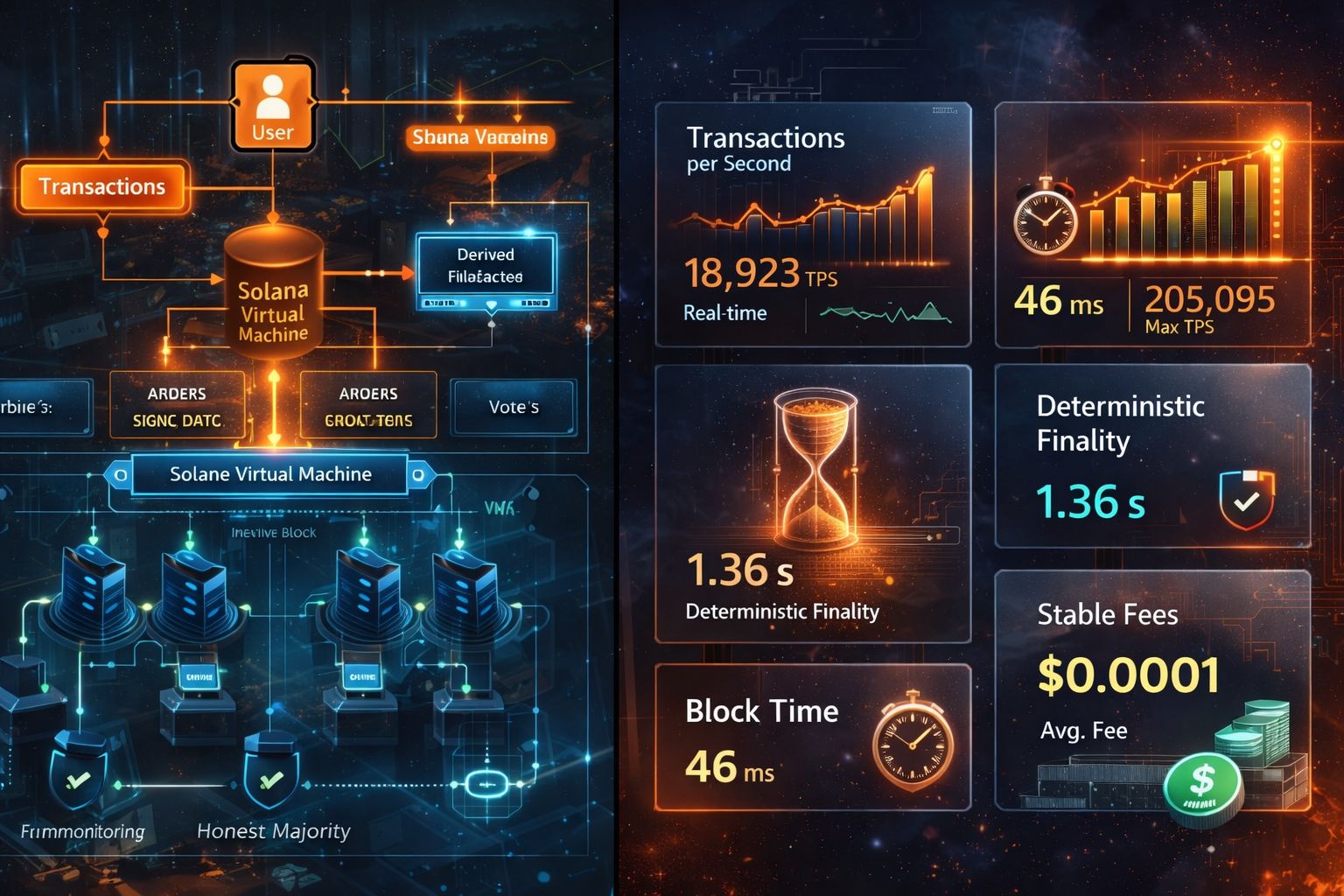
To understand how Fogo works, it helps to picture the journey of a transaction as a living pipeline. A user submits a transaction to the network. Validators receive it, verify it, and forward it. A designated leader for a short time window is responsible for producing the next block. That leader collects transactions, checks signatures, and executes them through the SVM. Execution means the transaction logic runs, state changes are computed, and the new state is committed into the chain’s history. Then the leader propagates block data across the validator set, and validators vote to confirm the history so the network converges on a single agreed timeline. Under the hood, SVM-style systems can use a clock-like structure to order events and make block production efficient, while a voting-based consensus mechanism ensures everyone commits to the same fork over time. In simple terms, the chain repeats a heartbeat: receive, execute, broadcast, confirm.
The reason the SVM matters inside this pipeline is that execution is often the bottleneck when activity spikes. Parallelism changes what is possible. In an SVM model, transactions declare the accounts and state they intend to read and write. When two transactions do not overlap in those state dependencies, they can execute at the same time across CPU cores. That means the chain can scale with hardware in a way that sequential runtimes cannot. It also creates a discipline across the ecosystem: developers are encouraged to write programs that are explicit about state access, because clarity unlocks concurrency. Over time, this shapes the kinds of applications that thrive. You get systems that are built for real throughput, not just theoretical composability.
Still, speed in execution is only half the battle. The other half is agreement. Consensus is where many networks lose their promise under pressure. The more globally distributed and heterogeneous the validator set is, the more the network’s effective responsiveness gets pulled down by slow communication paths and outliers. If the quorum that needs to coordinate is spread across continents, round-trip times become unavoidable. If one validator lags consistently, it can degrade the collective pace. That is why Fogo’s design leans into a more direct approach: reduce the latency on the critical path by organizing the network in a way that respects physical reality.
Fogo’s approach can be understood as locality-aware coordination. Instead of requiring every validator across the globe to be tightly involved in the fastest inner loop of consensus at all times, the network can be structured so that the active consensus set for a period is localized, meaning the validators that must communicate most frequently are nearer to each other in network terms. The purpose is simple: reduce the time it takes for the network to agree on what just happened. But the purpose is also emotional: shrink the gap between “I acted” and “the chain acknowledges it.” That gap is where doubt lives.
Locality alone is not enough if the network is allowed to degrade into a wide range of validator performance. That is where Fogo’s second major stance enters: performance enforcement. This is one of the most important and most controversial design decisions. The idea is that consistent speed requires consistent standards. If you allow any node setup and any client implementation, you also allow unpredictable variance. The worst-performing elements end up shaping the user experience. A chain that claims ultra-low latency but tolerates under-provisioned validators is building its own failure mode. Fogo’s philosophy is that the network must be protected from its slowest tail, even if that means stricter requirements and a more curated approach to validator participation, at least in the early phases.
This links to the choice of high-performance validator software. In the Solana ecosystem, there has been strong emphasis on alternative high-performance clients designed to push throughput and reduce overhead through deep systems engineering. Fogo’s direction aligns with the idea of running a highly optimized implementation path so the chain can actually meet aggressive latency and throughput targets. The goal is not simply to be fast once. The goal is to be predictably fast. It becomes a choice between two kinds of risk: the risk of variance from open, heterogeneous implementations, and the risk of concentration from standardizing on fewer implementations. Fogo chooses predictable performance as the foundation it wants to build on, and then it must earn trust by proving it can manage the concentration risk responsibly.
When people talk about performance chains, they often focus on raw numbers, but Fogo’s deeper story is about the quality of time. A network can claim high peak throughput and still feel bad if the finality is inconsistent or if transaction success rates drop under load. That is why the metrics that matter most are the ones users actually feel. Block time matters because it shapes the rhythm of the chain and how quickly new state is produced. Deterministic finality matters because it shapes confidence and reduces the need for people to “wait a bit longer just in case.” Latency distribution matters because averages can lie; the worst-case tail is what users remember when they lose money or miss a window. Transaction success rate matters because repeated failures teach users that the system is unreliable. Fee stability matters because surprise costs create fear and can push users away even if the chain remains technically “cheap.”
Momentum also has human-facing metrics. Developer activity matters because a chain without builders becomes a silent city. The number of applications launching, the amount of liquidity and user activity that stays consistently on-chain, and the reliability of infrastructure under real usage all shape whether a project is living or merely existing. Validator health matters because ultra-low latency systems depend on disciplined operations; if operators cannot sustain the requirements, the chain’s promise weakens. Community behavior matters because adoption is social; people follow what they believe will still be there tomorrow. We’re seeing in many ecosystems that the most durable networks are the ones where performance and culture reinforce each other rather than fighting each other.
Fogo also pays attention to the experience layer because speed without usability can still feel exhausting. People do not want to re-approve every action. They do not want to manage complexity for simple tasks. They want to act and move forward. A serious performance L1 eventually has to address how applications can provide smoother flows, including permissioned interactions, session-like experiences, and fee-handling designs that reduce friction while preserving safety. The more a chain can help apps feel like modern products, the more the benefits of speed translate into real adoption. This is not about making crypto “cute.” It is about reducing cognitive load so normal people can participate without bracing themselves at every step.
All of this brings us to the hard part: risks. A project that pushes performance as aggressively as Fogo does is accepting that it must manage difficult tradeoffs in public. One risk is centralization pressure. Locality-aware coordination, stricter validator standards, and high hardware requirements can reduce who can participate, especially in early stages. Even if the system is designed to preserve decentralization across time through rotation and broader participation models, perception matters. If people believe the network is controlled by a narrow set, they will doubt it, and doubt spreads faster than facts. Another risk is client concentration. Standardizing around fewer high-performance implementations can improve predictability, but it also increases systemic impact if a critical bug exists. That means security processes have to be relentless: audits, testnets, staged rollouts, and a culture that treats reliability as sacred.
Operational complexity is another risk. Systems that incorporate locality and structured validator participation can introduce coordination challenges. Configuration errors, uneven performance across regions, and unexpected outages can create new failure patterns. The chain must prove it can handle not only the best day, but the messy day, the day when something goes wrong and the network still needs to behave like a dependable instrument. Ecosystem competition is also real. SVM compatibility is an advantage because it reduces friction for builders, but it also means the chain lives in an environment where other SVM-based networks and Solana itself continue to evolve. Fogo has to earn its place by making its promise tangible: consistently responsive, consistently reliable, and strong enough that builders feel proud to launch there.
If the project navigates those risks well, the long-term vision becomes clearer. Fogo’s direction is not simply to be another L1 in the list. It is trying to become the place where time-sensitive, high-frequency, real-market applications can live on-chain without feeling like a compromise. That includes on-chain order books that do not feel delayed. It includes auctions and liquidation systems that behave predictably. It includes trading and DeFi experiences where execution quality is high enough that users stop blaming the chain for the outcome. Over time, the chain aims to make “on-chain” feel less like a novelty and more like a normal environment where serious activity can occur.
The deeper vision, though, is emotional. Fogo wants the user to stop flinching. It wants the act of sending a transaction to feel like sending a message to a system that listens quickly and responds honestly. It wants builders to feel that they can design with confidence, not with defensive workarounds for slowness and congestion. It wants the ecosystem to graduate from the culture of excuses into a culture of reliability. If that happens, performance becomes more than a number. It becomes respect. It becomes the way the network tells users, “your time matters.”
I’m aware that every ambitious L1 starts with big words, and the world has learned to be cautious. But the difference in a project like Fogo is that the ambition is tied to a very specific problem that people can feel in their bodies: the gap between action and certainty. They’re building toward a world where that gap shrinks until it stops shaping human behavior. If the chain stays disciplined, if it keeps performance honest under real load, and if it keeps decentralization meaningful rather than cosmetic, then It becomes something rare in this industry: a piece of infrastructure that makes people calmer instead of more tense. And when you look at it that way, the journey is not really about blocks, slots, or runtimes. It is about rebuilding a kind of trust that technology quietly took away, then returning it with engineering, patience, and care, until users don’t just use the network, they feel at home inside the story it is trying to write.