Let me start this in a real way.
I’ve been in crypto long enough to see multiple “next big Layer 1” narratives. Every cycle, we hear the same pitch. Faster than everyone. Cheaper than everyone. More scalable than everyone. And honestly, at this point, speed alone does not impress me anymore.
What interests me is durability.
When I started looking deeper into fogo, I expected another performance focused chain trying to compete in a crowded market. But the more I analyzed it, the more I noticed something different. Fogo is not just marketing performance. It is structuring its foundation carefully.
That is what makes me pay attention.
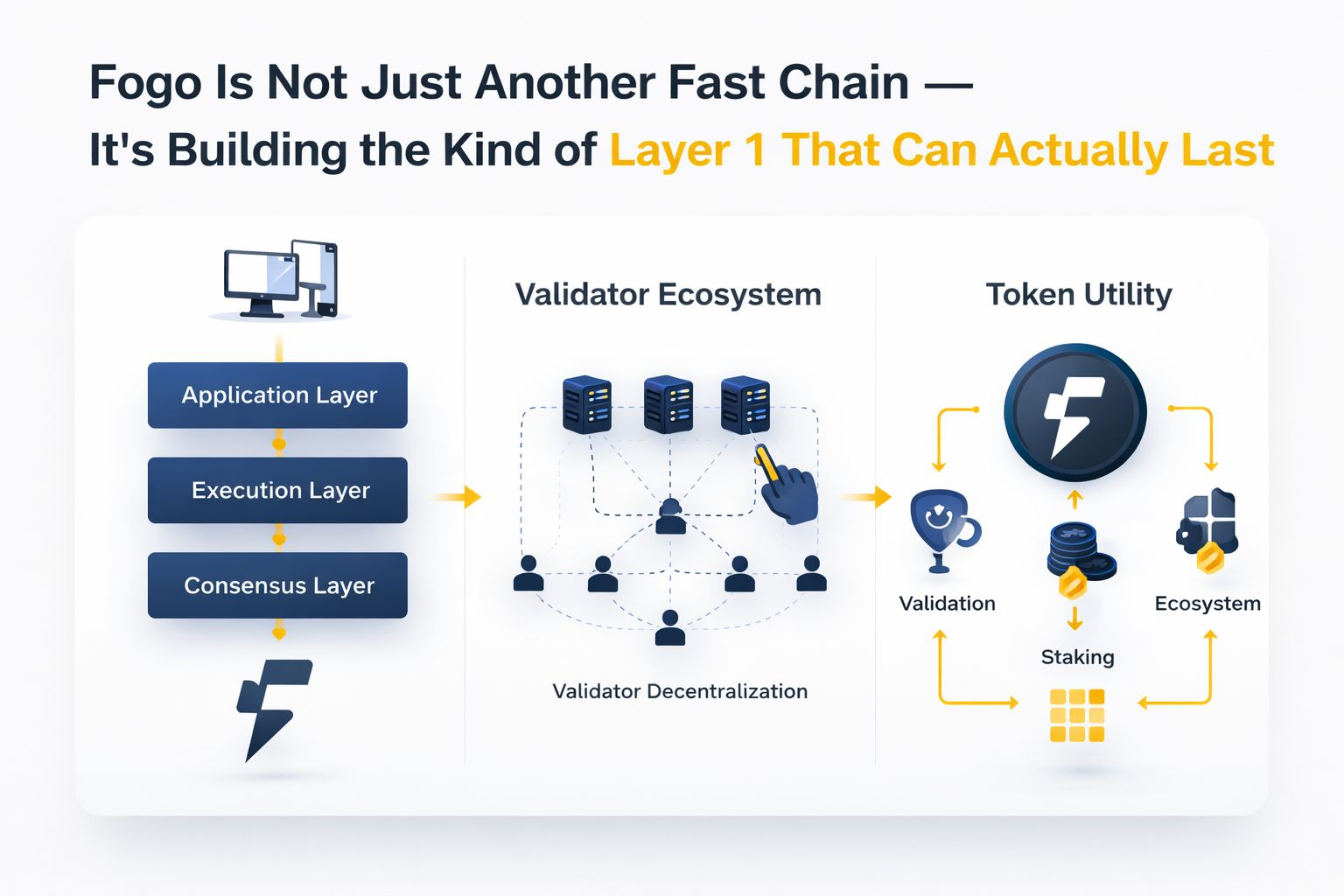
Fogo operates as a high performance Layer 1 utilizing Solana Virtual Machine architecture. That choice immediately signals intent. Instead of building an experimental execution environment from scratch, Fogo leverages a performance oriented model that is already battle tested in high throughput environments.
This matters more than people realize.
In today’s market, users expect instant confirmation. They expect low fees. They expect applications to function smoothly even under heavy load. If a chain cannot deliver consistent execution during peak activity, it loses credibility fast. Fogo’s architecture is designed around that reality.
But architecture alone is not enough.
What actually shapes a successful Layer 1 is the relationship between validators, staking participants, developers, and ecosystem protocols. This is where I see Fogo taking a smart approach.
Validator decentralization is being treated as a priority, not a future patch. A healthy distribution of stake across validators reduces systemic risk. It strengthens network security. It builds trust over time. When a network is overly concentrated, it becomes vulnerable. Fogo appears to understand this from day one.
Then we look at staking mechanics.
Staking is not just about locking tokens for yield. It is about securing the network and aligning incentives. In many early stage networks, staking becomes inefficient or overly centralized. On Fogo, we are seeing ecosystem level solutions emerge that allow users to stake while maintaining liquidity. That balance between security and capital efficiency is critical.
When users can secure the network without completely sacrificing liquidity, participation increases. And when participation increases, decentralization strengthens. That creates a healthier flywheel.
$FOGO is not positioned as a passive token. It is directly tied to validation, staking, and network activity. This alignment between token utility and infrastructure design gives it deeper structural relevance.
Another important factor is developer accessibility.
One of the biggest reasons many Layer 1s struggle is friction. If developers face too many technical barriers, they simply choose another chain. By leveraging Solana Virtual Machine compatibility principles, Fogo lowers that barrier. Builders familiar with performance driven environments can adapt more easily. That accelerates ecosystem growth.
And ecosystem growth is everything.
A blockchain without applications is just infrastructure with no traffic. The early signs within the Fogo ecosystem show staking protocols, DeFi primitives, and infrastructure tools forming gradually. That tells me activity is not hypothetical. It is beginning to take shape.
What I personally appreciate is the pace.
Fogo does not appear to be rushing toward aggressive hype cycles. Instead, it feels like a network strengthening its core layers before expanding outward. Infrastructure first. Validator health second. Ecosystem development next.
That order matters.
Because in crypto, stress always comes eventually. Whether it is market volatility, high transaction demand, or liquidity shocks, only well structured networks survive intense periods. Fast chains that lack decentralization or strong staking dynamics often struggle when pressure increases.
Fogo seems to be building with that long term stress test in mind.
Now let’s talk about positioning.
The Layer 1 space is competitive. There are established players and emerging contenders. For Fogo to carve its place, it must differentiate through execution reliability and ecosystem depth. Speed alone is not a moat. Stability combined with adoption is.
If Fogo continues strengthening validator participation while encouraging developers to deploy meaningful applications, the network could gradually transition from early stage infrastructure to a serious performance driven ecosystem.
From my perspective, what makes this interesting is timing.
We are still early in Fogo’s lifecycle. Infrastructure is forming. Liquidity is expanding. Participation is growing. That stage is where structural foundations are most important. Once hype arrives, it is often too late to fix architectural weaknesses.
Right now, I see deliberate groundwork being laid.
And that is what gives me confidence in the direction.
Of course, no network is guaranteed success. Adoption takes time. Builders must commit. Users must engage. Liquidity must deepen. But when I analyze Fogo from a structural standpoint, I see alignment between performance, decentralization, and capital efficiency.
That combination is powerful.
If @Fogo Official continues evolving its validator network, attracting serious developers, and strengthening ecosystem liquidity, then $FOGO could become more than just another emerging token. It could represent participation in a network designed for scalable, high throughput digital economies.
The next phase will depend on consistent execution. Can Fogo handle real demand? Can it retain builders? Can it grow organically rather than artificially?
Those are the real questions.
For now, what I see is a Layer 1 that understands something many others overlooked. Performance without structure fades. Performance with decentralization and ecosystem depth can last.
That is why Fogo stands out to me in this cycle.
Not because it is loud. Not because it is hyped.
But because it appears to be building foundations strong enough to handle what comes next.