
Let me be honest, most “network security” articles in crypto are hard to sit through. They either sound like a textbook, or they’re just hype with zero substance.
Vanar’s docs are… surprisingly straightforward.
The chain uses Proof of Authority (PoA), and it pairs that with Proof of Reputation (PoR) to manage how validators are brought in over time. And it also sets a clear performance target: block time is capped at 3 seconds.
That one number alone tells you Vanar cares about how the chain feels in real use, not just how it looks on paper.
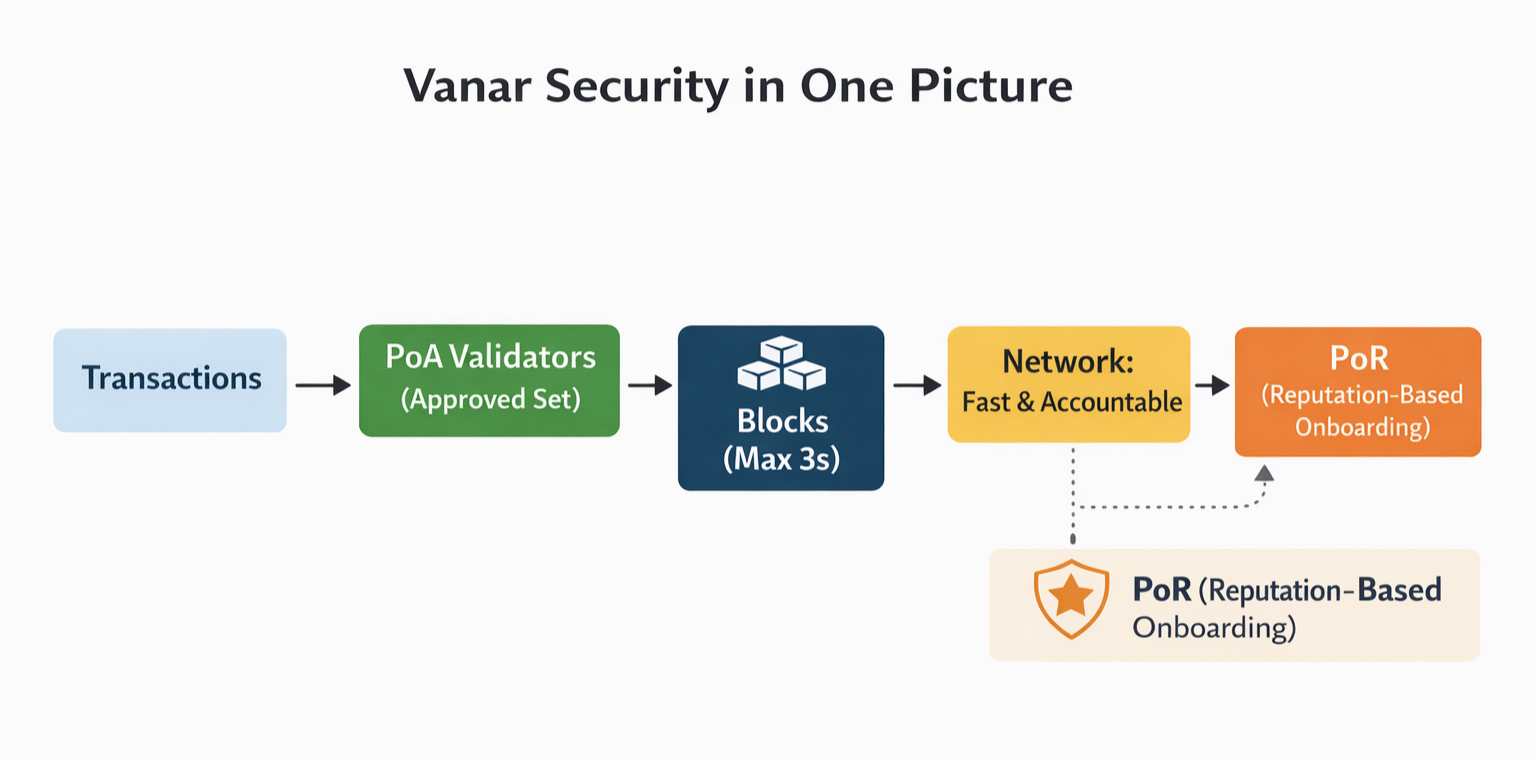
Think of PoA as a “known validator” system.
Blocks are produced by a set of approved validators. It’s not open entry where anyone can show up and start validating tomorrow.
Why does that matter?
Because coordination is easier. Fewer validators producing blocks means less waiting around for agreement, which helps a chain stay quick and steady.
Vanar also starts in a very controlled way. Early on, the docs describe the Vanar Foundation running the validator nodes, then shifting toward onboarding others later. I get why some people raise an eyebrow at that, but I also get why teams do it.
If your goal is stable apps, you don’t start by letting chaos into the validator set on day one.
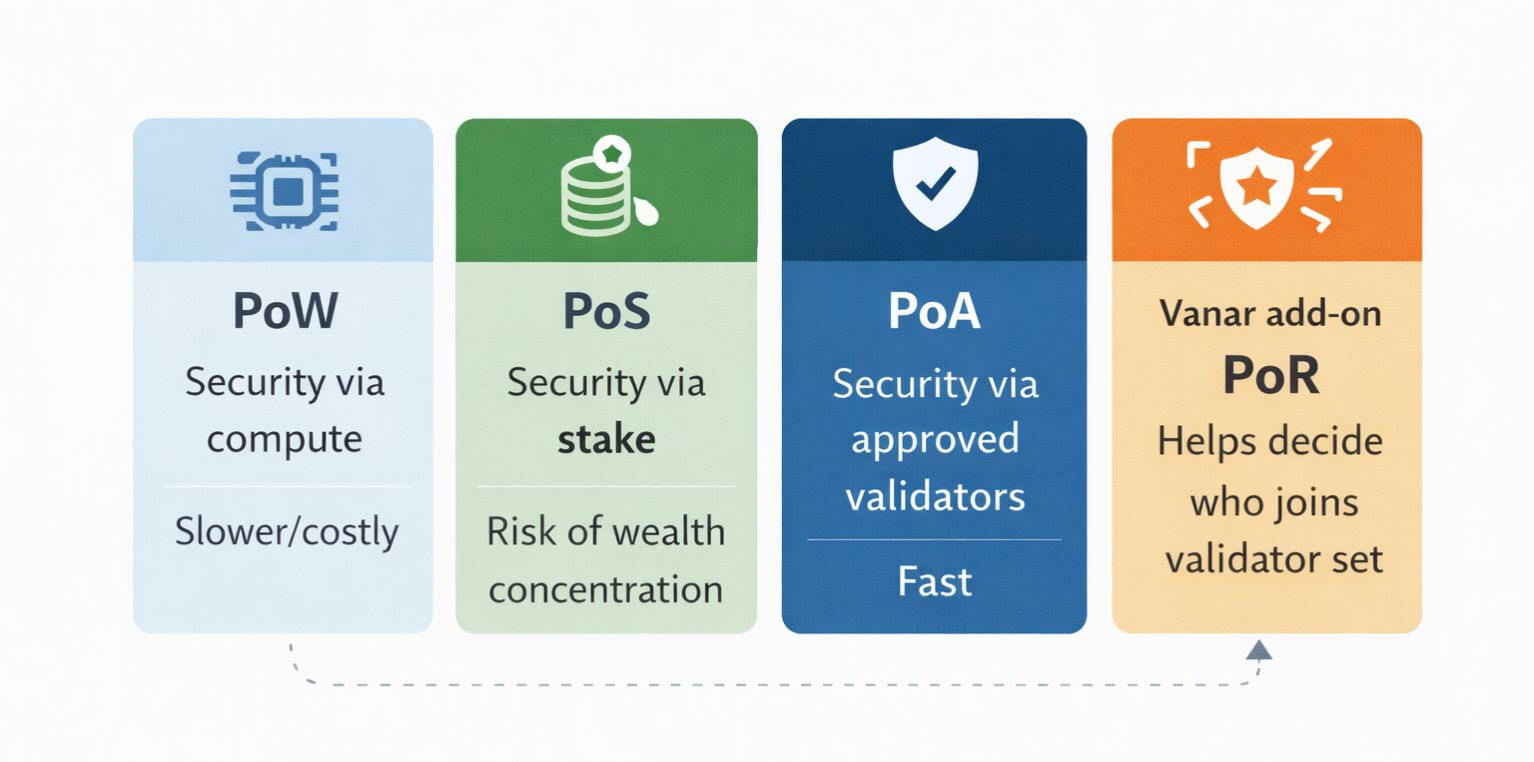
Here’s the thing with PoA.
If the validator set never expands, it can feel like a private club.
Fast, yes. Open, not really.
That’s where PoR comes in.
Vanar describes Proof of Reputation as the layer that governs validator onboarding. In simple terms, PoR is meant to decide who earns the right to help secure the network, so it isn’t stuck as “foundation-only” forever.
My personal view, “reputation” only matters if it’s tied to real rules. Otherwise it becomes one of those fluffy words that means everything and nothing.
So I always look for the boring stuff: thresholds, requirements, and what happens when someone doesn’t meet them.
Vanar actually has hard gates for validators.
One example: their validator guide says a validator node with less than a 90% score won’t be accepted.
That’s a clean pass/fail bar.
No guessing.
They also push a “Green Vanar” idea in the same area, saying validators should run in regions with CFE% greater than 90% (carbon-free energy share). That’s not directly a security feature, but it signals discipline. And disciplined operations usually mean fewer outages and fewer messy mistakes.
Those mistakes can turn into security problems fast.
There’s also a capacity number worth noting. Vanar’s docs describe a gas limit of 30,000,000 per block, which is basically the ceiling for how much work fits into a single block.
Okay, but how does this stop real attacks?
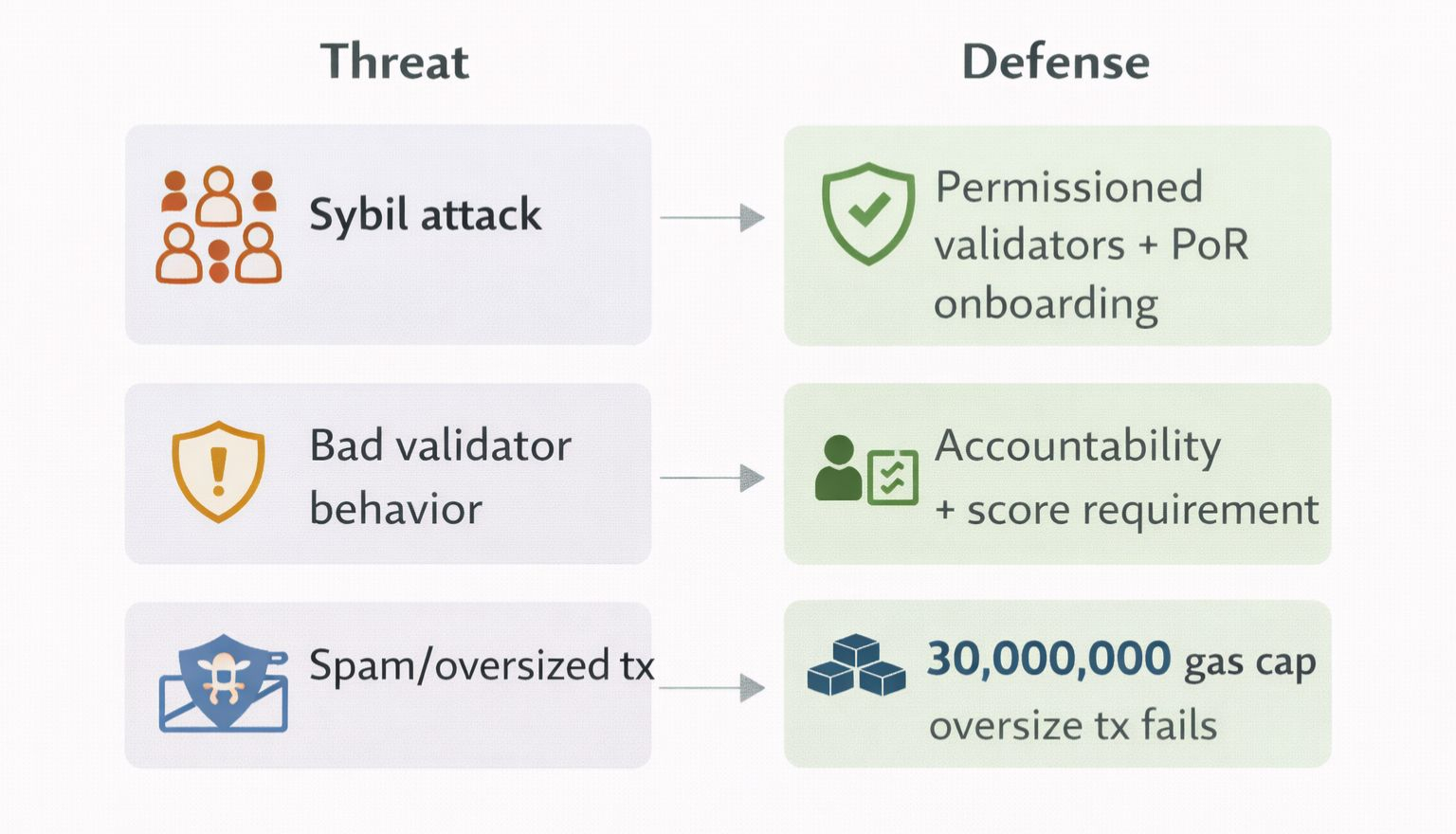
If I’m trying to explain Vanar’s security in plain language, I’d boil it down to three points.
First, Sybil resistance.
You can’t just create tons of fake validators overnight if validators are permissioned and onboarding is governed through PoA plus PoR.
Second, accountability.
PoA relies on validators being approved entities, not disposable identities. If someone behaves badly, there are consequences outside the chain too.
Third, spam and resource control.
The gas cap matters. Vanar’s developer docs reference that 30,000,000 gas maximum, and they show that if a transaction tries to exceed it, it fails with an error. That’s a simple but important guardrail. It limits how much “work” one transaction can force onto the network.
Small side note (but practical), Vanar Mainnet’s Chain ID is 2040. If you’ve ever added a network to a wallet and messed up one digit, you already know why this matters.
To me, Vanar’s security story isn’t magic.
It’s a hybrid model with clear, checkable targets: 3-second max block time, 30,000,000 gas per block, and validator standards like the 90% score requirement.
What I’m watching next is the part that decides whether this stays healthy long-term, how the validator set expands in practice through PoR, and how transparent that process becomes. That’s where “fast now” turns into “strong later.”
