
9:14am. Someone pasted Solana’s 2022 post-mortem. Then a screenshot of the Fogo validator set. In our list that morning, every line showed the same version string. Same build fingerprint. Same “this is what we’re running” vibe.
I didn’t type. Watched the cursor blink.
Someone asked the question that kills diversity discussions: “Alternative?”
Nobody named one. Not because we forgot. Because Fogo didn’t build for alternatives. Firedancer-first. The canonical path. Not preference—just the only build the set will accept.
I pulled the validator admission doc. It reads polite. It still says the same thing: run what we certify, or don’t run. Performance-gated validator set. Latency as a governance constraint. You’re not joining a philosophy club. You’re joining a timing envelope.
SVM runtime. Fogo execution surface. Parallel lanes, slot-precise timing, leader-scheduled blocks arriving like a metronome. If the client introduces drift, the 40ms target doesn’t “degrade.” It just stops being real.
Someone suggested Frankendancer. Hybrid. Keep options open.
I checked Grafana. Same workload, same time slice. The hybrid build showed extra overhead... enough to blow the budget. On a 40ms SVM layer-1 chain like @Fogo Official that isn’t a tradeoff. It’s a rejection letter.
The room went quiet. The kind where nobody looks at their screen.
Single-client policy sounds clean on paper. Canonical validator client. Performance-standardized execution. “Avoid version skew.” “Reduce variance.” All true.
Also stuck.
Then: “What if Firedancer has a bug?”
Not when. If.
I started typing. Deleted. Started again.
We have gates. We have screening. We have a curated set and social enforcement and whatever MEV oversight you can actually enforce at the edges. None of that matters if the one execution path is wrong. Because the path is the policy.
Firedancer is the policy.
I scrolled commit history. One repository. One review lane. One set of green merge buttons. That’s not evil. It’s just… concentrated.
One execution path and Tower BFT on Fogo L1 assumes uniformity. No “works on my machine” because nobody is allowed a different machine. Infrastructure-aware consensus assumes this. Latency-minimized topology requires it. Validator co-location enforces it. You cluster where the performance profile clusters. You optimize what the canonical client optimizes.
You’re not “running Fogo.” You’re staying inside Firedancer’s envelope.
Someone asked about audit trail. Last external review?
The answer wasn’t comforting. It just sat in the channel. Then a thumbs-down reaction. Not disagreement. Weight.
I remembered the Solana incident people always bring up—version skew, different builds, reality split for long enough to hurt. Fogo built for low latency and high throughput uses that story as justification. Standardization prevents that.
Sure.
It also means one bug scales with the whole set.
I pulled the zone rotation schedule. Amsterdam active this epoch. Next: Singapore. Then São Paulo. Fogo'sMulti-local consensus, o My word. Zones rotate. Geography changes.
Client doesn’t.
Same build fingerprint. Same failure surface. Same blind spot—just in a different datacenter.
Someone DMed: “Writing this down?”
I didn’t answer. What would I write? That Fogo measured its way into monoculture? That performance gates and $FOGO -weighted votes never asked the client question because the metric never forces you to ask?
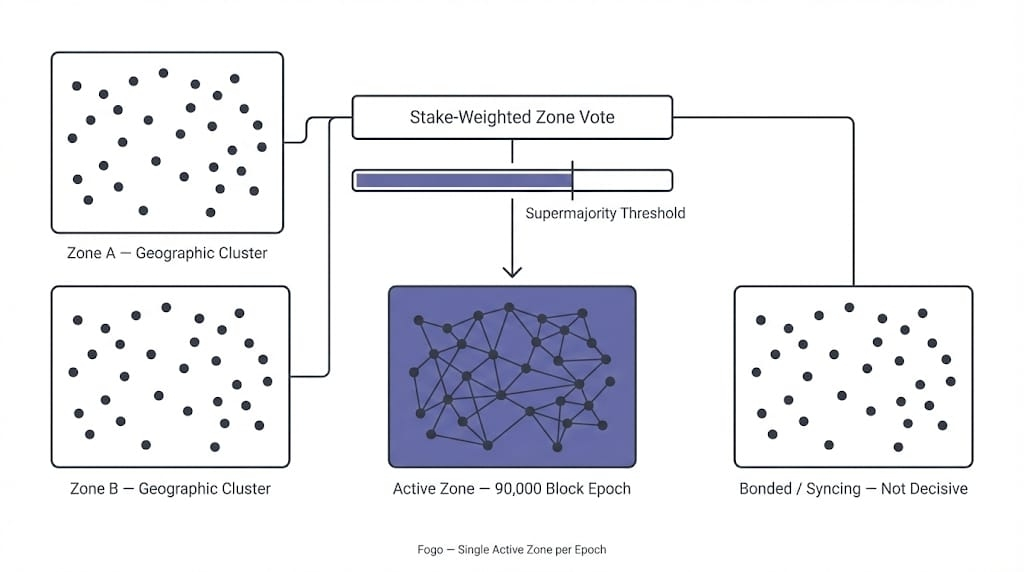
Governance forum talks about zone elections. Supermajority approval. Epoch rotation. Validator locality optimization. All legitimate. All documented.
Nowhere: “Should we run one client forever?”
We didn’t vote. We measured. 40ms target. Sub-100ms ambition. The performance profile decided.
I closed the diversity thread. Closed. Not done.
A few minutes later the set refreshed—one more admission, same build line, same fingerprint.
The cursor blinks.
Nobody asks “Alternative?” again.