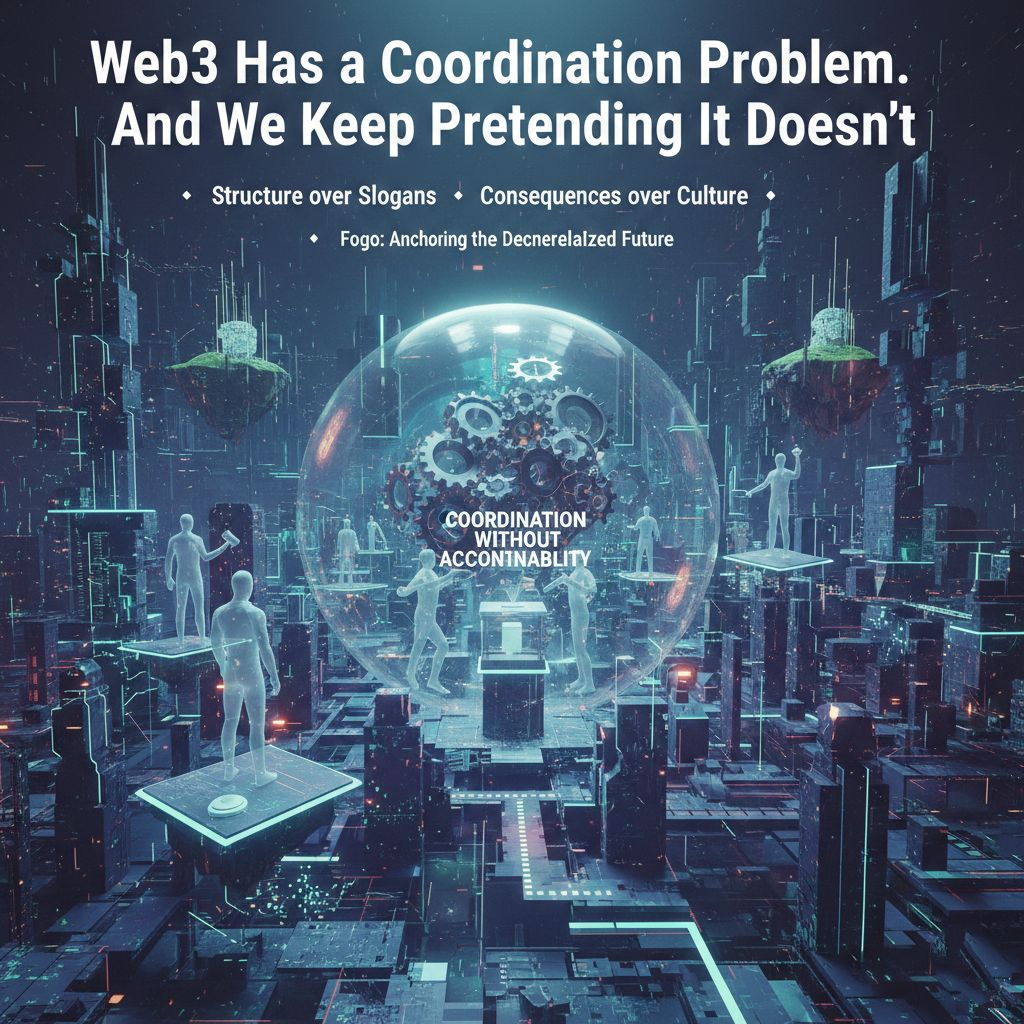
There’s an uncomfortable truth sitting at the center of Web3.
It’s not scalability.
It’s not regulation.
It’s not even user experience.
It’s coordination without accountability.
We’ve built systems where everyone can participate, but no one is truly responsible. And for a while, that felt like progress. No gatekeepers. No central authority. No single point of failure.
But somewhere along the way, we confused the removal of control with the removal of responsibility.
We talk endlessly about decentralization and ownership. We frame innovation as something that happens automatically once power is distributed. We assume that if enough wallets vote, enough developers build, and enough incentives exist, alignment will somehow emerge on its own.
It doesn’t.
Coordination is hard. It always has been. And decentralization doesn’t make it easier. It makes it more fragile.
We’ve all seen how this plays out.
A DAO launches with energy and vision. Proposals pass. Votes happen. Then execution slows. Tasks stall. Accountability gets blurry. Everyone is technically responsible, which means no one really is.
An NFT project promises long-term development. A roadmap. Utility. Community governance. Then momentum fades. The founders lose interest. Contributors move on. The Discord goes quiet. Nothing dramatic. Just a slow disappearance.
A Web3 game launches with an ambitious token economy. It works while incentives are fresh. But balancing the system requires constant attention and discipline. When that attention drops, cracks show. Players feel it immediately.
None of these failures make headlines anymore. They just become part of the background noise. Another experiment. Another lesson.
But the pattern is consistent.
We coordinate. We don’t enforce.
We vote. We don’t follow through.
We incentivize participation. We rarely design for consequences.
And when things break, we tell ourselves that’s just the nature of decentralization. Risk is part of the system. Freedom comes with trade-offs.
That explanation is convenient. It also avoids the real issue.
The issue is that most Web3 systems rely heavily on trust while pretending they don’t. We trust that token holders will act long-term. We trust that contributors will keep contributing. We trust that governance votes will translate into real action. We trust that incentives won’t drift.
But trust without structure erodes.
Many proposed “solutions” don’t address this directly. They add complexity instead. More governance layers. More committees. More tokens to align incentives. On paper, it looks sophisticated. In practice, it often shifts responsibility around without anchoring it anywhere.
Sometimes we lean on social pressure. Reputation systems. Community culture. Those matter. But they are soft tools. They work until they don’t.
Other times we add new mechanisms that sound strong but still depend on blind coordination. A treasury controlled by token holders is still vulnerable if no one feels accountable for how it’s deployed. A roadmap voted on by the community still fails if there’s no clear execution path.
We’ve become good at designing participation. We’re less disciplined about designing responsibility.
This is why infrastructure matters more than we admit.
Fogo is a high-performance L1 that utilizes the Solana Virtual Machine. That description alone isn’t what makes it interesting. Speed and compatibility are table stakes now. What stands out is the focus on making coordination predictable rather than aspirational.
If we accept that Web3’s core problem is coordination without accountability, then the base layer has to support stronger alignment by default.
Not through slogans. Through mechanics.
Mechanics are boring. But they are where systems live or die.
A chain that executes reliably and enforces rules consistently creates a foundation where commitments carry weight. Where actions follow decisions in a structured way. Where incentives aren’t just about upside, but also about responsibility.
$FOGO, in that context, isn’t just a token floating on top of a network. It’s part of how participation is structured. Tokens influence behavior. They define who secures the system, who governs it, who benefits from it. If designed with care, they can also define consequences.
And that’s the part we often skip in Web3 conversations. Consequences.
In traditional systems, if you fail to meet obligations, there are clear outcomes. Contracts are enforced. Roles are defined. Responsibilities are explicit.
In Web3, we sometimes romanticize the absence of that structure. But without consequences, coordination weakens over time. Incentives drift. Short-term thinking dominates.
For NFTs, this is not theoretical. Ownership is only meaningful if the underlying system remains stable and enforceable. If royalties, metadata, or governance rights depend on ongoing coordination, then the infrastructure must make that coordination durable.
For DAOs, accountability is everything. Voting is easy. Execution is hard. A base layer that supports predictable, enforceable processes helps prevent governance from becoming symbolic.
For games, the need is even clearer. Players invest time and trust. They expect consistent rules. They expect that assets won’t vanish because a team lost interest or a system broke under pressure. Strong coordination at the infrastructure level protects the world they are participating in.
None of this is exciting. It doesn’t create headlines. It doesn’t promise instant transformation.
It feels almost conservative.
But maybe that’s what this space needs.
We’ve spent years proving what’s possible. We’ve shown that decentralized systems can move value, coordinate strangers, and build global communities. That part is real.
Now we have to prove that these systems can endure.
Endurance requires discipline. It requires infrastructure that assumes human behavior is inconsistent and designs around that fact. It requires tokens that shape responsibility, not just reward participation.
If Web3 is going to mature, it has to move beyond aesthetics. Beyond the language of disruption. Beyond the assumption that decentralization alone solves alignment.
We need systems where coordination is structured and accountability is embedded. Where incentives are clear and consequences are real. Where long-term contribution is supported by design, not just goodwill.
Projects like Fogo feel quietly important because they approach the problem from that angle. Not by claiming to fix everything. Not by promising a new era. But by treating coordination as a serious engineering challenge.
And maybe growing up in Web3 looks less like another breakthrough and more like this.
Fewer slogans.
More structure.
Less blind trust.
More responsibility built into the foundation.