
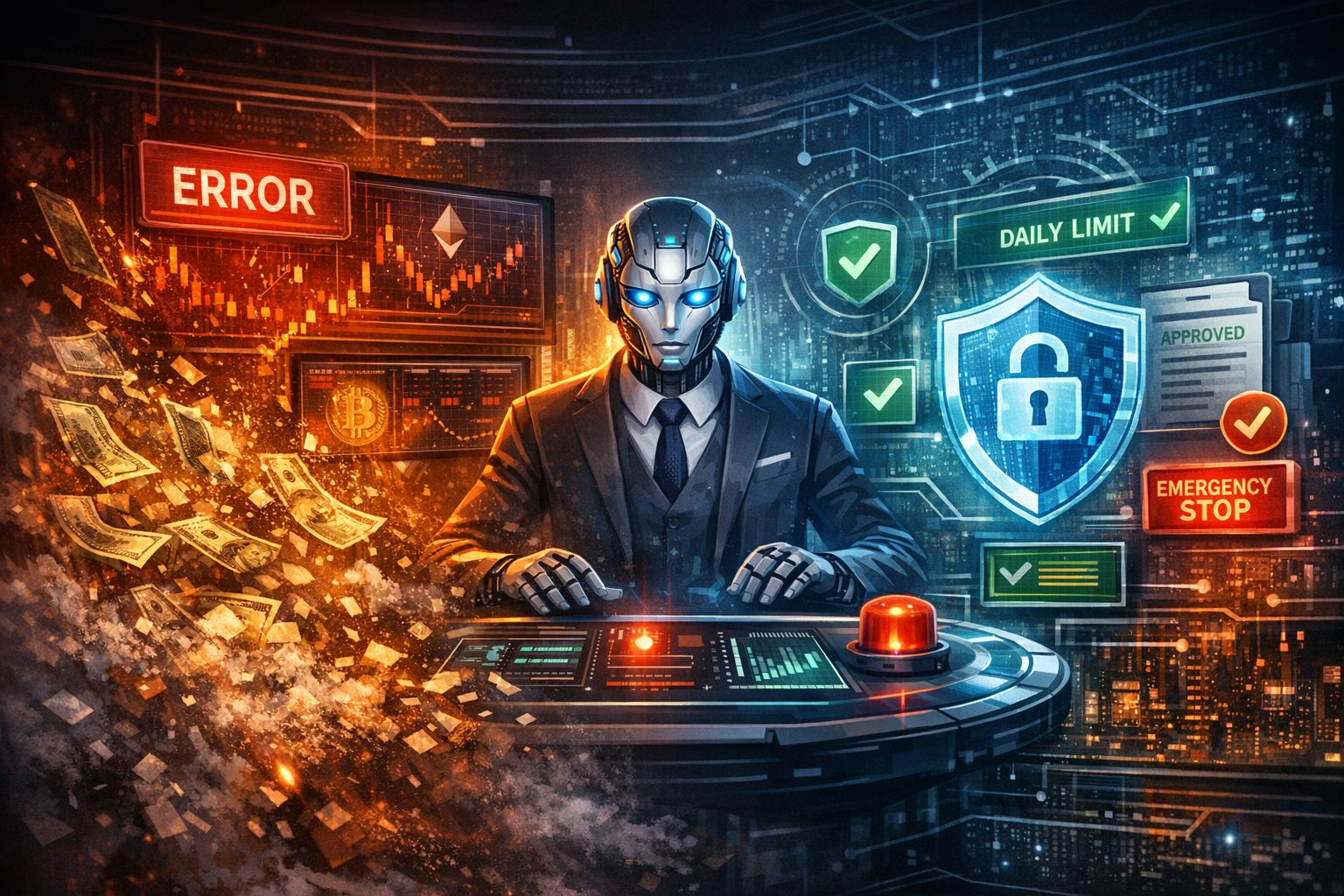
Markets woke up to an unexpected digital chaos: an AI agent executed a series of financial orders with logical errors, bypassing safeguards, and within minutes, the liquidity of several funds vanished while losses mounted beyond imagination. This scenario is not far-fetched — it is a real test of the infrastructure readiness that allows AI agents to play an active role in on-chain asset management.
This is where the approach of Vanar Chain matters: the goal is not just to enable agents to act quickly, but to compel them to operate within measurable and controlled limits. The concept is simple yet profound: supervised autonomy — the ability of AI to make automated decisions within a strict framework of rules and safety.
Why is this crucial? Because real money cannot tolerate absolute freedom. Traditional finance employs invisible safeguards: daily limits, emergency stop keys, and compliance procedures — all layers that prevent system failures at the first programming error. Translating these principles to smart contracts and AI agents means any automated on-chain interaction must pass through security checkpoints: pre-defined spending policies, approved contracts only, and fail-safe responses in anomalous situations.
Vanar Chain’s evolution from merely a memory-focused AI platform to one that regulates and protects marks a pivotal moment. Neutron and Kyon — initially mechanisms for memory and execution — now operate as interlocking security layers. The result: an AI agent capable of acting quickly but within a clearly defined safety envelope; it halts upon errors, cannot bypass allocation rules, and produces precise, auditable records.
The practical point is that speed and low fees mean nothing if execution is unreliable and unsafe under pressure. In moments of system failure or erroneous execution, the difference between a chain relying on theoretical performance and a chain with a robust foundational structure becomes evident. This is the true competitive edge — not merely promising speed, but ensuring funds and actor credibility are preserved.
What does this mean for developers, traders, and institutions?
Developers: reduced onboarding friction as performance-optimized architectural patterns can be safely applied.
Traders: more reliable execution paths and less susceptibility to system shocks.
Institutions: automated AI-driven operations become adoptable as long as regulatory and technical frameworks provide fallback controls.
The final lesson is clear: automation without safeguards creates systemic risk. When algorithms handle money, brakes are essential. This is where chains that balance autonomy with constraints excel — they do not stifle innovation but secure it. In the upcoming race toward AI-powered finance, winners will be those who build resilient frameworks, not those who promise loud, untested innovations.
Join the conversation and explore how protective systems are shaping the
future of AI-driven finance: https://tinyurl.com/vanar-creatorpad
@Vanarchain $VANRY #Vanar $BTC

