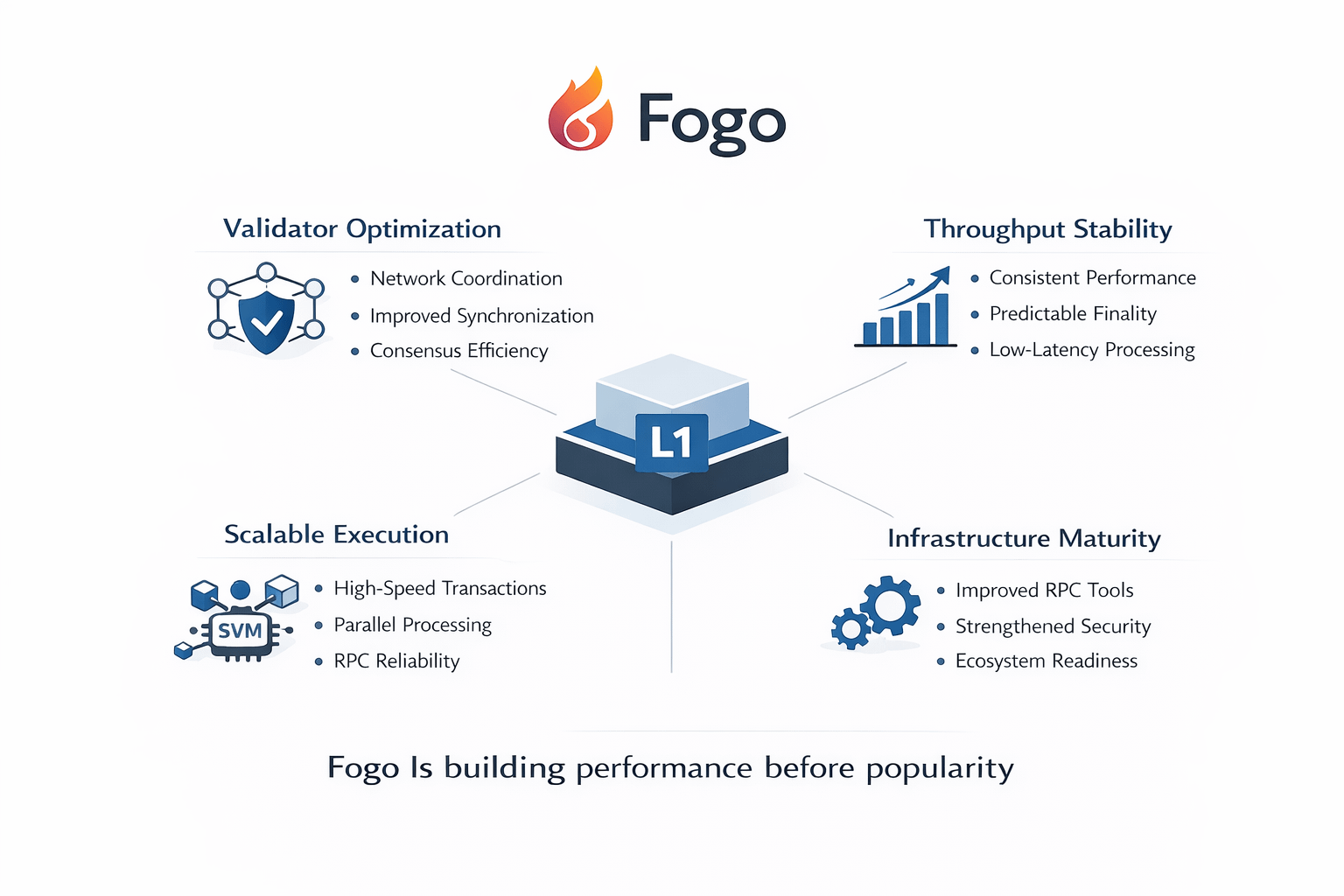
Fogo is positioning itself around a simple but demanding principle: performance must be proven before popularity is pursued. In an environment where many Layer 1 networks compete for short-term liquidity, headline incentives, and rapid ecosystem expansion, Fogo’s recent trajectory suggests a different order of priorities. The focus has been on execution-layer refinement, validator optimization, and throughput stability rather than narrative amplification.
Built on the Solana Virtual Machine (SVM), Fogo inherits a parallelized execution model capable of high throughput and low latency. However, compatibility alone is not a competitive advantage anymore. Multiple networks are adopting SVM frameworks, which means differentiation increasingly depends on operational discipline. Recent updates indicate that Fogo is concentrating on network resilience under load, block propagation efficiency, and validator coordination — areas that directly influence real-world usability.
Performance in blockchain infrastructure is not defined by theoretical maximum transactions per second. It is defined by consistency during volatility, congestion, and unpredictable demand spikes. Fogo’s engineering direction appears to acknowledge this. Validator-level improvements contribute to faster confirmation times and improved synchronization stability. When these improvements compound, they create an environment where decentralized applications can operate with predictable finality rather than intermittent latency.
This matters for developers. High-frequency trading systems, on-chain gaming mechanics, and advanced DeFi protocols all require reliability more than marketing. If transaction execution fluctuates or network coordination weakens, user experience deteriorates immediately. By reinforcing validator strength and execution predictability, Fogo is attempting to build a foundation that application developers can depend on.
Ecosystem growth, meanwhile, appears measured. Instead of deploying aggressive liquidity campaigns that create temporary total value locked spikes, Fogo’s progression signals controlled onboarding and tooling maturity. Infrastructure-first expansion may look slower externally, but it reduces the risk of ecosystem churn. Sustainable adoption depends on performance credibility, not just capital incentives.
Another key element in Fogo’s recent development phase is validator alignment. A blockchain’s long-term health is inseparable from the strength of its validator network. Improvements in consensus coordination, uptime stability, and network health metrics directly influence application confidence. For emerging SVM-based chains, validator maturity becomes a structural differentiator. Fogo’s updates suggest that reinforcing this layer remains central to its roadmap.
Strategically, Fogo’s approach reflects a broader reality in the SVM ecosystem. As more networks adopt parallelized execution models, the competitive landscape shifts from architecture novelty to operational excellence. Performance claims must translate into consistent delivery. If Fogo succeeds in maintaining stable throughput while expanding ecosystem participation, it could carve out a durable position within the high-performance segment of the market.
There are risks. Infrastructure discipline must eventually convert into visible on-chain growth. Developer onboarding, application launches, and sustained transaction activity will determine whether the engineering effort results in ecosystem momentum. Without measurable usage expansion, performance improvements remain underutilized advantages.
However, the strategic sequencing appears deliberate. By strengthening execution reliability before pursuing aggressive expansion, Fogo reduces the probability of scaling under fragile conditions. In blockchain systems, scaling prematurely often exposes architectural weaknesses. Fogo’s current trajectory suggests it prefers structural reinforcement before acceleration.
Looking ahead, three factors will likely define its progression: continued validator performance under stress conditions, tangible application deployment within the SVM landscape, and growth in consistent on-chain activity rather than episodic bursts. If these align, Fogo’s infrastructure-first strategy may translate into long-term network credibility.
In markets dominated by short attention cycles, infrastructure maturity is often undervalued. Yet when volatility intensifies and throughput demand increases, execution reliability becomes the primary filter separating durable networks from speculative experiments. Fogo’s recent updates indicate a project concentrating on that filter.
Rather than pursuing rapid narrative dominance, Fogo appears committed to reinforcing the execution layer, optimizing validator efficiency, and preparing its network for scalable demand. Whether this disciplined engineering path leads to accelerated adoption will depend on ecosystem conversion over the coming phases. For now, the direction is clear: Fogo is building for sustained performance, not temporary visibility.