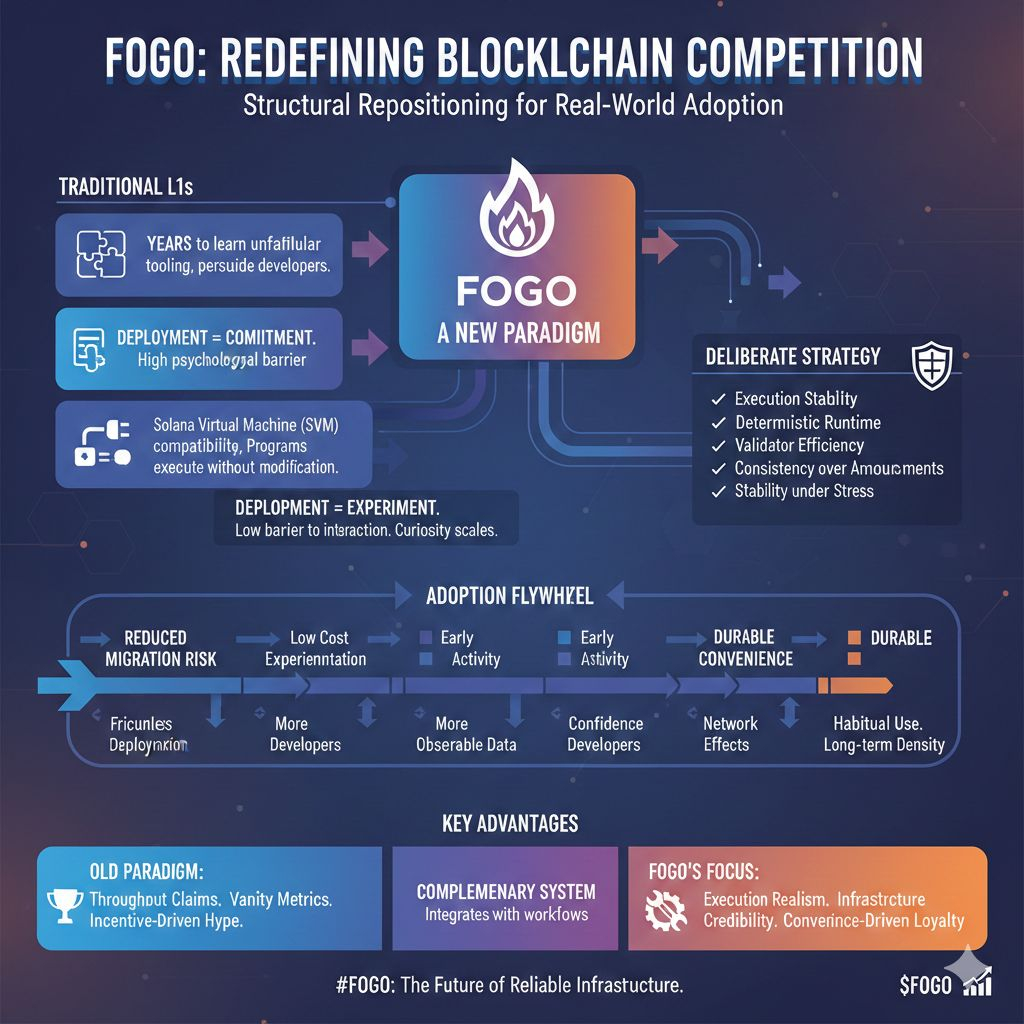
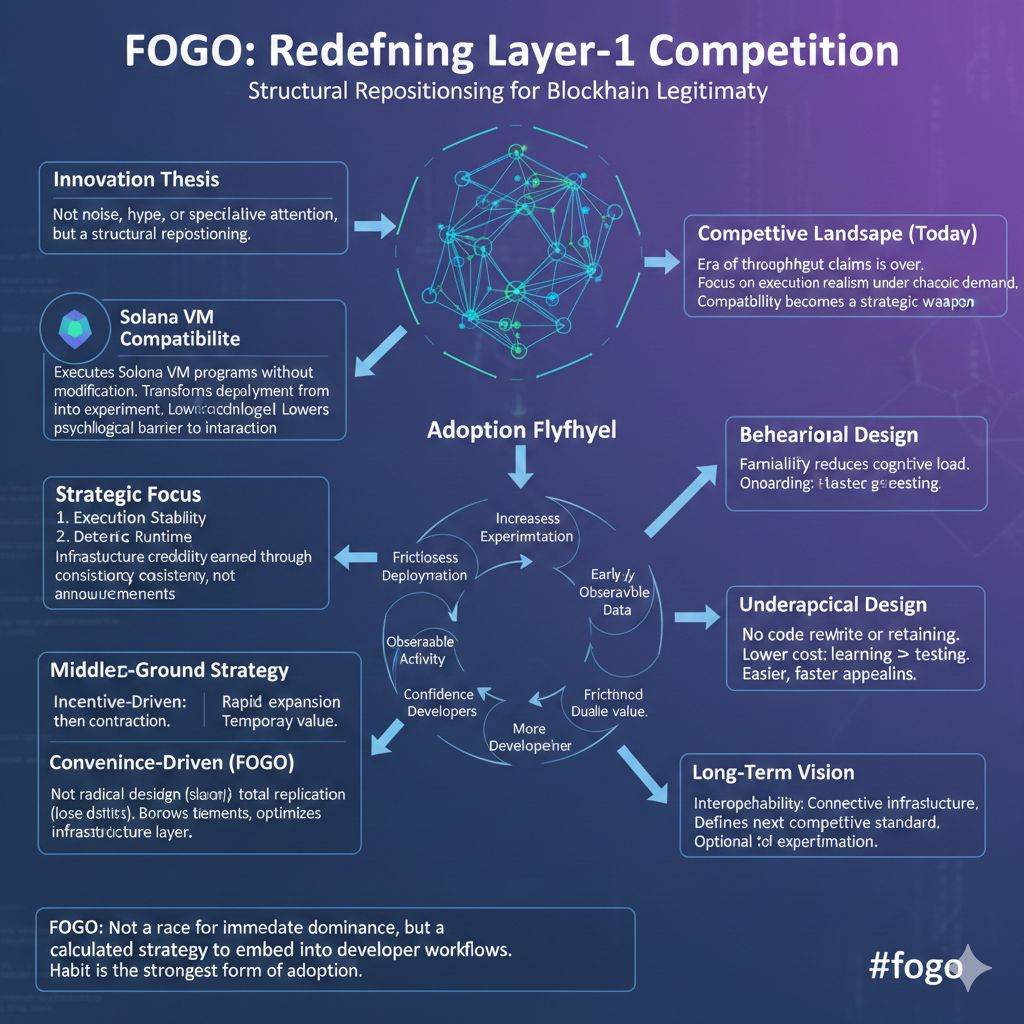
 is not noise, hype, or speculative attention, but a structural repositioning that quietly changes how new blockchains compete for legitimacy. Most Layer-1 networks spend years trying to persuade developers to learn unfamiliar tooling before they can even begin building an ecosystem. Fogo reverses that sequence by allowing programs designed for the Solana Virtual Machine to execute without modification. That single architectural decision compresses the adoption timeline because it transforms deployment from a commitment into an experiment. Builders no longer need conviction about long-term success before interacting with the network; they only need curiosity. In technology markets, lowering the psychological barrier to first interaction is often more powerful than increasing incentives, because curiosity scales naturally while incentives must be funded.
Recent development direction reinforces that this is not accidental positioning but deliberate strategy. Instead of prioritizing vanity metrics like project count or superficial transaction spikes, the network appears focused on execution stability, deterministic runtime behavior, and validator efficiency. Those priorities signal an understanding that infrastructure credibility is earned through consistency rather than announcements. Applications do not fail in ideal conditions; they fail when networks experience congestion, arbitrage pressure, or unpredictable transaction bursts. By engineering for stability under stress rather than speed in isolation, Fogo is aligning itself with the conditions that actually determine long-term adoption. Reliability is the hidden currency of infrastructure, and chains that earn it gain a reputation advantage that marketing cannot replicate.
Thinking about Fogo’s current position requires analyzing the competitive landscape as it actually exists today, not as it existed during earlier blockchain cycles. The era when throughput claims alone could differentiate a chain is over. Nearly every modern network advertises high performance. What distinguishes them now is execution realism: how they behave under chaotic real-world demand. In this environment, compatibility becomes a strategic weapon. Because Fogo aligns with a familiar execution environment, it inherits a baseline level of developer trust. Trust dramatically reduces adoption friction. When a builder already understands how a system behaves, experimentation feels safe. Safety accelerates participation, and participation accelerates network effects.
However, compatibility is not imitation. The subtlety of Fogo’s design lies in separating application-level familiarity from network-level independence. Developers interact with an environment they recognize, while the underlying infrastructure can still optimize validator topology, propagation logic, scheduling behavior, and fee dynamics. This layered differentiation allows the system to remain recognizable without becoming redundant. In strategic terms, Fogo is not trying to replace existing ecosystems; it is positioning itself as a complementary execution environment that developers can integrate into their workflow. Complementary systems historically scale faster than replacement systems because they do not demand abandonment of existing tools or habits.
Comparing Fogo with other blockchain architectures highlights why this middle-ground strategy is unusual. Some networks attempt radical redesign, introducing entirely new languages and execution models. While innovative, that approach slows adoption because developers must invest time before generating value. Other networks replicate established designs almost entirely, gaining compatibility but losing distinctiveness. Fogo sits between these poles. It borrows what is already trusted while retaining freedom to optimize at the infrastructure layer. That balance gives it a strategic flexibility many competitors lack. It can evolve internally without forcing external participants to relearn fundamentals.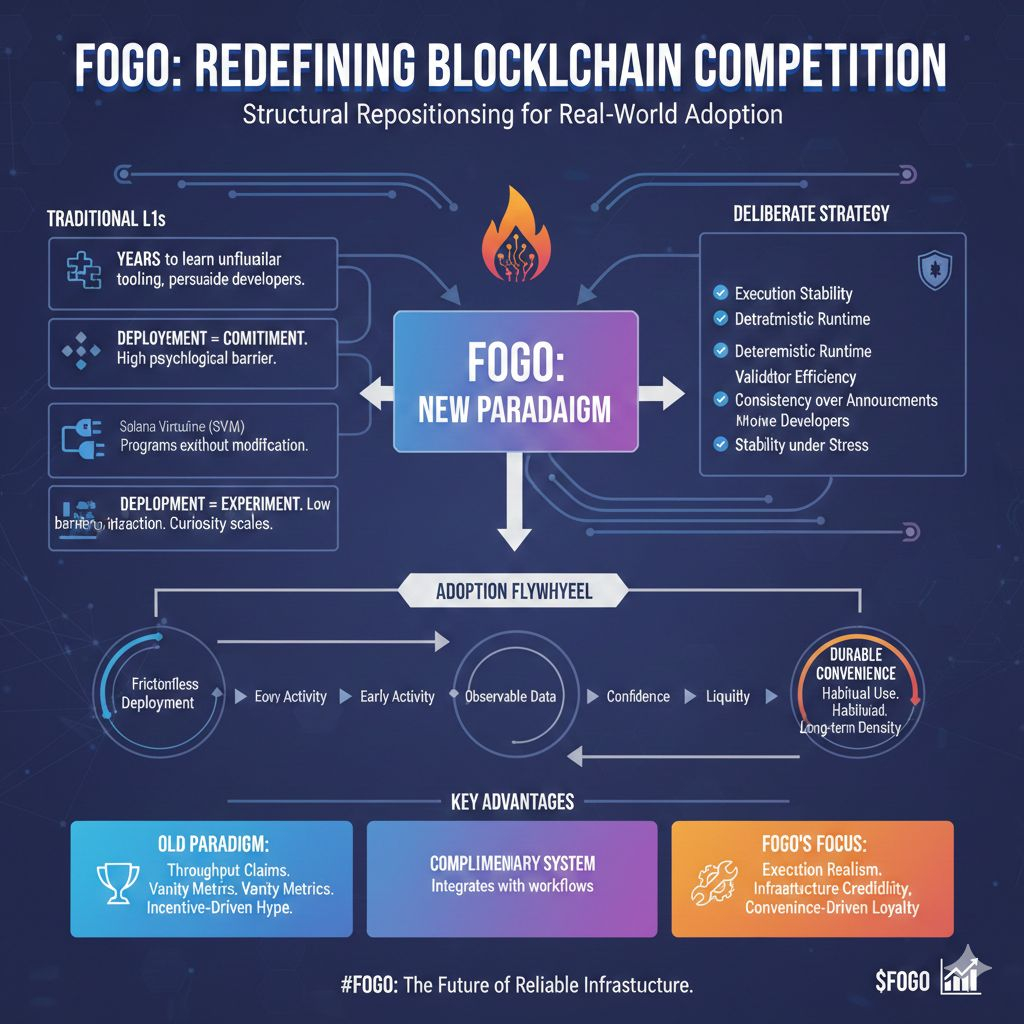
This balance also produces one of Fogo’s most underappreciated advantages: reduced migration risk. Builders considering deployment always evaluate downside scenarios. If experimenting with a network requires rewriting code, reconfiguring logic, or retraining teams, the perceived risk increases. By contrast, when deployment is frictionless, the cost of experimentation drops dramatically. Lower cost increases willingness to test. Testing increases early activity. Early activity generates observable data. Observable data builds confidence. Confidence attracts liquidity. Liquidity attracts more developers. This sequence forms an adoption flywheel that is driven not by marketing campaigns but by structural design. Systems that embed growth mechanisms into architecture tend to scale more sustainably than those that rely on external incentives.
Incentive-driven ecosystems often experience a predictable pattern: rapid expansion followed by contraction once rewards decline. Convenience-driven ecosystems behave differently. They may grow more gradually, but they tend to retain participants because their value proposition is operational rather than temporary. Fogo’s model leans toward the second category. Its appeal is not primarily token rewards or promotional campaigns but execution convenience. Convenience is durable. Once developers integrate a convenient system into their workflow, removing it feels inefficient. This stickiness can translate into long-term ecosystem density if the underlying infrastructure continues to perform reliably.
Another dimension of uniqueness lies in behavioral design. Technology adoption is influenced as much by psychology as by engineering. Developers are more likely to explore platforms that feel familiar because familiarity reduces cognitive load. Every additional concept a builder must learn creates friction. By aligning with an existing execution paradigm, Fogo minimizes that friction. Builders can treat deployment as an extension of their current environment rather than a departure from it. This subtle shift transforms onboarding from a learning process into a testing process. Testing is easier, faster, and more appealing than learning, which increases the probability of participation.
Looking deeper into system-level dynamics, Fogo’s architecture suggests a focus on predictable transaction behavior. In decentralized environments, unpredictability is often the source of user frustration and developer risk. Variations in confirmation timing, execution ordering, or propagation patterns can cause identical code to produce different outcomes across networks. By emphasizing deterministic execution characteristics, Fogo is attempting to make its environment statistically reliable. Statistical reliability is what allows sophisticated applications such as automated trading systems, complex DeFi protocols, or latency-sensitive infrastructure to operate confidently. Networks that deliver this reliability become preferred environments for serious builders rather than experimental playgrounds.
From a market perspective, perception evolves in phases. Early-stage projects are viewed with curiosity, mid-stage projects with skepticism, and mature projects with trust. The transition from curiosity to trust is where most platforms struggle. That transition depends less on announcements and more on consistent performance over time. Fogo’s emphasis on infrastructure fundamentals suggests an awareness of this progression. By prioritizing execution quality early, it increases the probability that future growth will be supported by real usage rather than speculative momentum. Real usage is the only metric that ultimately matters because it reflects genuine demand rather than temporary attention.
Interoperability is another strategic advantage embedded in Fogo’s positioning. Modern blockchain applications rarely operate in isolation; they rely on liquidity flows, cross-network integrations, and composable logic. Chains that cannot interact smoothly with others often face limitations regardless of their internal performance. Because Fogo’s execution environment aligns with a widely understood standard, it is naturally positioned to integrate into broader multi-chain ecosystems. This gives it the potential to function as connective infrastructure rather than an isolated destination. Infrastructure that connects systems tends to gain importance over time because it facilitates activity rather than competing for it.
Considering long-term industry evolution, Fogo’s approach may represent an early example of a broader design trend. As the blockchain sector matures, differentiation is shifting away from raw performance claims toward usability and integration efficiency. Developers increasingly value environments that reduce friction rather than those that simply advertise theoretical speed. If this trend continues, architectures that prioritize compatibility, predictability, and optionality could become dominant. In that scenario, Fogo would not just be participating in the market but helping define its next competitive standard.
Optionality itself is one of the network’s strongest benefits. Participants are not forced into exclusivity. They can deploy, test, and operate while maintaining presence elsewhere. Optionality reduces perceived risk, and reduced risk increases experimentation. Systems that make experimentation safe tend to attract innovators, and innovators often become the earliest contributors to ecosystem growth. This dynamic can create a virtuous cycle in which early technical adopters pave the way for broader participation. When infrastructure supports experimentation without penalty, it becomes a platform for discovery rather than a gatekeeper.
All of these factors converge into a single strategic insight. The true competition among Layer-1 networks is no longer about who can claim the highest numbers or the loudest headlines. It is about who can become the most reliable, easiest, and most predictable environment for real applications to run. Complexity can attract attention, but simplicity that consistently works attracts loyalty. If Fogo continues aligning its execution stability, developer familiarity, and infrastructure optimization, it positions itself to benefit from that principle. In a landscape crowded with promises, the platform that quietly delivers dependable performance often becomes the one developers return to repeatedly.
That is why the trajectory of $FOGO is best understood not as a race for immediate dominance but as a calculated strategy to embed itself into developer workflows. Once a system becomes part of a workflow, it stops being optional and starts being habitual. Habit is the strongest form of adoption because it operates automatically. If Fogo succeeds in reaching that stage, its competitive advantage will no longer depend on comparisons or campaigns. It will come from becoming the environment developers instinctively choose when they want their code to run exactly as intended. And if that behavioral shift takes hold, #fogo may not just compete within the Layer-1 landscape — it could quietly redefine what winning in that landscape actually means.