

Most blockchains talk about “mass adoption” like it’s a marketing trophy. Vanar treats it like a product problem you either solve—or you don’t get users. And honestly, that’s the right framing. Real people don’t wake up wanting an L1. They want a game that works, a digital item that feels real, a checkout that doesn’t glitch, an app that doesn’t make them learn a new language just to click “send.”
Vanar’s whole approach feels built around one stubborn truth: the first time a user hits friction, they disappear. They won’t “research gas.” They won’t “bridge funds.” They won’t join a Discord to ask why a transaction failed. They just leave. So Vanar’s obsession with onboarding, cost predictability, and fast execution isn’t a nice-to-have—it’s the core mission.
Onboarding is where most chains quietly lose the war. Not because the tech is bad, but because the experience is awkward. Wallet creation. Seed phrase anxiety. “You need gas.” “You sent it to the wrong network.” That stuff is normal to crypto people and completely absurd to everyone else. Vanar’s ecosystem direction—consumer-first lanes like gaming, entertainment, and metaverse-style experiences—makes sense because these are the only environments where you can bring users in without forcing them to become crypto-native first. A player joins a world, buys a skin, trades an asset, earns a reward—none of that should feel like “blockchain.” It should feel like… the internet.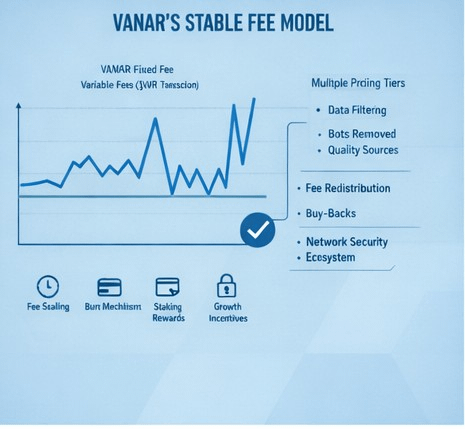
The most adoption-heavy decision Vanar has made is its fixed-fee design. This isn’t just “low fees.” It’s trying to make fees behave like something you can trust. A normal user doesn’t want cheap fees today and surprise fees tomorrow. They want boring. Predictable. Same every time. Vanar’s documentation talks about keeping the majority of transaction types around a tiny target level (roughly $0.0005 for most types), which is basically a statement of intent: micro-actions should be frictionless, not financially “considered.” If that stays true under pressure, it becomes one of Vanar’s strongest differentiators—because the average chain becomes unpredictable exactly when users are most active.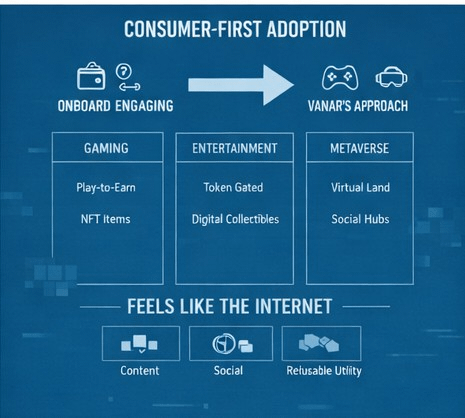
Now here’s the part that feels more honest than hype: fixed fees don’t just happen. Somebody has to maintain the mechanism that keeps the user experience stable even when the token price moves. Vanar describes a process where the network uses multiple sources for pricing, filters out weird data, and updates the fee calibration regularly. That’s not “pure crypto ideology.” It’s product engineering. It’s Vanar basically saying: we’d rather take the operational responsibility of keeping the experience smooth than let the user experience get destroyed by fee chaos.
That choice creates a trade-off, and it’s worth saying out loud: stability requires trust in how the system is operated, how transparent it is, and how resilient it is when things go wrong. But it also creates a real advantage: if Vanar can deliver “fees you don’t think about,” it removes one of the biggest psychological barriers in crypto. People don’t adopt systems that feel like a roulette wheel.
Speed matters too, but not the way crypto likes to argue about speed. For everyday users, speed isn’t a TPS number on a chart. It’s whether the action feels instant. Whether the game keeps flowing. Whether the payment completes without that awkward “pending…” moment. Whether things fail often. The fastest chain on paper still loses if the experience is inconsistent. Vanar’s emphasis on stable processing and predictable behavior is, in my view, more aligned with real-world expectations than chasing headline TPS.
Underneath, Vanar’s consensus approach looks like it’s built for controlled reliability early, then widening participation over time. The docs talk about a hybrid setup (PoA guided by PoR, with foundation involvement early and pathways to external validators). Again, this isn’t the most ideological setup on day one—but it’s consistent with Vanar’s big promise: smooth user experience first. The real challenge will be proving it can expand decentralization without breaking the stability that makes the chain attractive to consumer apps in the first place.
And then there’s VANRY—because adoption only matters if the token has a real role, not just a ticker. VANRY sits at the center of the system: it’s the gas asset, it’s part of staking/security incentives, and it connects across bridging representations. What’s interesting is how Vanar’s design can make VANRY more important while making it feel less annoying to users. If fees stay predictable and low, users stop feeling like they’re constantly “paying crypto tolls,” but the network still needs VANRY for execution and security. That’s the sweet spot: token utility that supports the system without turning the user experience into a finance lesson.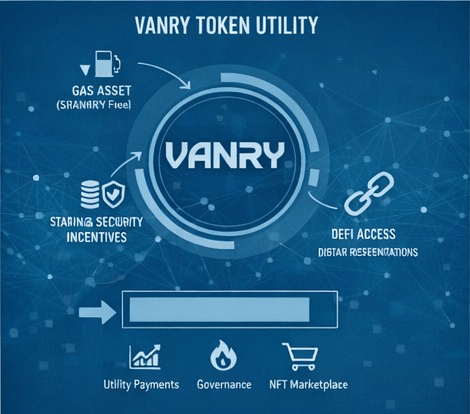
Economically, the story Vanar needs to prove is simple: real usage should turn into real demand. If Vanar’s ecosystem (games, entertainment, consumer rails, and now its broader AI-native infrastructure direction) drives repeat activity, then VANRY becomes the asset that underwrites that activity—through fees, staking, and potentially supply-side mechanisms like buybacks/burns if those are executed transparently and meaningfully. The token doesn’t win because people “believe.” It wins because usage becomes habitual and the network becomes hard to replace.
What I find most telling about Vanar right now is the direction of its identity. It’s not trying to be “another L1.” It’s trying to be an infrastructure stack where developers can build consumer-grade experiences without constantly negotiating with blockchain pain. The AI-layer narrative (semantic memory, contextual reasoning, automations) might end up being a real differentiator—or it might stay a narrative. The deciding factor will be whether these layers make building better apps genuinely easier, cheaper, or smarter in ways developers can feel immediately.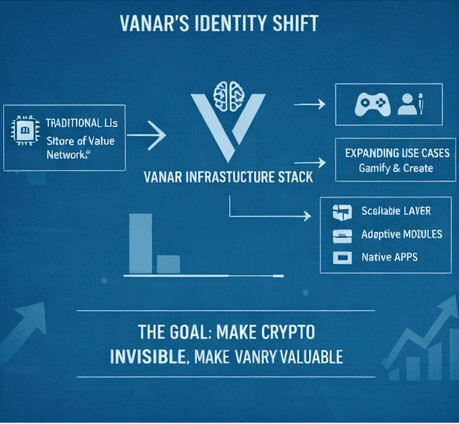
Here’s the honest conclusion: Vanar doesn’t need to “convince the crypto crowd.” It needs to make the non-crypto crowd forget they’re using crypto at all—while quietly turning that invisible usage into measurable VANRY value. If Vanar can keep fees boring, performance consistent, and decentralization expanding without cracking UX, it won’t be competing on slogans. It’ll be competing on something rarer in this space: trust earned through normal, repeatable behavior. That’s the kind of adoption that doesn’t spike for a week—it sticks.
