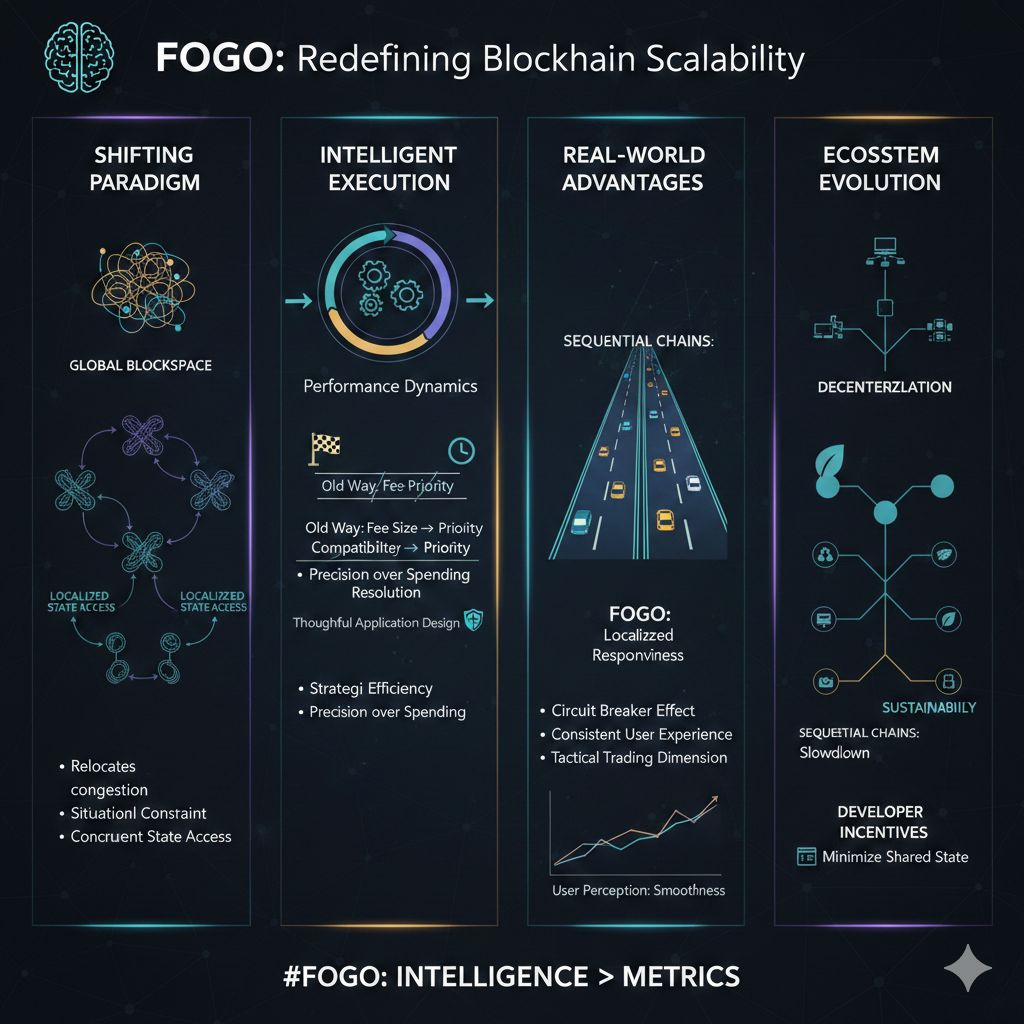
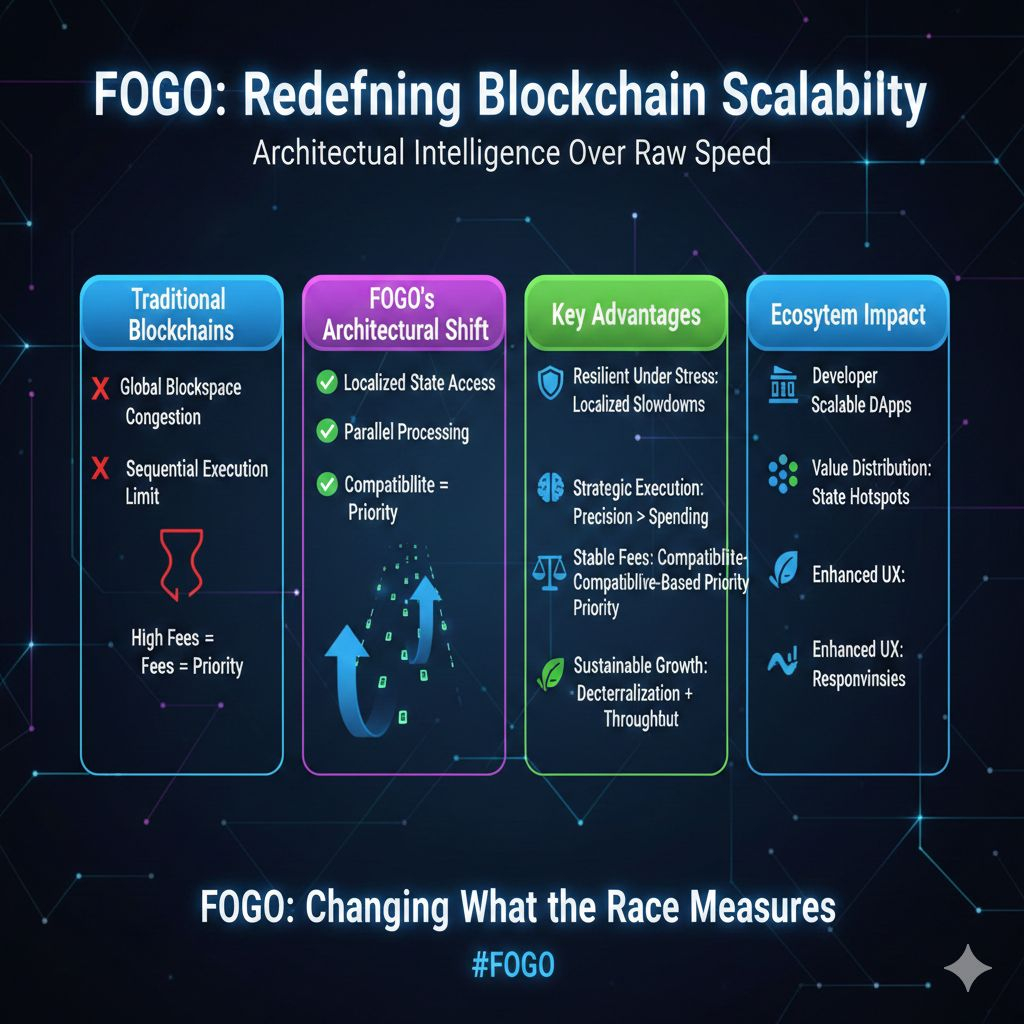
 Most chains try to scale by increasing capacity, but @fogo shifts the equation entirely by relocating congestion from global blockspace into localized state access. That architectural move changes everything about performance dynamics. Instead of every transaction fighting every other transaction, only those touching the same state compete. This transforms throughput from a universal limit into a situational constraint, which means the network keeps moving smoothly even when certain hotspots are crowded.
Recent refinements to execution scheduling and validator processing have reinforced this direction. The improvements didn’t just make the system faster; they made it more strategically efficient. Priority is no longer determined purely by fee size but by whether a transaction can execute without conflicting with others. That subtle shift introduces a new kind of efficiency market where intelligent transaction structure can outperform brute-force fee bidding. In practical terms, it rewards precision over spending power, which is a rare trait in blockchain environments dominated by auction mechanics.
Right now, Fogo’s position in the ecosystem is unusual because it competes on execution logic rather than headline metrics. Traditional comparisons focus on transactions per second or average fees, but those metrics miss how systems behave under stress. In networks built around sequential execution, heavy demand slows everyone equally. In Fogo’s model, demand slows only the users targeting the same resource. This localized slowdown effect acts like circuit breakers that isolate pressure instead of letting it spread. The result is a system that maintains responsiveness for most users even during peak activity, which dramatically improves real-world usability.
When compared with other architectures, the uniqueness becomes clearer. Sequential chains rely on strict ordering that forces every transaction through one processing lane. Some parallel chains attempt concurrency but still collapse into bottlenecks when shared data is accessed. Fogo approaches the problem from the opposite direction: it assumes conflicts will happen and designs execution around resolving them efficiently. By treating state access as the true limiting factor, it converts scalability into a question of how many independent state operations can occur simultaneously. That perspective aligns more closely with distributed computing theory than with traditional blockchain scaling models.
This structural design gives Fogo an edge that extends beyond performance numbers. Fee markets on most chains become volatile during demand spikes because price determines priority. In Fogo, compatibility determines priority first. Transactions that don’t collide with others can move quickly regardless of fee level, while conflicting ones must wait. This encourages developers to architect applications that minimize shared-state interaction, leading to cleaner contract structures and better load distribution. Over time, that incentive can reshape how decentralized applications are built, pushing the ecosystem toward inherently scalable design patterns.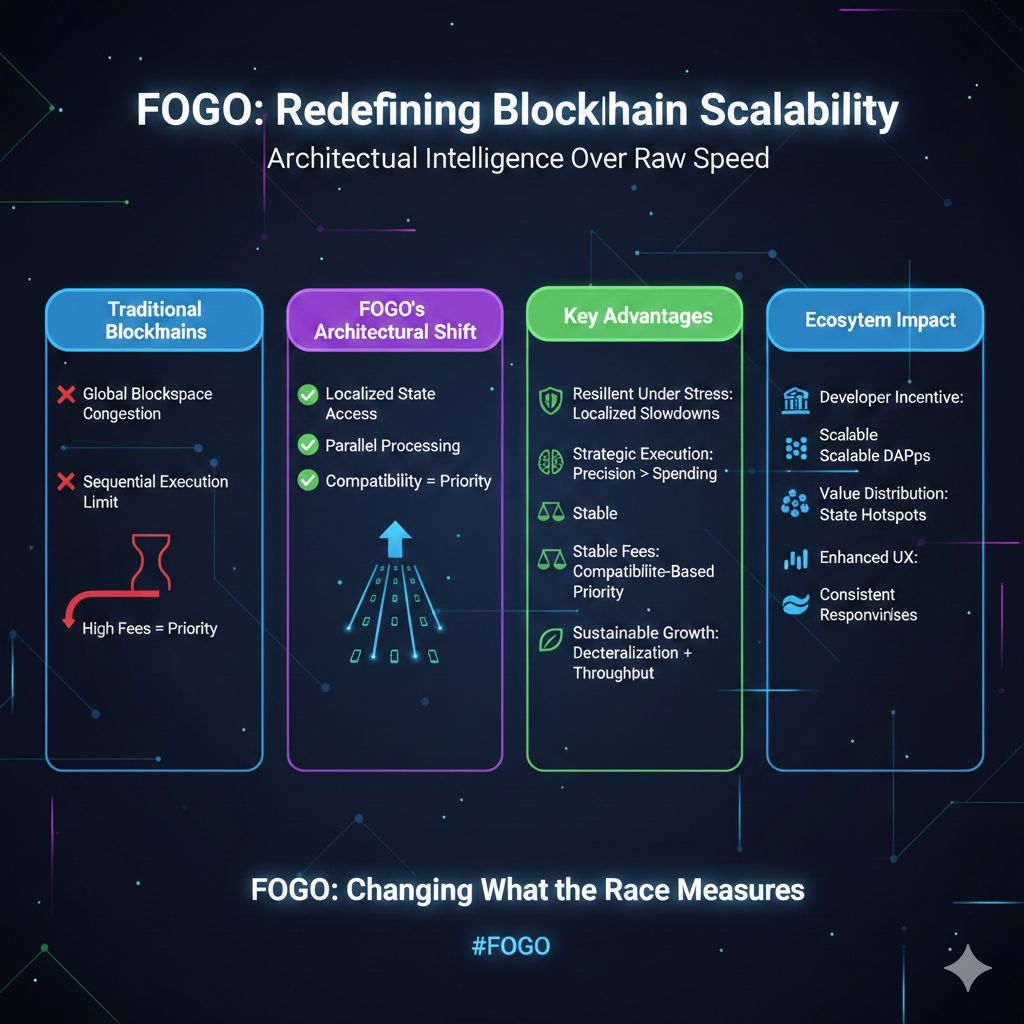
Another consequence appears in how extractable value forms. In typical networks, value extraction concentrates around transaction ordering within blocks. Because Fogo localizes contention, value opportunities cluster around specific state hotspots instead of the entire block. This makes them easier to anticipate and potentially easier to mitigate through thoughtful application design. In effect, architecture itself becomes a risk-management tool. Few blockchains embed that kind of protection at the structural level; most rely on external fixes after problems appear.
For traders and power users, this environment introduces a tactical dimension rarely discussed. Execution timing can be optimized not just by watching price but by understanding which parts of the network are contested. Interacting with low-conflict state can yield faster confirmations and lower effective cost, creating a strategic layer similar to liquidity analysis in traditional markets. For long-term participants holding $FOGO, the implication is that network value scales with how intelligently activity is distributed, not just how much activity exists. Systems that scale through coordination tend to sustain growth more smoothly than those that scale through brute capacity expansion.
Another advantage lies in sustainability. Networks that chase higher throughput by increasing hardware requirements often drift toward validator centralization. Fogo’s approach, scaling through smarter execution rather than heavier machines, can raise effective throughput without proportionally raising hardware demands. That balance helps maintain decentralization while still improving performance, a combination that is notoriously difficult to achieve. Over time, this can strengthen ecosystem trust because efficiency gains don’t come at the cost of accessibility for validators.
What’s particularly interesting is how early developer behavior already reflects this architecture. Builders quickly realize that minimizing shared state isn’t just optimization — it’s competitive strategy. Applications designed with distributed data structures and isolated write paths perform better under load, which means good architecture directly translates into better user experience. As more developers adopt these patterns, scalability becomes self-reinforcing. Growth strengthens performance instead of weakening it, which is the opposite of what happens on most networks.
User perception follows naturally from this structure. Congestion on many chains feels like a system-wide slowdown, but on Fogo it feels situational. Most interactions remain fast even if one area is crowded. That perception difference matters because users judge platforms by responsiveness, not theoretical benchmarks. A network that feels consistently smooth tends to attract more sustained activity than one that posts impressive numbers but becomes sluggish under pressure. Reliability, not raw speed, is what keeps users coming back.
All of this positions #fogo as a system competing on architectural intelligence rather than marketing metrics. Its updates show a consistent focus on execution design, its current standing reflects differentiation in how it handles contention, and its comparison with other networks highlights advantages that become more visible as usage grows. Instead of trying to win the race for biggest numbers, Fogo is changing what the race measures. And if that shift continues, it could redefine how the industry evaluates scalability itself.