
When I first started watching on-chain markets up close, I assumed speed was a scoreboard. Lower latency meant “better,” and that was the end of the story. Then I sat through a few ugly moves—fast candles, forced liquidations, oracle updates fighting for air—and I realized latency isn’t really a bragging metric. It’s a feeling. It decides whether people trust the next click. It decides whether traders act, or freeze, or flee back to a centralized exchange when it matters.
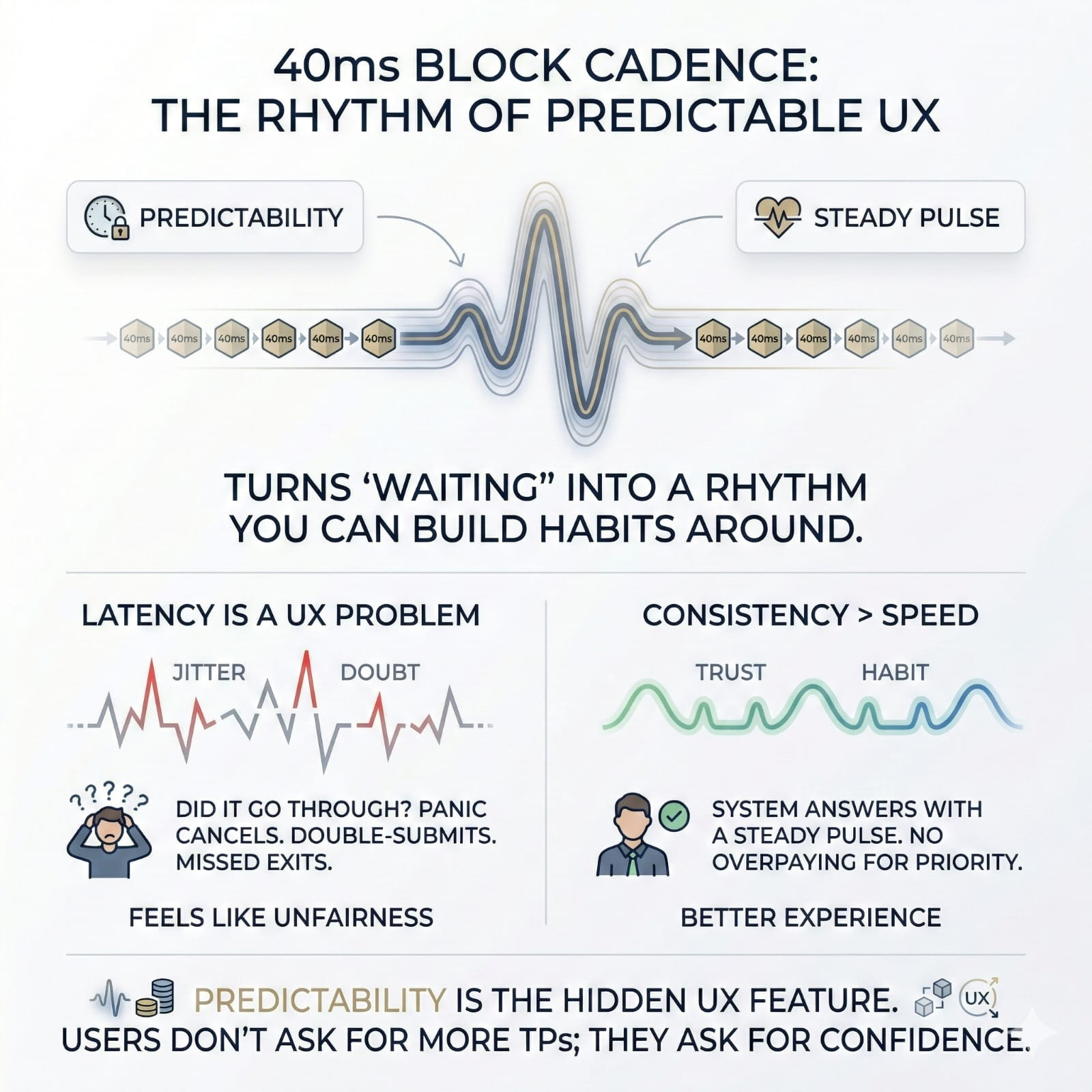
That’s why 40ms blocks matter in a way that isn’t abstract. A short block cadence changes what “waiting” looks like. It turns the chain into a rhythm you can build habits around. Not because every block is perfect, but because the system can become predictable—and predictability is the hidden UX feature. In practice, users don’t ask for “more TPS.” They ask for the moment where they submit an action and the system answers with a steady pulse instead of a shrug.
Latency is a UX problem because humans are the slowest and most fragile component in the loop. Even if a protocol is technically correct, the experience collapses if the user is forced to wonder, “Did it go through?” That doubt causes double-submits, panic cancels, and missed exits. It makes people overpay for priority, or stop trusting the venue altogether. Speed helps, but consistency helps more. Jitter—those random stalls and spikes—feels like unfairness even when it’s just physics and scheduling.
Choosing the SVM is a strategic decision in that context. If you want the chain to behave like a venue, you don’t burn years reinventing execution while the real fight is about how the venue performs under stress. You pick an execution environment that already has gravity—developer familiarity, tooling, mental models—and you spend your effort on the parts that shape real-time behavior: propagation, consensus, and tail latency. It’s a choice that says: don’t rewrite the engine, tune the track. Don’t obsess over novelty, obsess over how the system acts when everyone shows up at once.
The zone-based validator design is the same philosophy, just expressed physically. Geography matters. Proximity matters. Hardware limits matter. Not as a flex, but as an honest constraint. Markets don’t break because average latency is slightly higher; they break because the slow tail drags decisions into uncertainty at exactly the wrong moment. Zone-based validation tries to trade some “everyone participates all the time” purity for a tighter, more consistent rhythm—less jitter, fewer surprise stalls, a cadence that feels like a metronome instead of a heartbeat skipping beats. The real question isn’t whether it’s fast on a quiet day. The question is whether the rhythm stays intact during volatility.
This is where the comparison to traditional exchanges stops being an analogy and becomes a mirror. Centralized exchanges openly optimize around colocation and matching-engine proximity. They build a tiny world where time behaves nicely. That comes with tradeoffs—fairness debates, access costs, concentrated control—but it’s also why people default to CEX when the screen turns red. They’re choosing certainty. They’re choosing the venue that feels like it will still respond in the middle of the stampede. A decentralized system that wants to compete with that reflex has to acknowledge the same underlying truth: physics is policy. If you don’t design for it, it will design you.
Then there’s the part nobody loves talking about: approvals. Wallet pop-ups are not a minor annoyance. They are a human-rate limiter. They add seconds right where seconds hurt the most. “Fogo Sessions” are interesting because they aim at that exact choke point: time-window authorization instead of repeated, interruptive signing. You authorize once for a bounded period and a bounded scope, and you act within that window. It’s not magic; it’s simply moving permission from a constant negotiation to a controlled, temporary contract. In human terms, it’s shaving human latency, not just network latency.
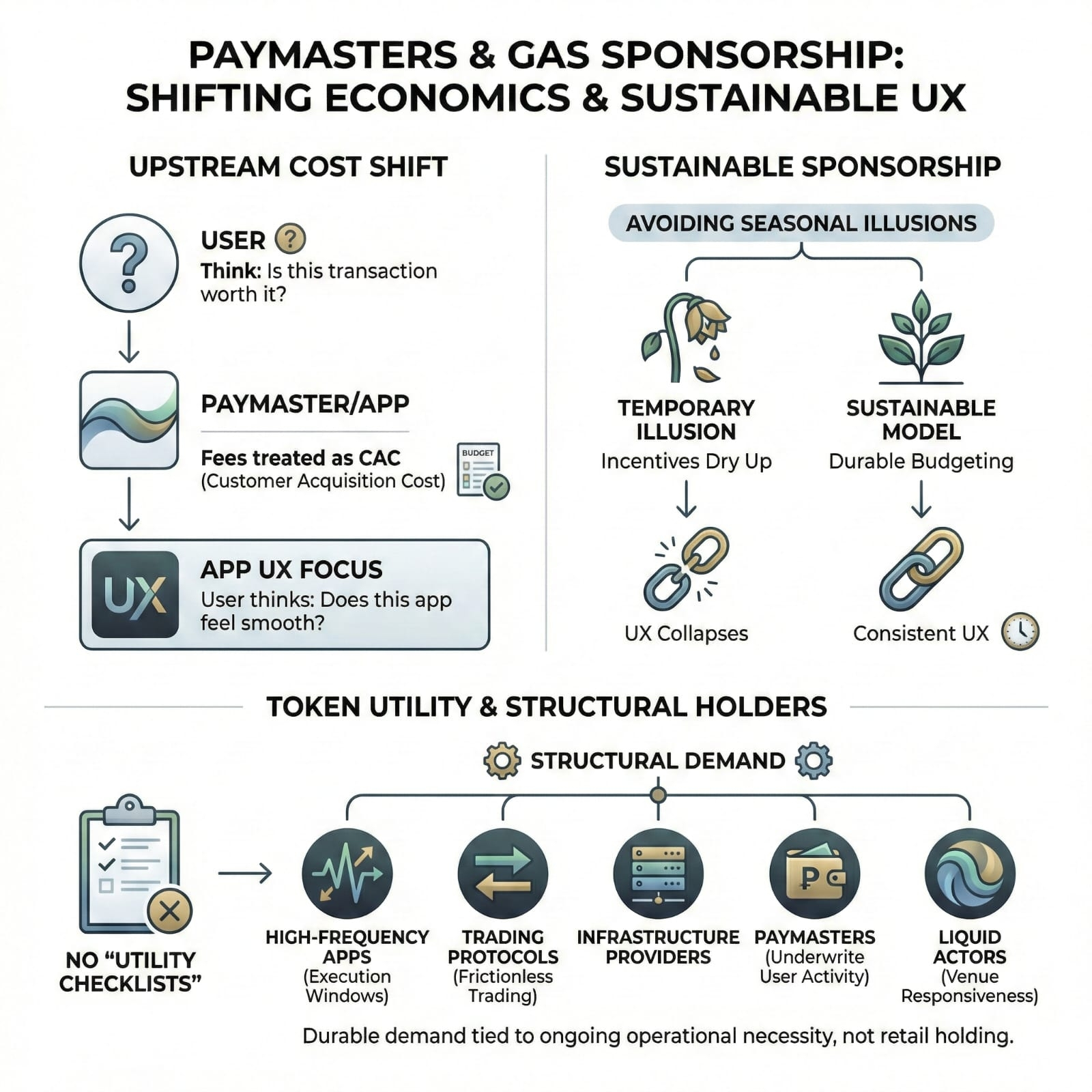
Paymasters and gas sponsorship push that idea further into economics. When apps sponsor fees, costs move upstream. The user stops thinking, “Is this transaction worth it?” and starts thinking, “Does this app feel smooth?” The app, meanwhile, starts treating fees like CAC—customer acquisition cost—something to budget and justify the same way Web2 products justify onboarding spend. That shift can be healthy, but it has a sharp edge: sponsorship has to be sustainable, or it becomes a temporary illusion that disappears the first time incentives dry up. UX can’t be a seasonal promotion.
From a token lens, I don’t find “utility checklists” very useful. What matters is who must hold the token at scale if the system works as intended. If you want venue-like behavior—fast cadence, sponsored flows, reliable throughput—then structural holders tend to be operators: high-frequency apps that care about execution windows, trading protocols that can’t afford friction, infrastructure providers, paymasters who underwrite user activity, and the actors who keep the venue liquid and responsive. Retail holding can exist, sure, but the durable demand story is usually the one tied to ongoing operational necessity.
That’s why supply and unlock dynamics matter more than narrative. Long unlocks can be fine—sometimes they’re responsible—but they raise the bar. Demand has to be structural, not incentive-driven. If demand comes mostly from temporary rewards, you don’t get a market; you get a festival that ends. If demand comes from actual operating needs—apps sponsoring users because it makes business sense, protocols holding for throughput guarantees, infra holding because it’s required—then the unlock schedule becomes background noise instead of a cliff edge.
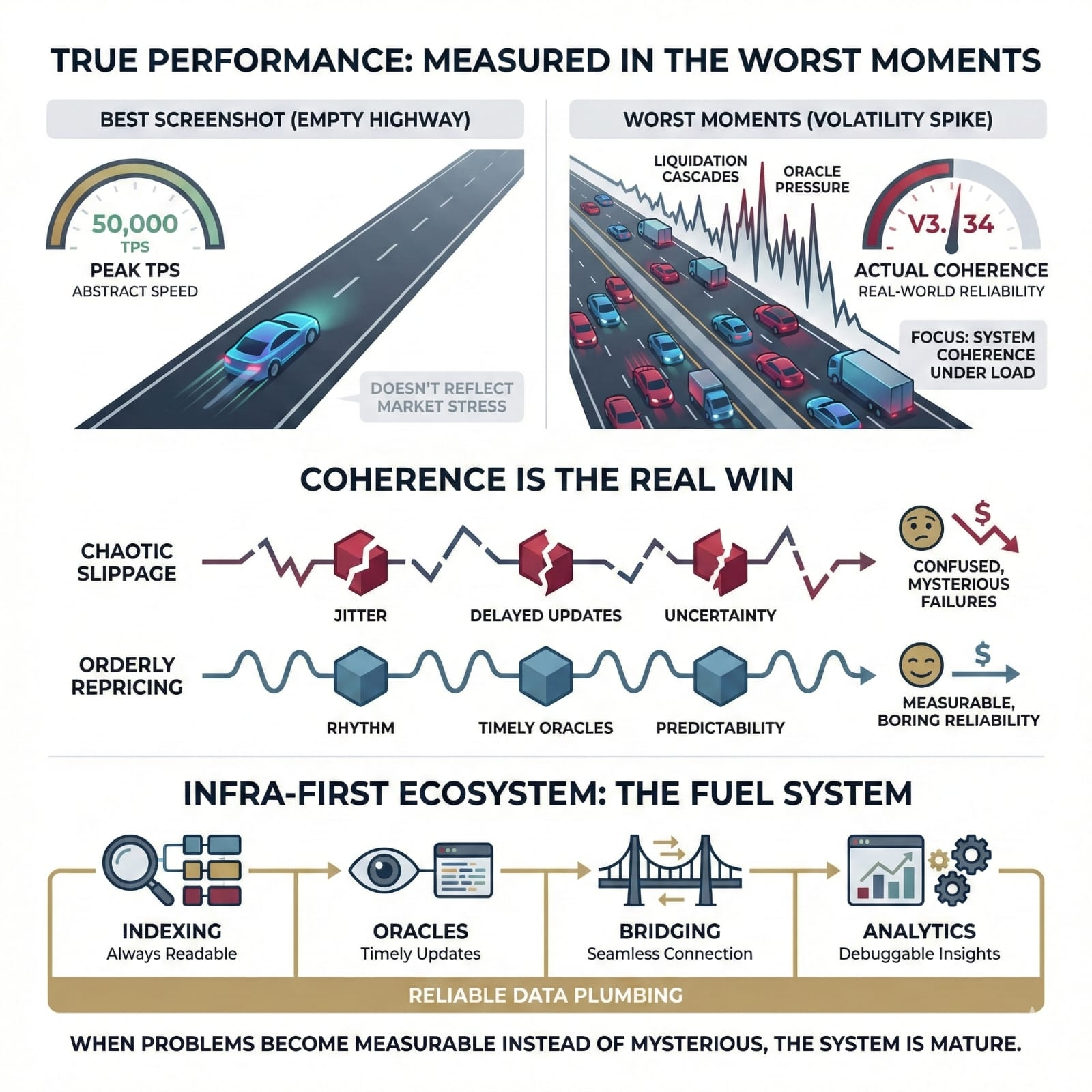
Performance metrics should be read through the worst moments, not the best screenshots. I don’t care much about peak TPS claims, because markets don’t fail at peak throughput on an empty highway. They fail during volatility spikes: liquidation cascades where everyone needs blockspace now, oracle pressure where updates must stay timely, and crowded mempools where the difference between “rhythm” and “jitter” becomes the difference between orderly repricing and chaotic slippage. The promise of a tight cadence isn’t that everything is fast. It’s that the system stays coherent when it’s busy.
That coherence is why the ecosystem story needs to be infra-first. Indexing, oracles, bridging, analytics—this stuff is the fuel system, not the paint job. A fast venue without reliable data plumbing is just a faster way to get confused. If the chain wants to be taken seriously under load, the surrounding infrastructure has to be boring in the best way: always there, always readable, always debuggable. The real win is when problems become measurable instead of mysterious.
And the competitor you feel in your bones is still the centralized exchange. Not because decentralization doesn’t matter, but because in the moments of stress, people choose whatever behaves like it won’t abandon them mid-action. If Fogo can keep rhythm, reduce jitter, shave human latency, and make sponsorship sustainable, it gets a shot at changing that default behavior—not with hype, but with operational trust earned in the hard minutes.
So I keep a watch list, not a verdict. I want to see sustained throughput under stress, not a clean demo. I want to see paymasters that remain funded because the math works, not because the marketing budget is burning. I want to see native developers building things that only make sense with a 40ms cadence—mechanisms designed around consistent time, not ports that ignore it. And I want to see real token demand driven by operators who need the venue to function, not by incentives trying to manufacture a feeling.
If those pieces hold together, 40ms blocks stop being a number people quote and start being a property people rely on. Not a slogan. A rhythm. The kind you can trade on without holding your breath.
