
For more than a decade, the number four has defined Bitcoin’s market rhythm. The asset’s price behavior has historically aligned closely with its four-year halving cycle, where a reduction in block rewards tightened supply, ignited powerful bull runs, and eventually gave way to deep bear markets.
However, as Bitcoin moves deeper into the post-2024 halving phase, cracks are beginning to appear in this long-standing pattern. The question many investors are now asking is simple but profound:
Is Bitcoin’s four-year cycle losing its reliability — or evolving into something bigger?
The Historical Role of the 4-Year Cycle
BTC halvings reduce the block reward paid to miners roughly every four years, creating a supply shock. Historically, this has driven a predictable sequence:
1. Post-halving supply squeeze
2. Strong multi-month rall
3. Euphoria and parabolic price action
4. Sharp correction and prolonged bear market
5. Cycle reset
Previous cycles followed this template closely:
2016–2018 cycle:
+125% rally post-halving
Followed by a brutal 73% drawdown
2020–2022 cycle:
Over 300% upside
Then a 64% correction, bottoming in 2022
2023 recovery:
BTC rebounded over 150% as the next halving approached
These boom-and-bust phases conditioned investors to expect violent upside — and equally violent downside.
Why the 2024 Cycle Looks Different
The most recent Bitcoin halving occurred in April 2024, reducing the block reward to 3.125 BTC. Traditionally, the first year after a halving has been bullish.
Yet this time, Bitcoin is behaving very differently.
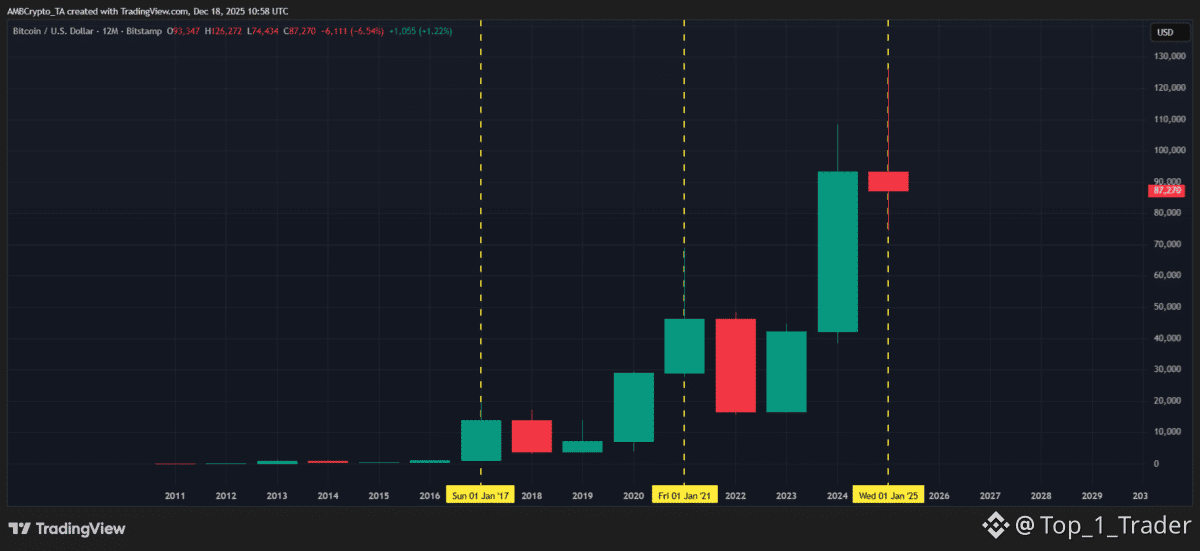
With the market nearing the end of Q4, BTC is on track to close the first post-halving year down roughly 7% — an outcome that sharply contrasts with previous cycles.
Rather than explosive upside or panic-driven selloffs, Bitcoin has spent much of this cycle consolidating, frustrating both bulls and bears.
This deviation raises an important possibility:
Bitcoin’s price is no longer driven purely by halving-based scarcity cycles.
New Fundamentals Are Rewriting Bitcoin’s Playbook
Several structural changes are reshaping Bitcoin’s market dynamics and dampening extreme volatility.
1. Institutional Capital Has Changed Market Behavior
Unlike past cycles dominated by retail speculation, the current environment includes institutional investors with longer time horizons and disciplined allocation strategies.
Large players don’t chase parabolic tops or panic sell bottoms — they accumulate strategically.
2. ETF Launches Are a Game Changer
The approval and launch of spot Bitcoin ETFs in 2024 fundamentally altered demand mechanics.
ETFs:
Provide continuous, regulated inflows
Reduce reliance on speculative leverage
Encourage long-term holding behavior
This creates a structural bid beneath price, softening deep corrections.
3. Declining Exchange Reserves Signal Accumulation
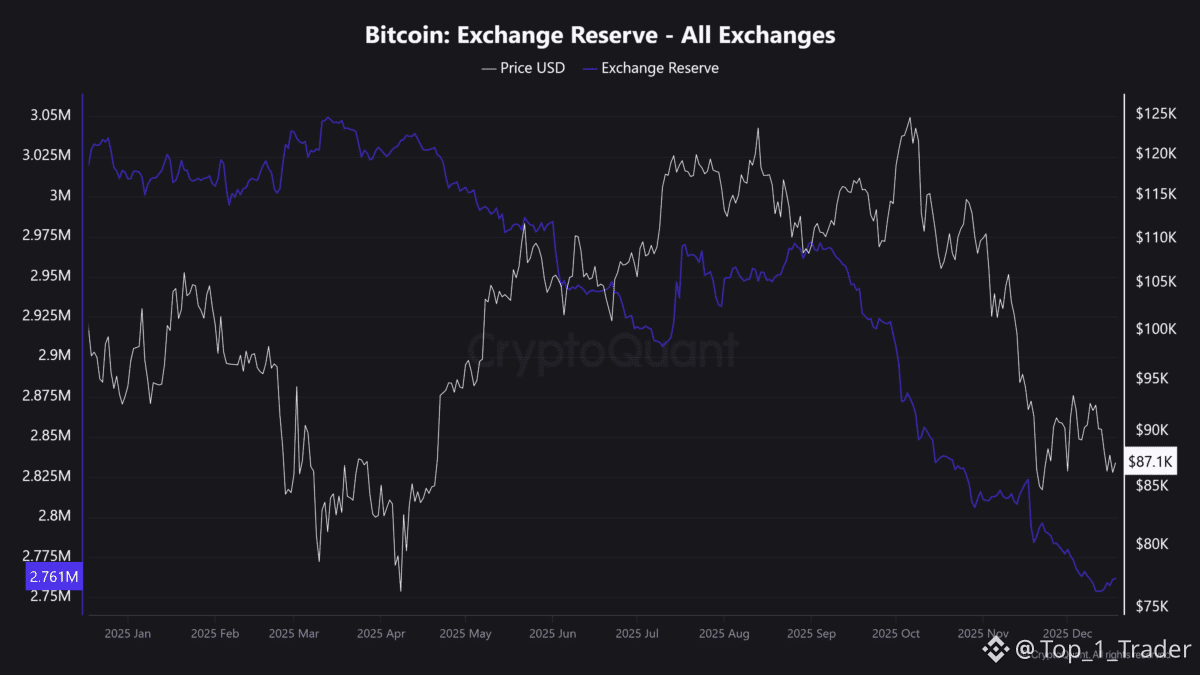
According to on-chain data, exchange reserves have continued to fall, with approximately 140,000 BTC accumulated in Q4 alone.
Lower exchange balances historically:
Reduce sell pressure
Increase supply tightness
Support price stability
Instead of speculative blow-off tops, accumulation appears steady and persistent.
4. Bitcoin Is Maturing as a Macro Asset
Bitcoin is increasingly viewed not just as a speculative asset, but as:
A macro hedge
A digital store of value
A portfolio diversifier
This broader role reduces the probability of 70%+ drawdowns that characterized earlier, hype-driven cycles.
From Boom-Bust to “Supercycle”?
In previous four-year cycles, Bitcoin’s extreme volatility was fueled by narratives and retail euphoria. Massive rallies were followed by devastating crashes.
This cycle tells a different story.
Instead of:
+300% rallies followed by −70% crashes
We are seeing:
Sustained consolidation
Shallower pullbacks
Prolonged bullish structure
Many analysts now argue that Bitcoin may be transitioning into a “supercycle” — a prolonged bullish phase marked by higher lows, slower upside, and fewer catastrophic drawdowns.
In this framework, current weakness doesn’t signal a bear market. Instead, it resembles mid-cycle digestion within a longer-term uptrend.
Final Thoughts
Bitcoin’s traditional four-year boom-and-bust pattern is showing clear signs of evolution.
The 2024 halving did not trigger immediate explosive gains — but it also hasn’t led to panic or collapse. Instead, Bitcoin appears more stable, more institutionalized, and more structurally supported than ever before.
Key takeaways:
The 4-year cycle may be losing predictive power
Institutional inflows and ETFs are reshaping demand
Falling exchange reserves signal long-term accumulation
Volatility is compressing, not disappearing
Bitcoin may be entering a supercycle, not ending one
Rather than asking whether the four-year cycl
e is broken, a better question might be:
Has BTC finally grown beyond it?