
There was a moment when I opened several apps inside Fabric Protocol one after another while the market was deep in the red. My mind was already tired from checking wallets, signing transactions, and reviewing every step carefully. But something interesting happened. I didn’t feel the usual frustration of learning a new interface. My hands already knew what to do.
It wasn’t because the apps had flashy designs. It was because the experience felt familiar.
After spending years moving through different crypto ecosystems, I’ve noticed a common pattern. Many projects talk about user experience, but very few actually build it in a consistent way. One app works one way, the next one uses different terms, different layouts, and by the time you reach the final confirmation step, you’re not completely sure what’s happening anymore. That kind of fragmentation slowly drains the user.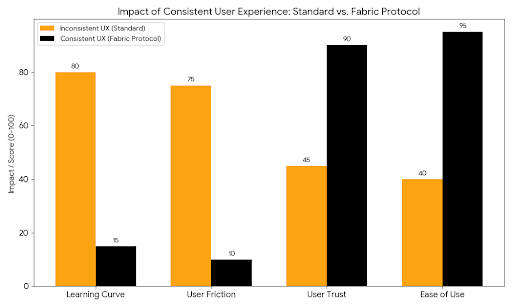
What caught my attention with Fabric Protocol is its focus on standardizing UX across the ecosystem.
This doesn’t mean every app looks the same. That would make things boring and restrictive. Instead, it means the logic of how things work stays consistent. Once you understand how to navigate one app, how system states are shown, or how feedback appears, you can move into another app without feeling lost. Your brain doesn’t have to start from zero every time.
Some people might think this is a small detail. I think it’s the opposite.
Most products don’t fail because of one huge mistake. They fail because of hundreds of tiny friction points that slowly build up. A confusing button placement. A term that changes without reason. A transaction step that makes the user hesitate for a few seconds. These things quietly drain mental energy.
Ironically, builders often spend months adding new features while overlooking how exhausting the product has become for the user.
If Fabric Protocol can truly maintain shared UX standards across its ecosystem, it’s addressing the real problem: reducing the cognitive load for users, not just polishing the surface.
Of course, this approach comes with its own challenge. If you standardize too much, every app can start to feel identical and lose its personality. Each product in an ecosystem has its own role, so it needs space to express that. The real difficulty is creating an experience that feels familiar while still allowing every app to serve its unique purpose.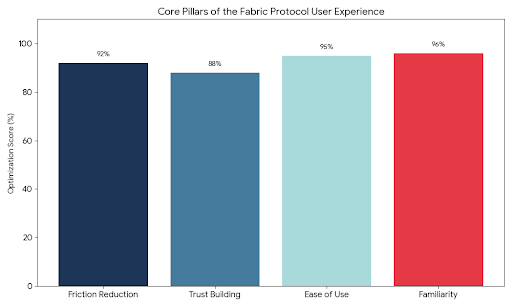
From an investor’s perspective, I appreciate this kind of thinking because it reflects maturity. Teams chasing attention usually focus on loud narratives and quick hype. But teams that have been through multiple cycles understand that long-term success often comes from solving quieter problems.
Most users don’t leave because they hate the product.
They leave because they feel tired.
Because every new app requires learning something again.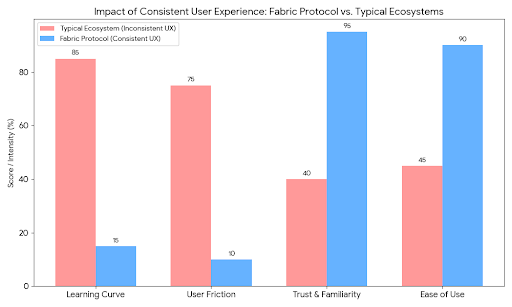
Because they constantly worry about clicking the wrong thing.
From a builder’s perspective, shared UX across Fabric Protocol apps creates something deeper. It becomes a kind of soft infrastructure for the ecosystem. Not infrastructure measured in TPS or smart contracts, but in familiarity. When users return and everything still feels clear and predictable, they feel like they’re still inside the same world.
And that kind of cohesion is extremely difficult for competitors to copy.
In the end, a strong ecosystem isn’t defined only by technology or the number of apps it has. It’s defined by how consistently it treats users across thousands of small interactions.
If Fabric Protocol continues down this path, its real value may not come from big promises. It will come from something much quieter — the habit of users returning day after day because the experience simply feels easy and familiar.
And in a market where users are usually forced to adapt on their own, it’s worth asking:
#ROBO @Fabric Foundation $ROBO
