

I started paying attention to Midnight Network because it feels different from many other projects in the blockchain space. In a market where countless platforms repeat similar narratives about scalability, speed, or decentralization, Midnight seems focused on solving a very specific and very real problem inside Web3. That problem is privacy, but not in the simple sense of hiding everything. Instead, it is about creating a system where information can stay protected while still allowing people to prove what matters.
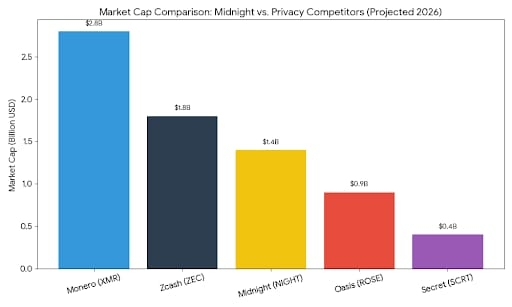
When I look at the current blockchain landscape, I see a clear tension between transparency and privacy. Most public blockchains were designed around the idea that everything should be visible. That design made sense in the early days of crypto because transparency helped create trust. Anyone could verify transactions, audit smart contracts, and confirm that the network was operating honestly. But as blockchain technology started moving toward more serious applications, that level of exposure began to create limitations.
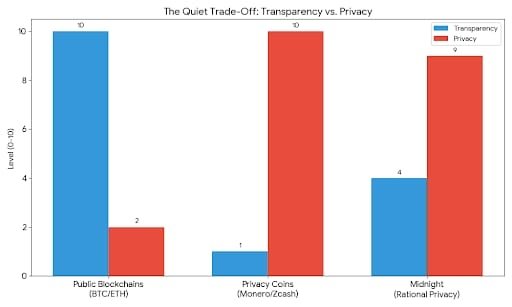
Not every type of data belongs on a fully public ledger. Personal identity details, private business logic, financial agreements, and sensitive transactions cannot always exist in an environment where every piece of information is visible to everyone. At the same time, systems that hide everything completely can create their own problems. If nothing can be verified publicly, it becomes harder to build trust in the network. This is the gap where I think Midnight becomes interesting.
The core technology that makes Midnight possible is based on Zero-Knowledge Proofs. This concept changes the way verification works inside a blockchain system. Instead of forcing users to reveal all underlying information, zero-knowledge proofs allow someone to prove that something is true without exposing the data behind it. When I first started exploring this idea, I realized how powerful it could be for blockchain infrastructure.
In simple terms, it means a user could prove that a transaction follows the rules of the network, that a contract condition has been met, or that a piece of information is valid, without revealing the sensitive details involved. That changes the entire relationship between privacy and trust. Instead of trust coming from full transparency, trust can come from mathematical proof.
What makes Midnight stand out to me is that it treats privacy as a functional tool rather than a marketing feature. Many crypto projects talk about privacy as if it is simply a shield that blocks outsiders from seeing data. Midnight approaches it differently. It seems to treat privacy as something that can be applied strategically, depending on the situation. Some information can remain confidential while other elements of the system remain verifiable.
This design philosophy feels much more practical for the future of Web3. I believe the next phase of blockchain adoption will involve far more complex use cases than simple token transfers or public smart contracts. Industries like finance, healthcare, supply chains, digital identity, and enterprise infrastructure all deal with information that cannot be completely public. If blockchain is going to support those environments, it needs to evolve beyond the transparency-first model.
That is why I see Midnight as part of a broader shift happening in Web3. The early generation of blockchains proved that decentralized systems could work. The next generation needs to prove that decentralized systems can handle real-world data responsibly. Privacy is a huge part of that challenge, and Midnight appears to be building infrastructure designed specifically for that reality.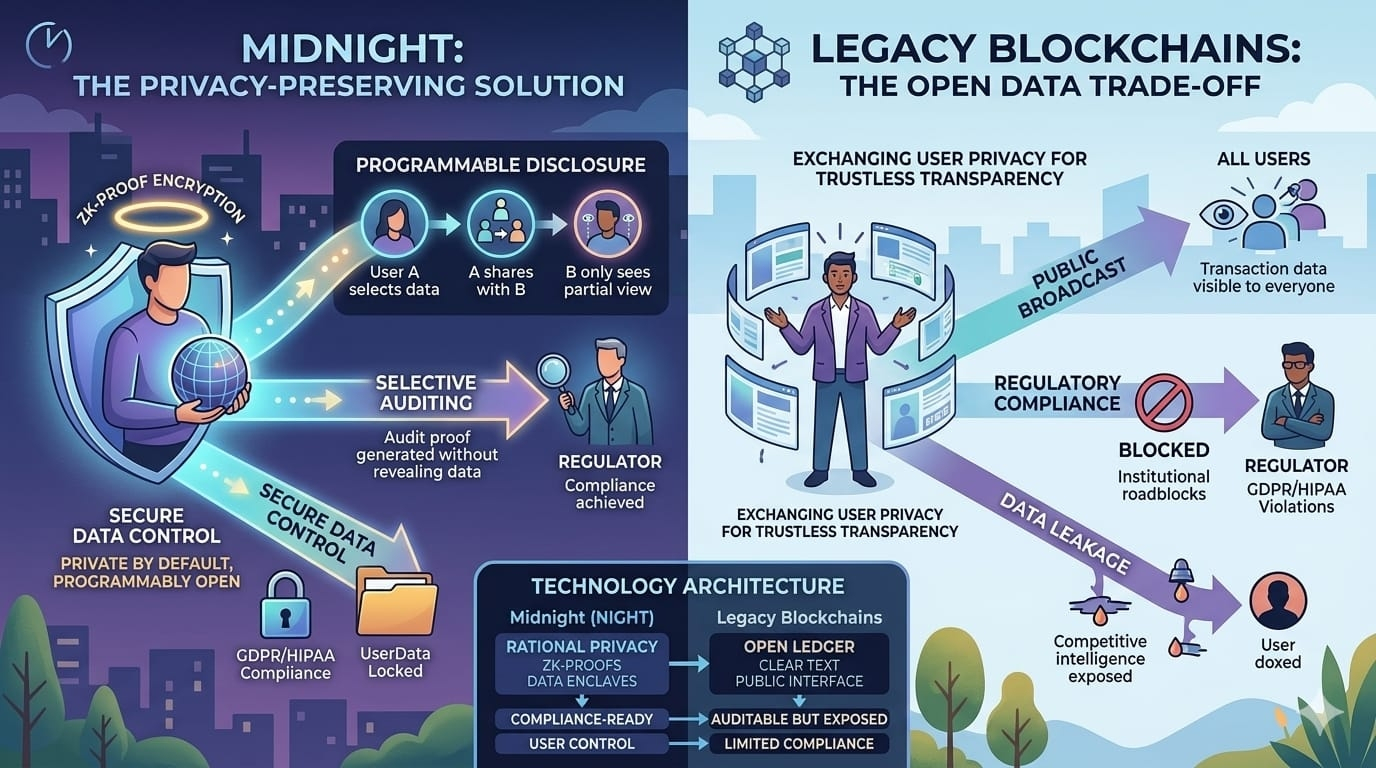
Another aspect that caught my attention is how the project structures its network economy. Instead of relying on a single token to represent every function within the ecosystem, Midnight separates certain roles within the network. This creates a clearer distinction between the token that represents value and the resources used to power private execution on the network. From my perspective, this kind of design suggests that the team is thinking carefully about how the system should function over the long term.
Too many blockchain projects focus heavily on short-term speculation rather than long-term architecture. When I study Midnight, it gives the impression of a network designed around utility first. That does not mean the token has no role in the ecosystem, but it suggests that the underlying goal is to create a functional platform rather than just another asset driven purely by hype cycles.
I also find it interesting that the project seems focused on attracting builders rather than just attention. In blockchain ecosystems, real value usually comes from development activity. A network becomes meaningful when developers start creating applications, experimenting with new tools, and building systems that other people want to use. Midnight appears to understand that the real strength of a blockchain comes from the community that builds on top of it.
When I strip away the technical language surrounding the project, the core idea behind Midnight actually becomes very easy to understand. People want control over their digital information. They want the ability to use online systems without exposing every detail of their identity or activity. At the same time, they still want the benefits that blockchain provides, such as verifiable ownership, transparent rules, and decentralized infrastructure.
Midnight sits directly at that intersection. It attempts to create a blockchain environment where confidentiality is not an afterthought but a fundamental part of the network design. That distinction matters because many existing systems attempt to add privacy later as an additional layer. Midnight seems to be building privacy directly into the foundation of the network itself.
Of course, strong ideas alone are never enough in the crypto industry. I have seen many projects with impressive concepts fail to translate those ideas into functioning ecosystems. Execution is always the real test. For Midnight, the next phase will depend on whether developers adopt the platform, whether applications begin to appear, and whether users actually find value in the privacy-focused infrastructure it provides.
Still, I think there are good reasons why the project continues to attract attention. Its narrative feels grounded in a real need rather than a temporary trend. Blockchain technology cannot rely on full exposure forever. As the industry matures, systems will need to protect certain types of information while still preserving trust and verification.
#night $NIGHT @MidnightNetwork
