You learn pretty quickly in this market that crypto often looks its strongest right before the floor falls out. You’ve watched tokens light up your feed, boasting massive volume and vibrant charts, with everyone repeating the same metrics as if numbers alone prove staying power. But a few weeks later, the excitement remains visible while the actual user stickiness vanishes. That kind of cycle changes how you read new projects. Now, when a narrative trends, you ask a much harder question: once the initial rush of attention fades, what is left that people truly need, use, and pay for?
This is exactly why Fabric Protocol’s pitch—Pioneering Governance for General-Purpose Robots—warrants a closer look. The underlying premise isn't just the tired narrative that "robots are the future." It’s the realization that a decentralized robot network requires rigid rules, financial incentives, and public accountability before it can be trusted in the real world.
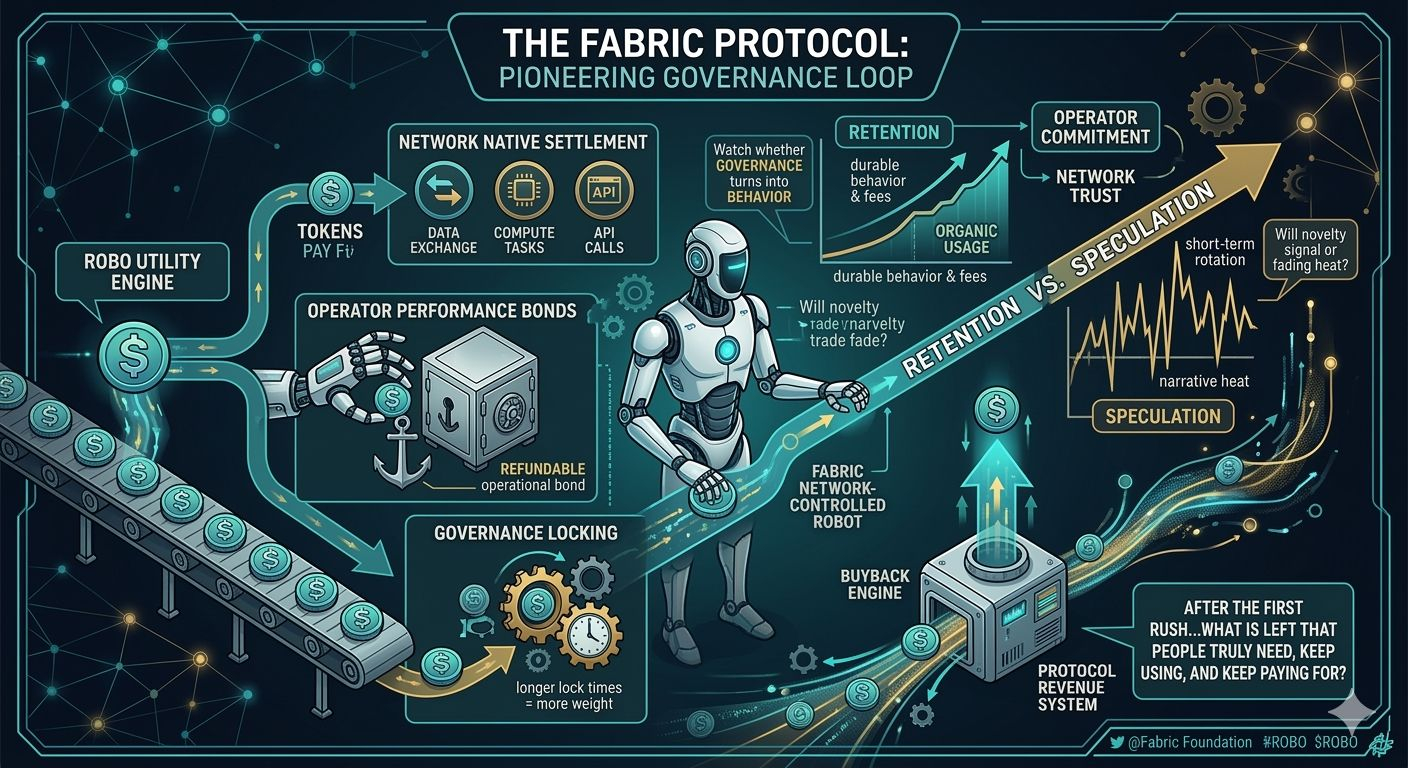
Fabric positions itself as an open network where data, computation, and oversight are coordinated through public ledgers. Crucially, it frames the token not as a pseudo-equity claim, but as a pure utility engine for on-network fees and operational bonds. They are treating governance as a complex system design problem, not just a marketing sticker slapped onto a token.
The Mechanics of Durable Demand
For anyone analyzing the market, the practical test is whether this governance design actually translates into durable economic behavior.
Fabric requires robot operators to post refundable performance bonds in the native token just to register hardware and provide services. The protocol also enforces native settlement across data exchanges, compute tasks, and API calls. Add in a time-weighted governance locking mechanism—where longer locks equal more weight—and a proposed system where protocol revenue drives token buybacks, and you see the blueprint. In plain English: the architecture is attempting to manufacture demand through actual network capacity and operator accountability, rather than relying entirely on speculative trading.
The Reality Check: The Cold Start Problem
But here is where you have to be careful. You have to look for the retention problem.
Fabric's own whitepaper is intellectually honest enough to acknowledge the "cold start" dilemma. Early in the network's life, organic revenue will be sparse. Initial rewards will have to blend activity subsidies with actual revenue before making the hard pivot to a fully sustainable model as the network matures. That tells you something vital: right now, the architecture is running ahead of the proof. Anyone can write a whitepaper detailing how retention should work. Very few can showcase a long enough history of repeated, organic usage to prove that it does.
Market Traction vs. Real Adoption
The market is clearly paying attention. With a circulating supply of roughly 2.23 billion out of a 10 billion max, a market cap hovering in the low $90 million range, and daily volume hitting the mid $40 millions, there is meaningful traction here for a recently launched token.
But remember, launch attention is not retention. Trading volume can signal genuine interest, or it can just be short-term rotation and narrative heat that evaporates when the next shiny object appears. The risks are obvious to anyone paying attention:
Governance might remain highly concentrated early on.
Real-world robot demand could lag years behind token market expectations.
Fee-based utility could stay purely theoretical.
Regulatory friction across different jurisdictions could throttle growth.
So, what actually changes your mind? You want to see repeated usage. You want hard evidence that operators are actually bonding tokens, that users are paying for real services, and that demand holds steady after the novelty trade dies down.
If you are looking at this ecosystem, don't stop at the chart, and don't get blinded by the sci-fi robot story. Watch whether the governance turns into behavior, whether that behavior generates fees, and whether those fees drive retention. That is where serious conviction begins, and it is exactly where weak narratives usually break.
@Fabric Foundation #ROBO $ROBO