
Most conversations about the future of crypto tend to circle around finance. Trading. Payments. Stablecoins. Yield strategies. For more than a decade the industry has focused on how value moves across digital networks. Yet every once in a while a different idea appears in the background. Something less about markets and more about coordination between systems.
Lately I have been noticing more discussion about what people call the robot economy. At first the phrase sounded like distant science fiction. The kind of concept people mention when talking about AI and automation. But the more I thought about it the more the idea started to feel logical. If machines are going to operate independently in the physical world they will need systems that allow them to interact with other machines and with infrastructure around them.
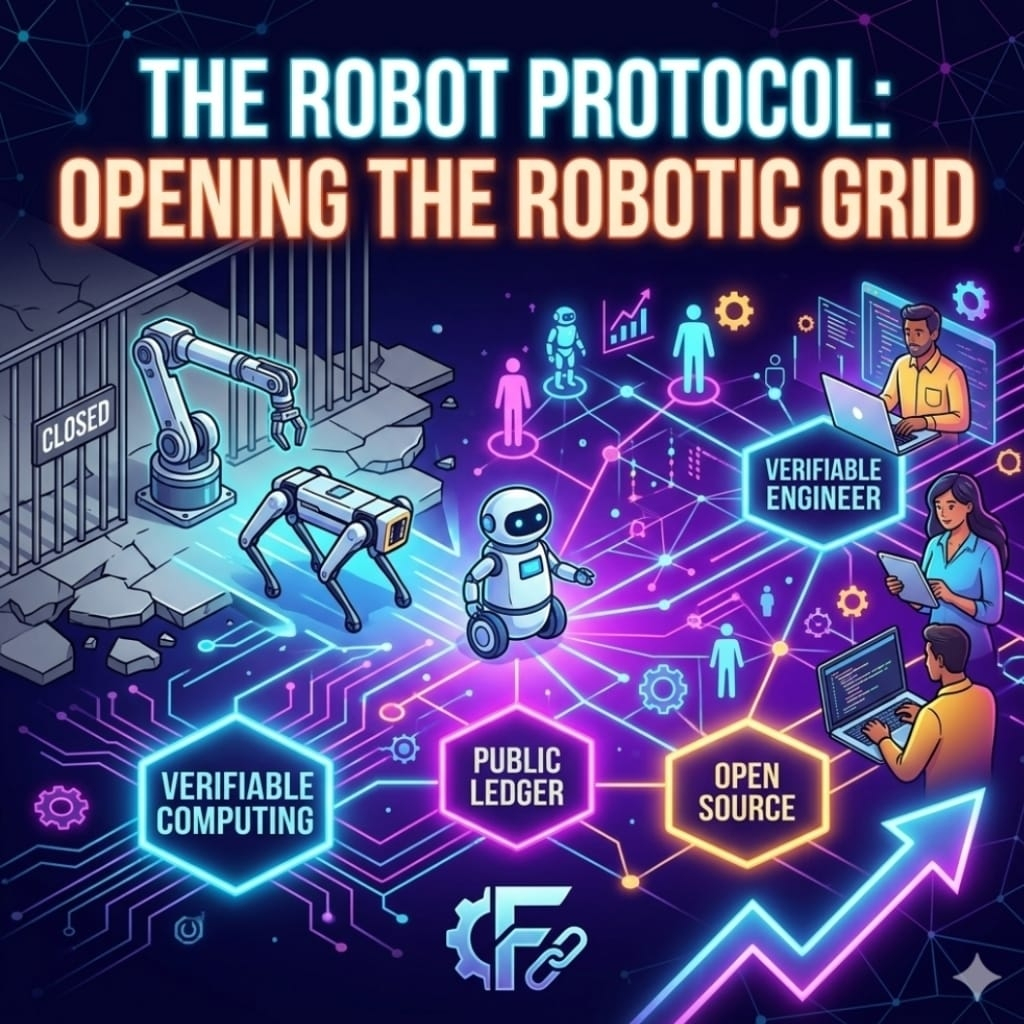
That is where projects like Fabric Foundation enter the picture. The concept seems less focused on financial speculation and more focused on building digital infrastructure. Infrastructure that could allow autonomous machines to operate within decentralized networks rather than isolated platforms. When I first looked into it what stood out to me was not hype but the shift in perspective.
Right now machines are everywhere. Warehouses rely on robotic systems to move goods. Drones inspect bridges and pipelines. Autonomous vehicles are being tested across multiple cities. Yet almost all of these machines exist inside closed systems run by specific companies. They perform tasks but they do not really interact with broader open networks.
I noticed that this limitation becomes obvious once you imagine machines operating at scale. A delivery robot moving through a city might need access to charging stations. Navigation data. Maintenance services. Security verification. Today those services would likely be controlled by different centralized systems.
A decentralized infrastructure layer could allow machines to interact with shared protocols instead of isolated platforms. In that kind of environment machines could verify identity. Request services. Exchange value. All without depending on one central authority.
Blockchain networks start to make sense in this context. Machines do not need trust in the human sense. But they do require reliable methods to verify identity and confirm transactions. Distributed networks can provide those functions through rules and cryptography rather than centralized control.
One part that really caught my attention is machine identity. Humans already manage digital identities across many platforms. Machines will eventually need something similar. A robot operating in public space would need credentials permissions and verifiable records of activity.
Without that kind of system large scale automation becomes difficult. Machines would struggle to interact safely with infrastructure around them. Digital identity layers could help solve that problem by allowing machines to prove who or what they are inside a network.
Another interesting piece involves payments. Machines performing tasks might need to pay for electricity. Data access. Cloud services. Maintenance. Traditional payment systems were never designed for constant machine to machine transactions.
Crypto networks however were built for digital value exchange. From what I have seen they can support small automated transactions without heavy overhead. That makes them surprisingly compatible with autonomous systems.
Something else that stands out to me is data. Machines collect enormous amounts of information about the physical world. Sensors measure traffic patterns. Weather conditions. Infrastructure stress. Environmental changes.
If that data remains trapped inside private systems its usefulness stays limited. But if networks allow machines to share and verify information across decentralized platforms the potential becomes much larger. Entire data economies could emerge around machine generated insights.
Of course it is important to stay realistic. Most autonomous systems today are still tightly controlled by companies. Fully open machine networks are not going to appear overnight. Infrastructure takes time to mature.
Still the direction feels interesting. AI gives machines the ability to make decisions. Robotics allows them to act in the physical world. What remains missing is large scale coordination between machines operating independently.
This is where the concept of a robot economy starts to make more sense. Machines could eventually negotiate access to services. Purchase resources. Share useful data. All within decentralized environments that follow transparent rules.
One thing I keep thinking about is how crypto originally solved a coordination problem between strangers. People who did not know each other could still exchange value through shared protocols. Machines might actually be perfect participants in systems like that because they follow rules exactly as written.
Fabric Foundation seems to approach the challenge from the infrastructure level rather than the application level. Instead of building a flashy product the focus appears to be on creating the rails that autonomous systems could rely on later.
That approach feels quiet but realistic. Most technological shifts do not happen through sudden breakthroughs. They happen through layers of infrastructure forming gradually beneath the surface.
When I step back and think about it the idea is strangely fascinating. The future of decentralized networks might not only involve humans interacting with digital assets. It could involve machines interacting with each other as economic participants.
Whether the robot economy develops exactly this way is impossible to know. Technology often moves in directions nobody expects. But the possibility itself changes how I think about blockchain infrastructure.
Maybe the long term role of these networks is not only about finance. Maybe they become coordination layers for a world where humans machines and digital systems all participate in shared networks. And when I think about that possibility the space suddenly feels much bigger than markets alone.