Midnight is one of the few projects you haven’t dismissed after the first pass, and that alone says more than any pitch deck ever could.
You’ve watched this market recycle the same ideas for years. New wrapper, new branding, same old noise underneath. Privacy gets dragged out every cycle, usually either as rigid ideology or cheap decoration. One side wants everything hidden and calls that purity. The other wants everything exposed and calls that trust. Most of it falls apart the second real-world friction shows up.
Midnight at least seems to understand where the actual grind is.
You aren't looking at it as some clean answer to an old problem. You are looking at it as an attempt to work inside a mess that crypto still hasn’t solved. How do you keep sensitive data protected without making the whole system unusable? How do you let something be verified without turning every interaction into a public spectacle? That tension is real. It always has been. Most projects just pretend it isn’t.
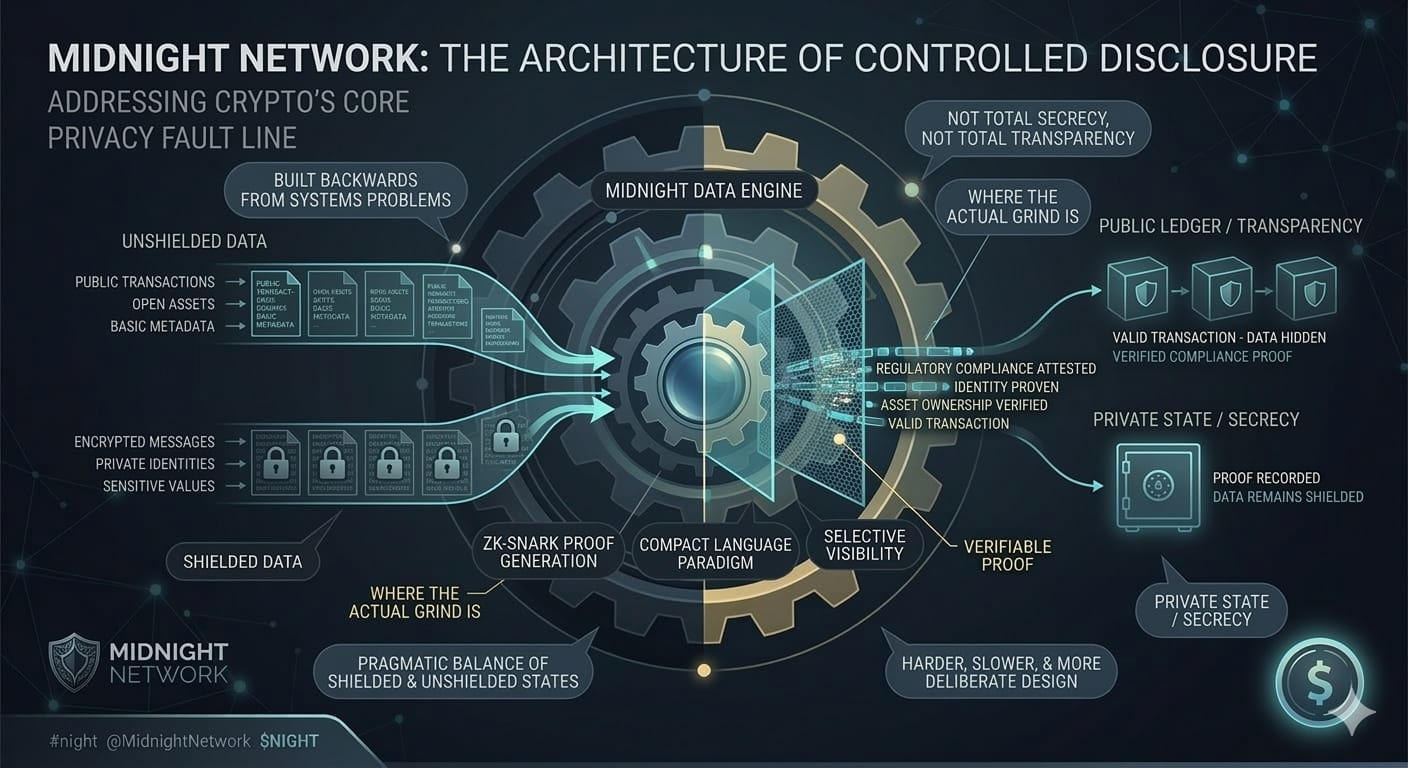
That’s what keeps pulling you back here. Midnight doesn’t feel like it was built by people trying to win the loudest week on the timeline. It feels narrower than that. More deliberate. Maybe more stubborn, too. By leveraging Zero-Knowledge (ZK) cryptography to create a dual-state architecture—where shielded and unshielded data exist side-by-side—the whole thing seems centered on controlled disclosure. Not total secrecy, not total transparency, just enough visibility to prove what matters (like regulatory compliance or identity) without throwing the underlying data wide open.
That’s a harder design problem than the market likes to admit. And honestly, harder usually means slower.
The market hates slow. It wants stories it can price in a weekend. Midnight is not that kind of story. It doesn’t hand you an easy line to repeat. Because it relies on a novel programming language called Compact to simplify ZK smart contracts, developers actually have to learn a new paradigm. You have to sit with it for a while, and most people won’t. They’ll skim it, flatten it into another generic privacy narrative, and move on to whatever has more velocity.
You get why. You are tired too.
After enough cycles, you develop a reflex for these things. You start asking where the compromise is hiding, where the weak point is, where the nice theory is going to hit a wall. With Midnight, you keep looking for the moment the structure starts to wobble. You are still looking. That doesn’t mean it won’t happen. It usually does. Novel programming languages face massive friction. Tooling breaks. Adoption stalls. Builders lose patience trying to balance public and private states. The market punishes anything that requires thought. You’ve seen that movie too many times.
Still, there’s something here that feels more serious than the usual crypto assembly line.
A lot of projects are built backwards. First, they imagine the asset. Then the narrative. Then they spend months trying to make the utility sound natural. Midnight doesn’t read that way to you. Coming out of the research-heavy culture of Input Output Global (IOG), it feels like the project started with an actual systems problem—bridging Web3 with traditional data protection laws—and only later built the network around it. That doesn’t make it special. It just makes it harder to throw into the same pile as the usual cycle clutter.
And you think that matters.
Because the real test is never whether a project sounds smart in isolation. Plenty of dead projects sounded smart. Some of them sounded brilliant right up until nobody used them. You aren't interested in whether Midnight’s ZK-Snarks can be explained well in a whitepaper. You are interested in whether it can hold up once people actually try to build with it, stress it, work around its execution environments, and complain about it. You want to see what happens when the abstraction wears off.
That’s where the truth usually shows up. In the friction. In the boring parts. In the places where nobody is clapping.
Midnight feels like a project that knows what it is trying to solve. You can’t say that about most of the market anymore. Most of the market is still running on recycled confidence and short memory. This one feels more focused than confident. More aware of the trade-offs. Less interested in performing certainty. You respect that, even if you don’t fully trust it yet.
Maybe that’s why it sticks with you. Not because you think it’s guaranteed to work. You don’t think that about anything anymore. But because beneath all the usual noise, this one seems to be pushing at a real fault line in crypto instead of just dressing one up.
#night @MidnightNetwork $NIGHT