
The blockchain industry has experimented with many different token models over the years. However, one of the most interesting designs emerging recently is the dual-asset model introduced by Midnight.
Instead of relying on a single token for everything, Midnight introduces a two-layer economic system built around Night and DUST.
This structure aims to solve one of the biggest challenges in blockchain ecosystems: how to maintain sustainable network activity without creating excessive fee pressure on users.
The Core of the Midnight Economy
At the heart of Midnight’s design is $NIGHT, the network’s native utility token.
Rather than simply acting as a payment token, $NIGHT plays a deeper role in the ecosystem. It supports:
• Network participation
• Incentive alignment
• Ecosystem sustainability
• Long-term network growth
But what makes Midnight unique is how $NIGHT interacts with DUST.
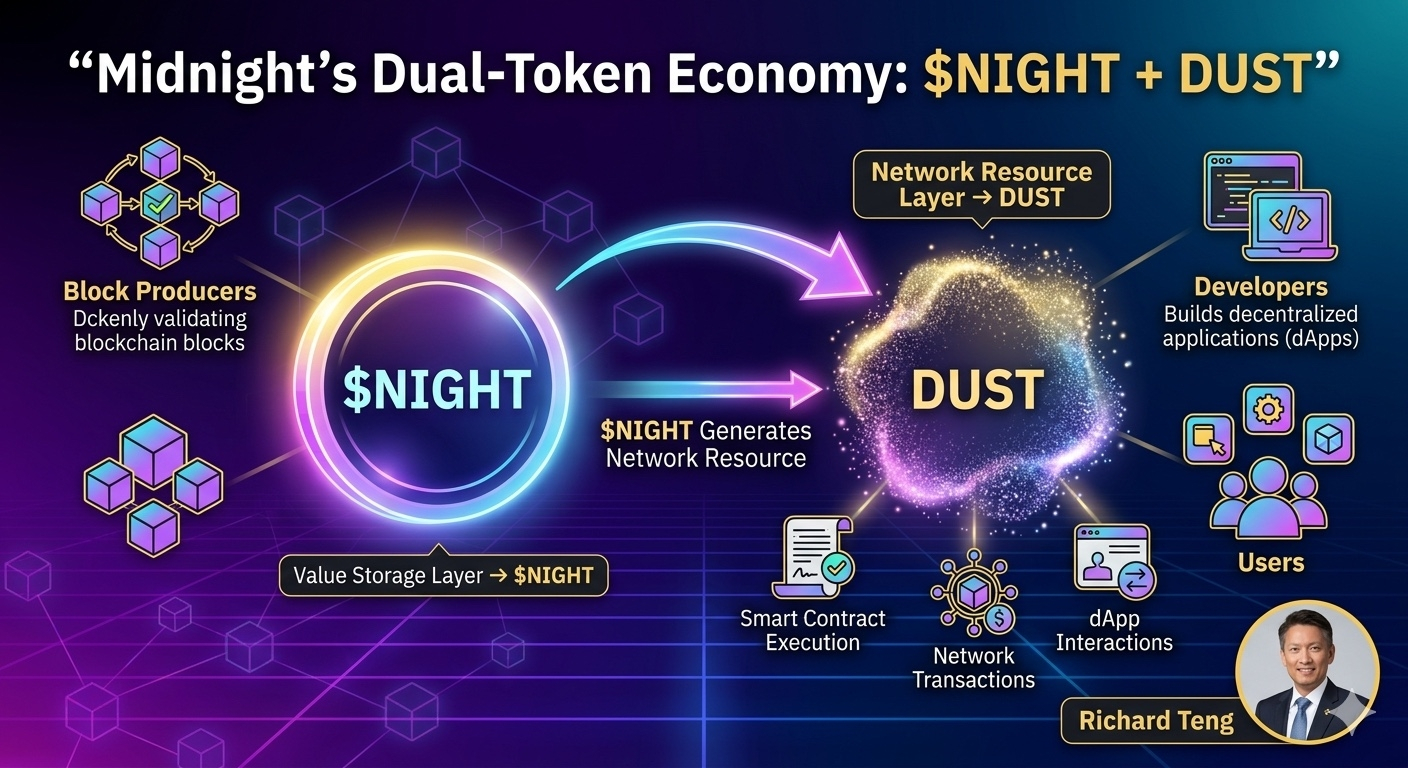
Instead of directly paying fees using the main token, the network introduces a mechanism where:
night generates DUST, and DUST is used to power transactions.
This model is called a token-generates-resource system.
Why This Model Is Interesting
Many blockchains struggle with a problem: when network activity increases, transaction fees often become extremely expensive.
This makes it harder for developers to build applications and discourages everyday users from interacting with the network.
Midnight’s model attempts to solve this issue by separating value storage from network resource consumption.
In simple terms:
• $NIGHT stores ecosystem value
• DUST powers network operations
This separation can create a more balanced economic structure where the network remains efficient while still maintaining strong token value.
Incentives That Strengthen the Network
A successful blockchain ecosystem requires the participation of multiple groups.
These include:
• Block producers who validate transactions
• Developers who build decentralized applications
• Users who interact with the ecosystem
Midnight’s tokenomics is designed to encourage participation from all three groups.
Through carefully structured incentives, the system aims to reward those who contribute to:
• Network security
• Transaction processing
• Ecosystem development
This cooperative incentive design is intended to support long-term ecosystem stability rather than short-term speculation.
The Vision for a Multi-Chain Future
Another important aspect of Midnight’s strategy is multi-chain compatibility.
Instead of operating in isolation, Midnight aims to become part of a broader blockchain infrastructure where different networks can interact and share value.
This could open the door for:
• Cross-chain decentralized applications
• Interoperable smart contract ecosystems
• Expanded liquidity across networks
As the blockchain industry moves toward a multi-chain world, infrastructure projects that enable secure interaction between networks may become increasingly valuable.
Why Developers and Users Should Pay Attention
The long-term success of blockchain technology depends on more than just speed or scalability.
It also requires sustainable economic design
Projects that create balanced incentive structures often become the most resilient ecosystems over time.
Midnight’s approach — combining a dual-asset token model, cooperative incentives, and multi-chain vision — suggests that the project is aiming to build infrastructure for the next generation of decentralized applications.
For developers interested in privacy-focused smart contracts and for users exploring new blockchain ecosystems, Midnight represents a fascinating experiment in next-generation tokenomics.
As Web3 continues to evolve, models like night generating DUST could become an important blueprint for sustainable blockchain economies