When you look at the tech space right now, it’s undeniably messy. Every week, a new project pops up claiming to revolutionize AI, robotics, or crypto. Half of them vanish in six months, and the other half survive on vague marketing threads until the hype eventually dies out.
But when you dive into Fabric Protocol, it feels a little different. It isn’t promising a miracle, but it is tackling a massive, real-world problem that most people are ignoring.
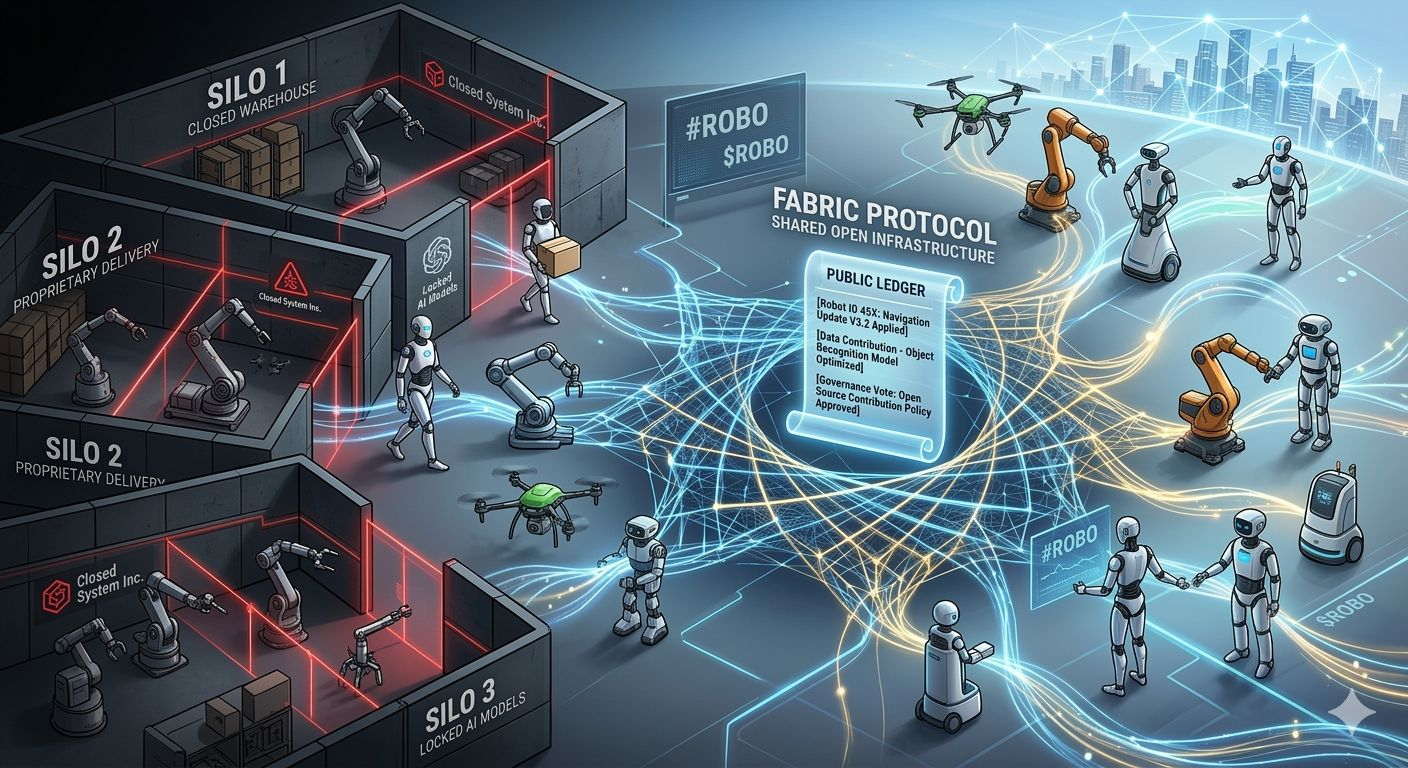
The core issue is actually very simple to understand: robotics right now are stuck behind corporate walls. One company builds warehouse machines, another handles delivery bots, and a third trains AI models. None of them share data. Everything—software, updates, learning models—is locked up in private, isolated silos.
Imagine if the internet worked like that. Imagine if Google and Amazon had completely separate internets that never connected. It would be total chaos, and it would slow global progress to a crawl. That’s exactly what the robotics industry looks like today.
Fabric Protocol is attempting to build a shared, public ecosystem where robots, developers, and AI agents can actively interact. It creates a space where data gets recorded, updates are tracked, and contributions are visible across the board. Instead of one mega-corporation owning the entire stack, it functions as an open infrastructure layer.
Think about the implications. If a developer halfway across the world figures out a better way for a robot to navigate a crowded hospital, that upgrade could theoretically spread across the open network instead of being hoarded by a single corporate product line. Faster progress, powered by collective intelligence.
It sounds brilliant on paper. But when you look deeper, adoption is the real hurdle.
Big companies love control because control equals profit. They have zero incentive to share their proprietary data with random developers on a public network. Breaking that corporate stronghold and convincing them to plug into an open system is going to be incredibly difficult.
Then you have to consider the actual mechanics. Fabric Protocol is trying to connect three massive pillars: data, computing power, and governance rules. All of it is recorded on a "public ledger for robots."
While putting robots on a public ledger sounds weird at first glance, the logic is incredibly sound. If autonomous machines are going to operate in warehouses, streets, and hospitals alongside humans, you need a transparent way to verify their updates and behaviors. You need to know exactly what they are doing and why they are doing it, without having to blindly trust a giant tech monopoly. Transparency isn't just a buzzword here; it's a safety requirement.
What makes this project stand out in the current market is its structure. Instead of being driven by venture capitalists looking for a quick exit liquidity event, it’s backed by a non-profit foundation. That doesn't guarantee success by any means, but it fundamentally shifts the incentives away from short-term cash grabs and toward actual, long-term infrastructure building.
Still, the risks are glaring. Building global infrastructure for robotics isn't a weekend hackathon. It takes years, maybe a decade. And if you know the crypto and tech markets, you know they are notoriously impatient. If people don't see massive progress quickly, they jump ship to the next shiny AI or "agent" token.
Network effects take a long time to build. Developers need rock-solid incentives to build on it, and companies need undeniable reasons to participate. Without that momentum, the network just sits empty.
But if you zoom out and look at the future, having thousands of disconnected, siloed robot systems running around the world is a logistical nightmare. No coordination, no transparency, just companies doing whatever they want.
Fabric Protocol is at least trying to solve that nightmare before it fully materializes.
Is it perfect? Definitely not. Is there some hype? Always. But compared to the absolute circus of useless tokens pretending to be AI right now, it actually feels like a practical attempt to build something necessary.
@Fabric Foundation #ROBO $ROBO