In the rapidly evolving world of artificial intelligence, one of the greatest challenges is not the power of AI—but its reliability. As AI systems become more integrated into decision-making, automation, and critical infrastructure, the consequences of errors become increasingly significant. Modern AI models, despite their impressive capabilities, are still vulnerable to problems such as hallucinations, misinformation, and bias. These weaknesses create a gap between what AI can generate and what humans can confidently trust.
This is where Mira Network introduces a transformative vision.
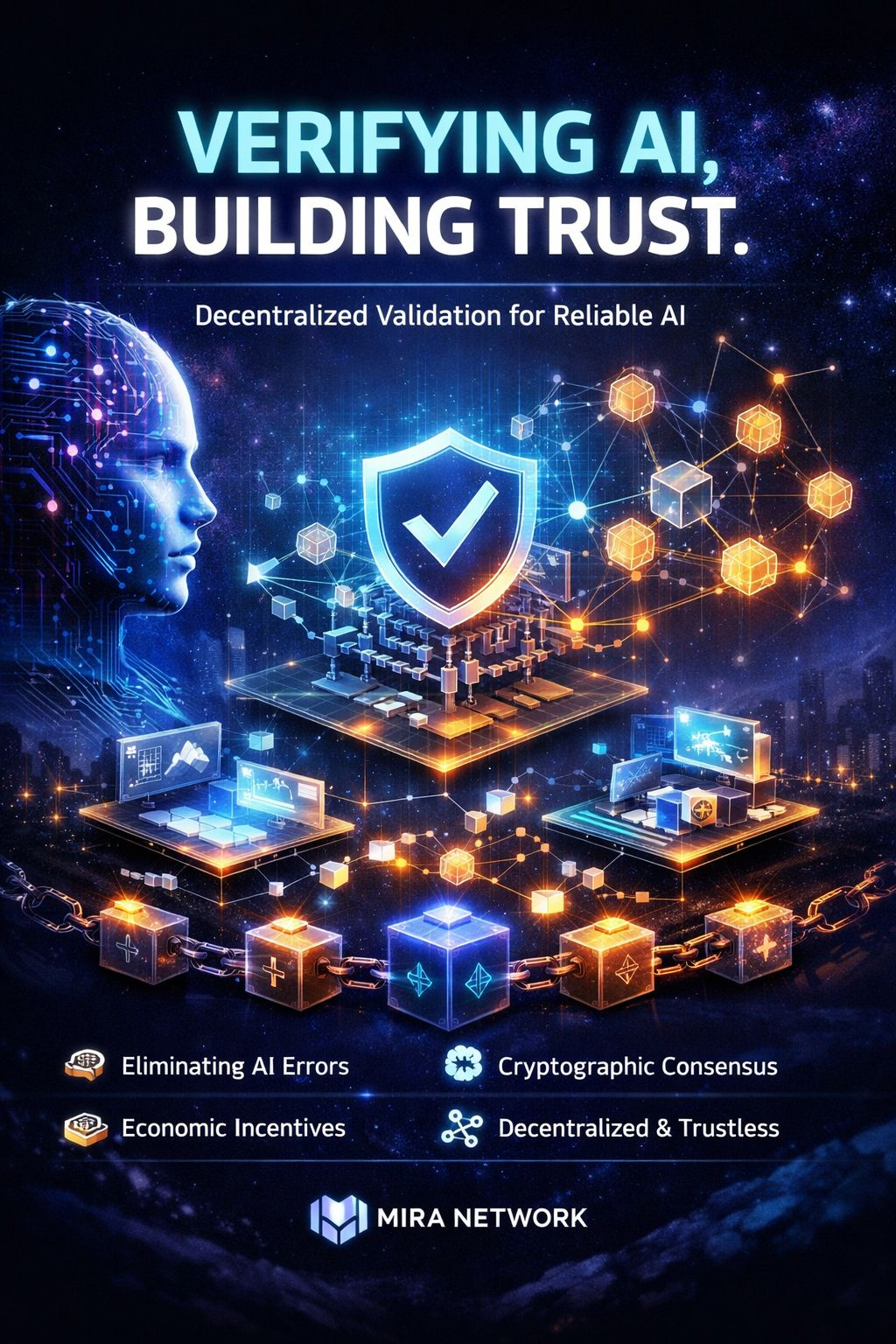
Mira Network is designed as a decentralized verification protocol that redefines how artificial intelligence outputs are validated. Instead of relying on a single model or centralized authority to determine accuracy, Mira distributes the process of verification across a network of independent AI systems. This approach introduces a new layer of accountability, transparency, and trust into the AI ecosystem.
At the heart of Mira Network lies a powerful idea: AI results should not simply be accepted—they should be verified.
When an AI produces an output, Mira Network breaks the information into smaller, verifiable claims. Each claim is then analyzed and validated by multiple independent AI models operating within the network. Rather than trusting one system blindly, the network evaluates the collective agreement between models. This multi-model validation dramatically reduces the risk of hallucinations and biased responses that often occur when relying on a single AI source.
To ensure the integrity of this process, Mira integrates blockchain technology. The verified results are recorded through cryptographic consensus, creating a transparent and tamper-resistant record of validation. This means that once information is confirmed, it becomes part of a trusted and auditable system where manipulation is extremely difficult.
But Mira Network does more than simply verify information—it introduces an economic framework that incentivizes honesty and accuracy. Participants in the network are rewarded for contributing reliable verification, while dishonest or inaccurate behavior is discouraged through economic mechanisms. This system transforms trust from a centralized authority into a decentralized, incentive-driven process.
The impact of such a model is profound.
In sectors where accuracy is critical—finance, healthcare, governance, research, and autonomous systems—the ability to verify AI outputs could redefine how technology is used. Instead of questioning whether an AI result is reliable, organizations can depend on a system where validation is embedded directly into the process.
By transforming AI outputs into cryptographically verified information, Mira Network bridges the trust gap between artificial intelligence and real-world decision making. It moves AI from a system of probabilistic responses to one supported by transparent, verifiable consensus.
This shift represents a new paradigm for artificial intelligence. Rather than building bigger and more powerful models alone, the future may depend on networks that ensure those models are accountable, verifiable, and trustworthy.
Mira Network stands at the center of this transformation—building the infrastructure where AI is not only intelligent, but provably reliable.