
I had a Mira queue open long enough to watch a label do more work than the claim itself.
2 claims from the same workflow came in. One cleared in 4 minutes. The other sat for 47. Same product surface. Same action family. Same downstream consequence if it went wrong. The only clean difference on the screen was low risk.
That was where the wording changed for me. This was not metadata anymore. It was dispatch.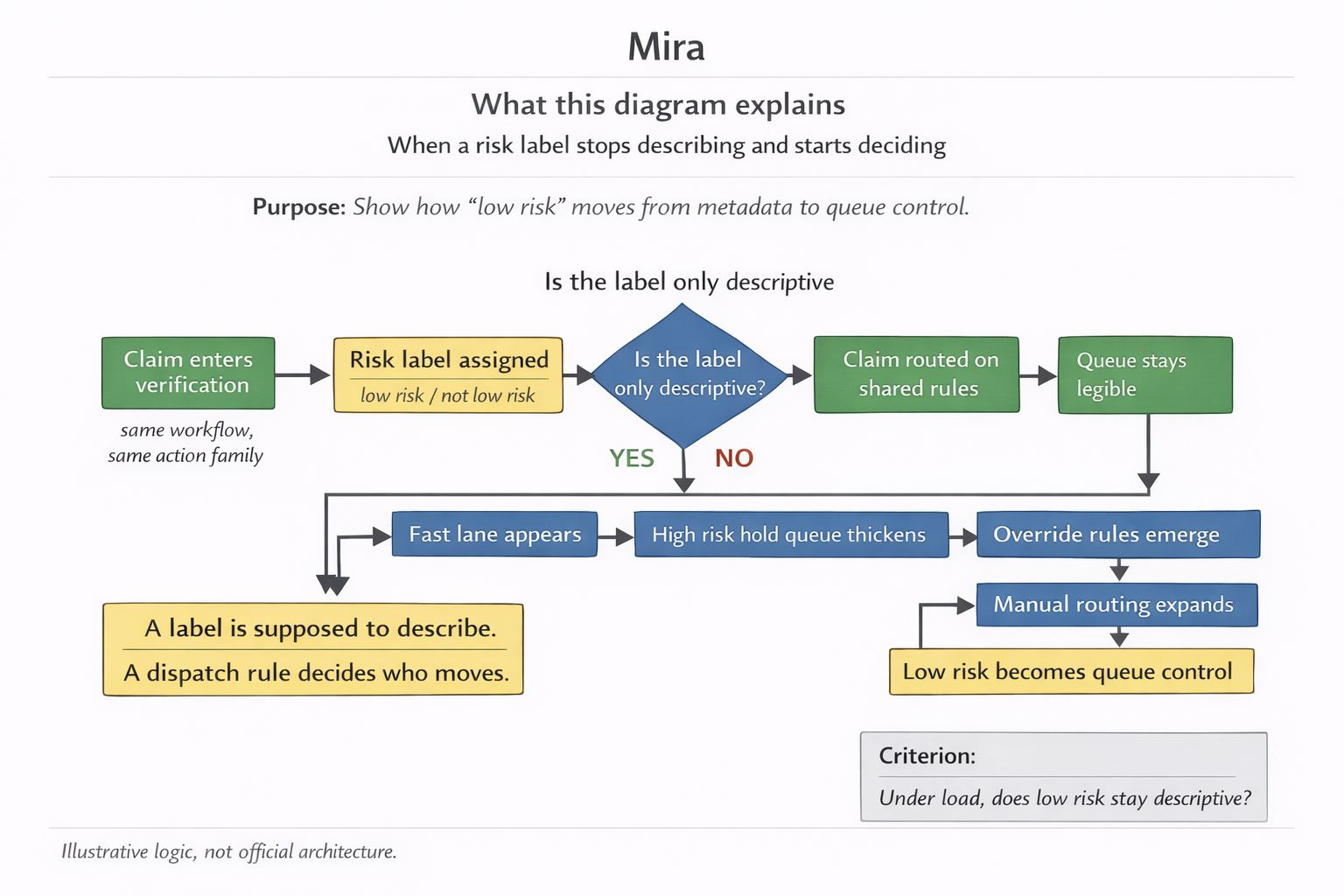
That is the seam on Mira I keep coming back to. Mira makes a lot of sense when you describe it from the top down. Break output into claims. Send those claims across independent verifiers. Use proof and consensus to settle what stands. That is a cleaner architecture than asking people to trust a whole blob because it sounds confident. But once claims start moving through the system at different speeds, a label like low risk stops feeling cosmetic very quickly.
The axis is description versus dispatch.
At first, a risk label sounds neutral. It sounds like something attached after the important work is already understood. In production, that is rarely where it ends. The moment a label starts influencing queue order, reviewer attention, escalation timing, or whether a claim reaches the action path at all, it stops describing the claim and starts behaving like routing logic.
That distinction matters more than people think.
A label is supposed to tell you what a claim is like.
A dispatch rule tells you what gets to move.
Once those 2 jobs collapse into the same object, the system starts teaching a different lesson than the one it advertises.
That is why the 4 minute versus 47 minute split bothered me. Not because queues should be perfectly equal. They never are. It bothered me because the label looked descriptive while acting operational. The fast lane was wearing the clothes of neutral language.
And once that happens, the rest of the stack adapts around it.
The first artifact is obvious. A fast lane hardens around claims carrying the right label. At the start, teams treat it as harmless optimization. Lower stakes should move faster. Fine. Then the high risk hold queue starts thickening, because high risk rarely means unimportant. Usually it means the opposite. The claims that touch money, permissions, safety, reputation, or irreversible actions are exactly the ones that begin waiting longest.
Then come override rules. A team gets tired of a claim sitting too long, so someone adds a rule saying this category can be reclassified under certain conditions. Maybe it is a product owner. Maybe it is an ops lead. Maybe it is an internal service that quietly widens the low risk bucket when the queue gets ugly. Nobody calls this governance, but that is what it is.
After that, manual routing appears for claims that do not fit neatly enough into either side. Not low risk enough to move cleanly. Not clearly dangerous enough to justify full escalation. So they land in the most familiar place in modern systems, the lane for things nobody trusts the label to decide by itself.
That is when low risk stops being metadata.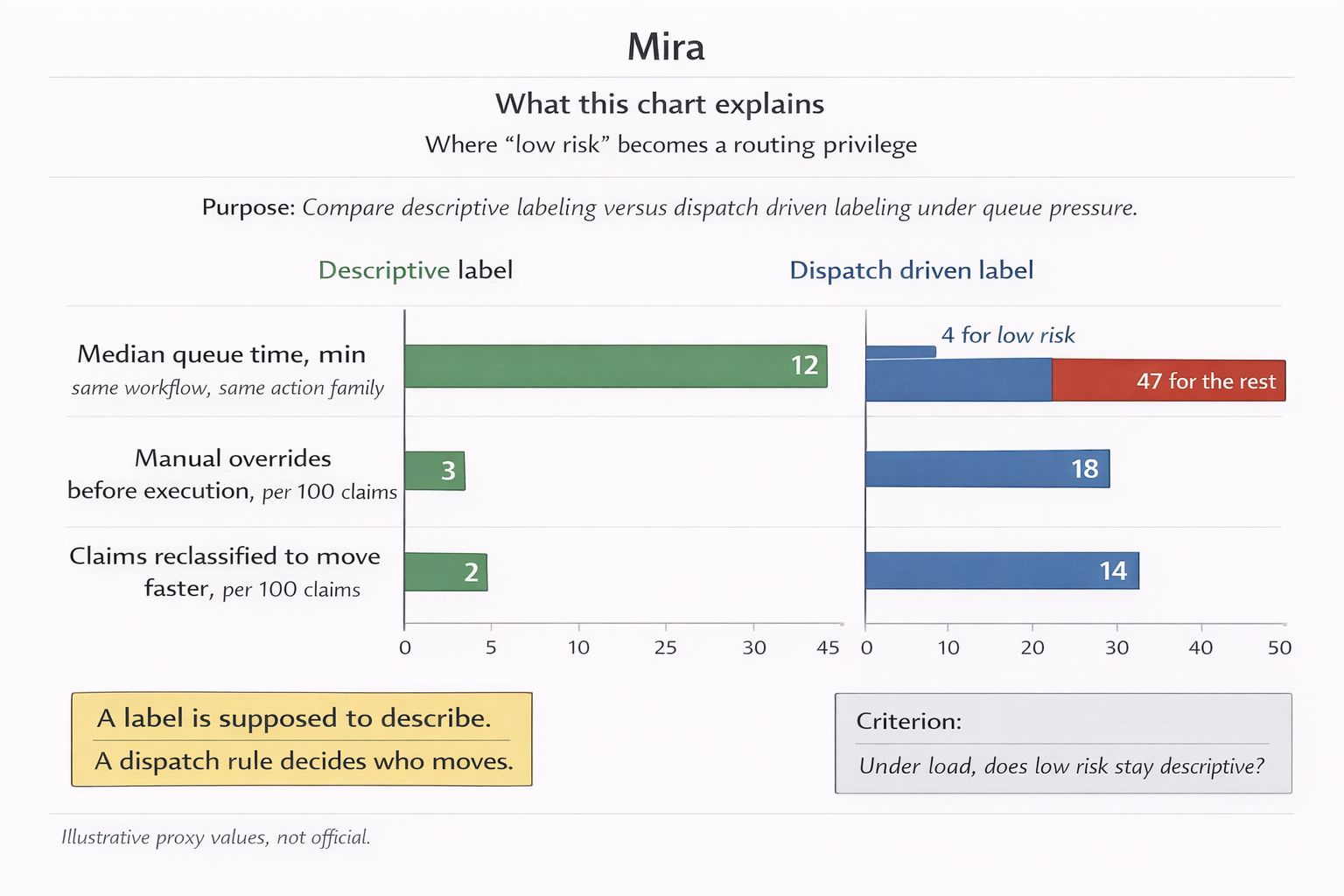
It becomes queue control.
The reason this matters on Mira specifically is that Mira works at claim level. It is not trying to bless a whole output in 1 pass. It is asking the network to handle smaller units with more precision. That is a strength. It also means small classification choices carry much more operational weight. If the system starts treating low risk as a throughput lever, then claim level verification can quietly turn into claim level traffic shaping.
And the bad version of that shift is subtle. It does not look like corruption. It looks like efficiency.
The dashboard improves.
The lanes move.
The easy claims close.
The hard ones collect operational debt off to the side.
That is where the real product question sits. Mira does not just need to verify claims. It needs to keep labels from becoming a hidden decision layer that determines which claims get timely verification and which ones get translated into supervision. A label that only describes is useful. A label that describes and dispatches at the same time is dangerous, because the second job eventually dominates the first.
You can see the system learning this in reverse. Teams start writing for the label. A claim gets framed a little more softly so it fits the safer bucket. A sharp assertion gets split into smaller pieces, not because the pieces are truer, but because they route better. Some claims do not get rewritten for verification quality. They get rewritten for queue compatibility.
That is not a small shift in behavior.
The queue starts teaching language how to survive.
And the more it does that, the less low risk means this claim is inherently safer, and the more it means this claim was expressed in a way the system can clear cheaply.
That is a very different thing.
The audit here is not complicated. Queue time by risk label, but split by claim family, not just averages. Reclassification rate before execution. Share of manual overrides that exist only to get a claim out of the hold queue. Escalation thresholds added after labels failed to settle borderline cases. And the one I would care about most, whether claims with similar downstream consequences still move at radically different speeds because 1 label has turned into a routing privilege.
The pass fail line is not philosophical. If low risk stays descriptive and queue behavior remains legible without constant override rules, pass. If the label becomes the hidden throttle on what reaches the action path, fail.
Because then the network did not just classify risk.
It priced movement.
None of this is free to fix. If Mira wants low risk to remain a description instead of a throughput instrument, it has to absorb more ambiguity in the shared layer. That means more borderline cases handled honestly, more queue friction where the classification is unclear, and more pressure on the system to explain why something moved quickly instead of hiding that choice behind a tidy label. Builders will hate some of that. It makes the surface less clean. It slows the parts of the system people like to point at in screenshots. It forces operators to admit that hard claims do not become easier just because the queue wants them to.
But the alternative is worse. If the shared layer does not carry that ambiguity, every serious team starts writing local routing law around a supposedly descriptive label. The protocol stays neutral on paper. The integrators become the real dispatch layer in practice.
That is how a label becomes power quietly.
Now the token, and only because this is where it has teeth. If $MIRA matters here, it should matter in the part of the stack that prevents labels from collapsing into throughput privilege under load, verifier capacity, escalation handling, queue discipline, and the boring infrastructure that keeps classification from becoming a private fast lane with neutral sounding language wrapped around it. If that discipline is weak, the cost leaks anyway into private override systems, privileged routing, and the teams that can afford to decide which claims are low risk enough to move.
The useful test is simple. When Mira is busy, does low risk still describe the claim, or does it quietly decide who moves first. Do override rules stay rare, or do they become the bridge between labels and action. Do similar claims with similar consequences move through the system on similar terms, or does 1 neutral sounding tag keep deciding whose time matters.
And the question I would keep asking after every busy week is the bluntest one. Is low risk still telling the truth about the claim, or is it now just the queue speaking through a label.