
I stopped treating consensus threshold like a harmless setting the day a payment approval claim closed at 3 of 5 and I still would not let the workflow act on it.
Nothing looked broken. The receipt came back clean. The dashboard counted the claim as verified. 3 verifiers were willing to close it. 2 were not. If you only watched closure, the system had done exactly what it was configured to do. That was the problem. The claim did not slip through because the rule failed. It closed because the rule had already decided how much visible doubt the workflow was willing to carry forward.
That was when N of M stopped reading like configuration.
It started reading like policy.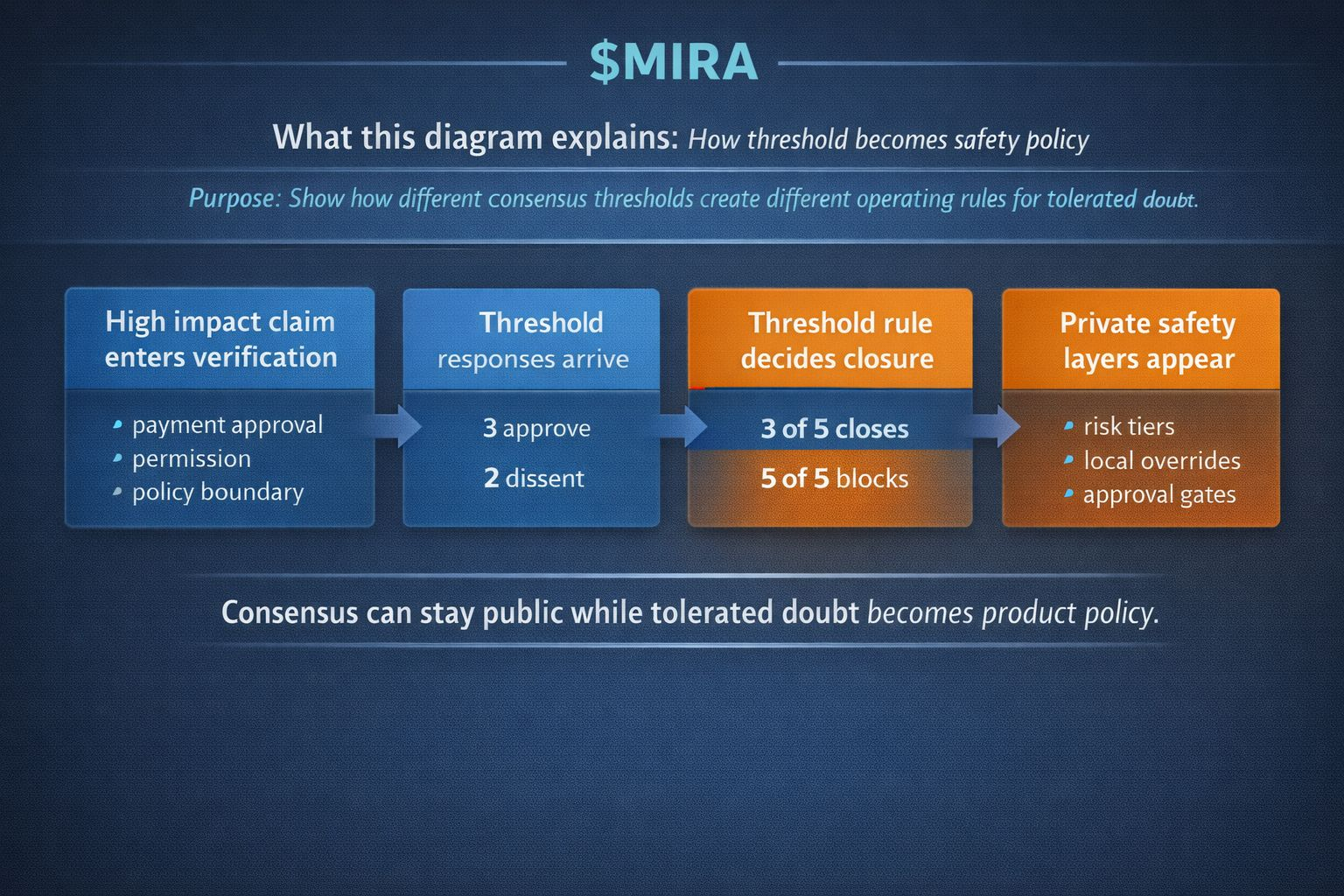
Mira makes this easy to miss because the architecture sounds clean. Break output into claims. Send those claims to independent verifiers. Let consensus close what stands. But in production, what matters is not just whether claims are checked. It is how much disagreement the system is still willing to treat as safe enough to move with.
3 of 5 and 5 of 5 are not two versions of the same setting.
They are two different doctrines of tolerated doubt.
One says the workflow can move while some disagreement is still alive inside the verifier set. The other says certain claims should not close while doubt is still visible. That difference does not live in the model. It is already encoded before the claim reaches finality.
Consensus is only the surface.
Threshold decides how much dissent can survive and still be called resolved.
You see it most clearly on sharp claims. Not the easy ones. The ones that touch permissions, transfers, approvals, policy boundaries, reputational actions. A claim that closes at 3 of 5 may still look respectable on paper. But if 2 serious verifiers are still unconvinced, the workflow has not removed uncertainty. It has priced uncertainty and chosen to move anyway.
That is not just a technical setting.
It is a governance choice disguised as consensus math.
The usual defense is speed. Lower thresholds keep queues moving. They keep dashboards healthy. They stop the network from stalling every time a claim hits rough edges. That part is true. The missing half is what happens downstream. Lower thresholds do not remove doubt. They push some of it past closure and let the workflow absorb it later.
Teams feel that before they always name it. A claim closes, but high impact actions start getting a second glance. Then the second glance becomes a risk tier rule. 3 of 5 is fine for low consequence claims. Sensitive ones need 5 of 5. Then comes the quiet hold window for actions that technically passed but still do not feel safe to execute. Then a manual lane appears for claims that met threshold but did not produce enough comfort.
At that point, the shared layer is still verifying claims.
The product is already writing its own safety policy around the result.
That is where the boundary moves.
The threshold closed the claim.
The workflow still was not ready to trust it.
The real object here is not agreement alone.
It is tolerated dissent.
What matters is not only how many verifiers said yes. It is how much unresolved disagreement the system agreed to absorb and still call closure. That is what threshold encodes. Not philosophical truth. Not model confidence. Operational tolerance for live doubt.
And once different teams choose different tolerances, the same network starts producing different safety regimes under the same verification architecture. One team treats 3 of 5 as enough. Another insists on 5 of 5. A third closes at 4 of 5 unless money is involved. From the outside, they are all using Mira. In practice, they are running different doctrines of acceptable uncertainty.
That is where drift begins.
The network stays shared.
The safety rule moves local.
Better teams tune carefully. They know where a lower bar is acceptable and where it is reckless. Smaller teams inherit the default, trust the badge, and discover too late that the default was really a product philosophy about how much disagreement they were willing to automate.
Raising threshold is not free either. Push it too high and the queue thickens. Border claims linger. Backlogs form around exactly the places where products want smooth automation. Teams get impatient. Someone adds an exception path. Someone else writes a fallback rule. Before long, the network preserves stricter finality on paper while operators quietly build fast paths around the waiting.
So the choice is not clean.
Lower threshold carries doubt forward.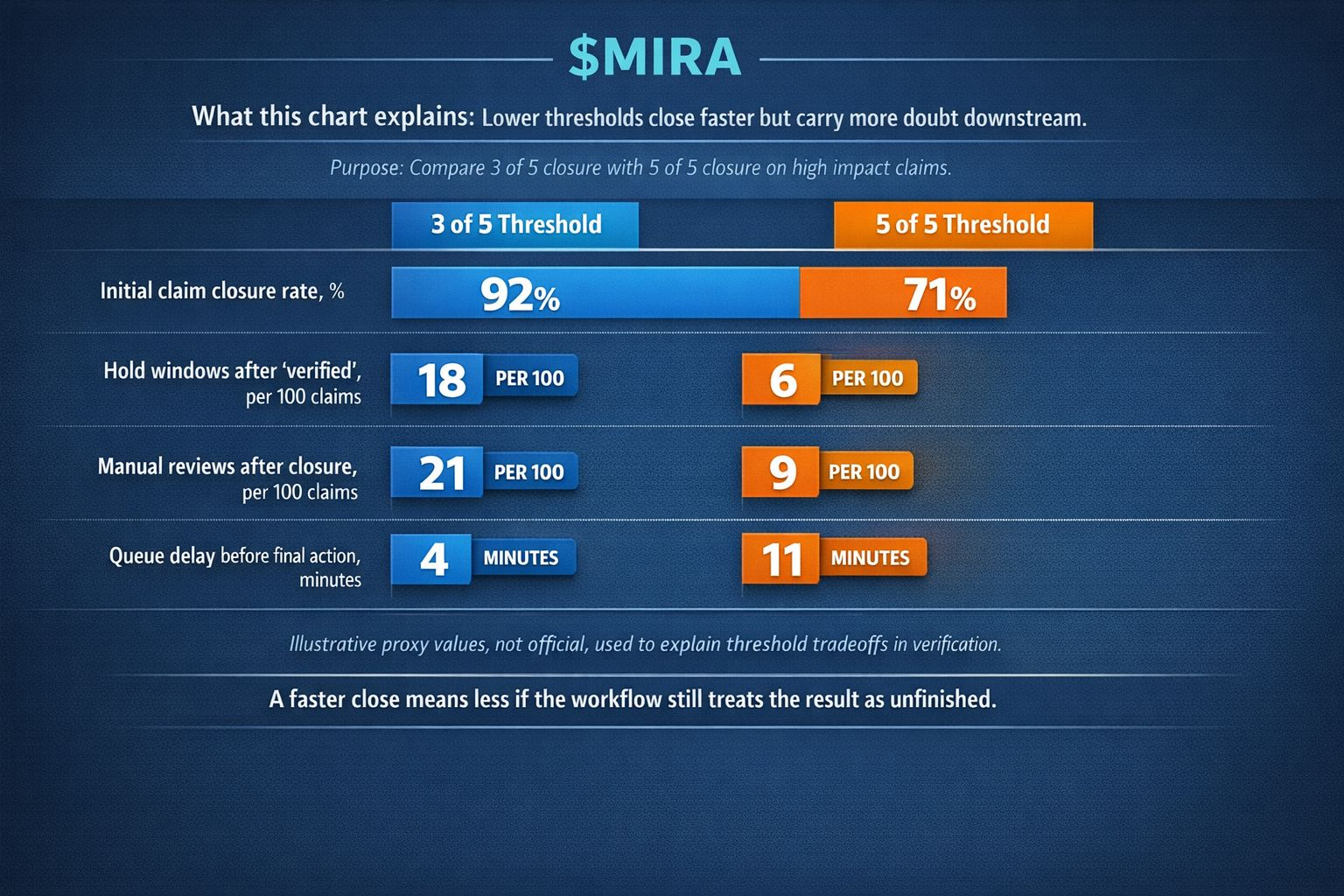
Higher threshold invites bypass.
Mira only gets interesting if that seam stays visible instead of turning into folklore. Threshold should not be a number people inherit and forget. It should stay legible as the place where a workflow declares what kind of uncertainty it is willing to operationalize.
If that stays invisible, every serious integration rebuilds its own second layer. Threshold exceptions. Local risk tiers. Manual approvals after valid closure. Product rules that decide when the network result counts and when it only begins another round of judgment.
The receipt still matters.
It is no longer the whole story.
That is where quiet centralization starts coming back.
Consensus stays public.
Safety posture moves private.
The token matters only if it helps carry the cost of honest thresholds. More verification work where closure should be strict. More waiting where uncertainty should stay visible. More economic support for workflows that refuse to flatten disagreement just to keep throughput pretty. Otherwise the network will always drift toward the flattering threshold, the one that closes fast, looks healthy, and pushes the real safety cost downstream.
The useful checks are plain. When claims get sharper, do thresholds rise cleanly with the risk, or do teams build private overrides instead. Do hold windows shrink over time, or do they become permanent bridges between formal closure and practical trust. When a claim closes at 3 of 5, does the product act on it with the same confidence it shows on the dashboard, or does someone quietly treat it as unfinished. And the simplest one of all, when Mira says verified, is that because doubt was actually resolved, or because the workflow decided it could afford to carry the rest.