
#ROBO $ROBO @Fabric Foundation
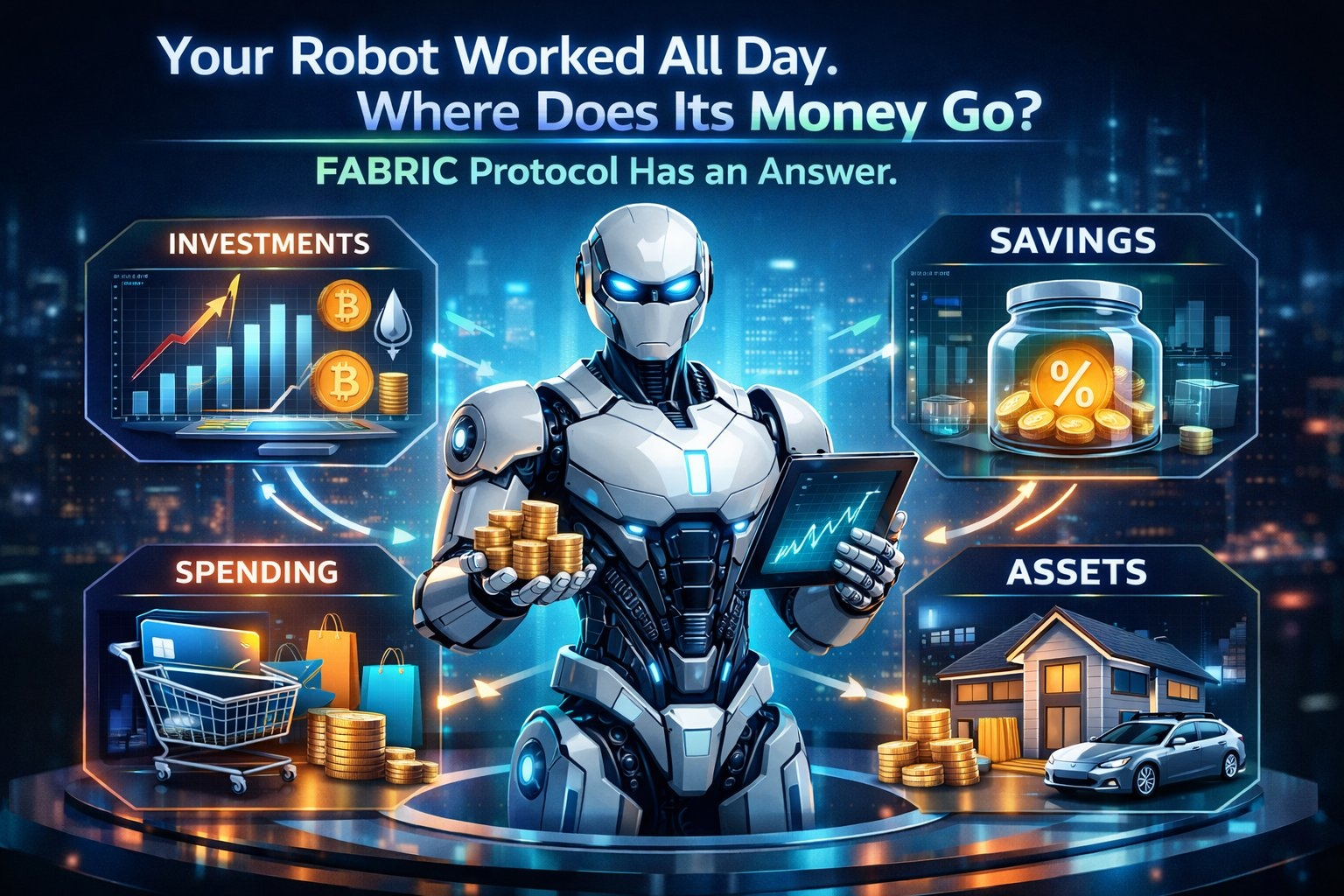
Imagine a warehouse robot that works sixteen hours straight.
It lifts crates, scans barcodes, moves pallets, sorts packages, and updates inventory systems with machine precision. Its motors never tire. Its sensors never lose focus. Its algorithms constantly optimize movement through the warehouse floor like a chess player calculating the next move.
By the end of the day, the robot has generated measurable economic value. It has saved time, reduced labor costs, and increased logistical throughput.
But this raises a curious question.
Where does the value created by that robot actually go?
Today, the answer is simple: it goes to the company that owns the machine. The robot itself is merely a tool—an automated extension of corporate infrastructure.
Yet as artificial intelligence systems become more autonomous and robots begin to participate directly in digital markets, this model begins to look increasingly incomplete. Machines are evolving from tools into economic actors. They can negotiate, transact, and coordinate with other machines.
If a robot can work, earn, and spend, then the next question becomes unavoidable:
Who controls its wallet?
And more importantly—who verifies its actions?
This emerging dilemma sits at the intersection of robotics, blockchain infrastructure, and decentralized governance. It is precisely the kind of problem that Fabric Protocol, supported by the Fabric Foundation, aims to explore.
At the center of this vision lies a token called $ROBO, but the token itself is not the real story. The deeper idea is infrastructure: a coordination layer for machine economies.
If the internet connected people, and blockchains connected value, networks like Fabric are attempting something more ambitious.
They want to connect autonomous agents.
The Rise of Machine Economies
Robots are no longer confined to factory floors.
They deliver groceries, monitor crops, inspect pipelines, manage warehouses, and even assist in surgical procedures. Meanwhile, AI agents operate in digital environments—writing code, executing trades, scheduling logistics, and managing cloud infrastructure.
These systems increasingly make decisions without immediate human input.
In other words, they act.
Economists sometimes describe this transition as the emergence of machine economies: networks in which autonomous systems exchange services, data, and payments.
A delivery drone might pay for airspace routing data. A warehouse robot might purchase predictive maintenance services from an AI diagnostic system. A fleet of autonomous vehicles might negotiate charging station access based on dynamic electricity prices.
Once machines can transact, they require financial rails.
Traditional payment systems were not designed for this world. Bank accounts assume legal identity and human oversight. Payment networks impose latency, compliance layers, and geographical constraints.
Robots operate at machine speed.
They need a programmable financial layer that moves just as quickly.
Blockchain infrastructure offers one possible answer. Smart contracts can execute transactions autonomously, digital wallets can store value programmatically, and decentralized networks can coordinate participants without centralized intermediaries.
Yet even blockchain introduces a new problem.
Who verifies that the robot actually did the work?
The Accountability Problem
Consider again the warehouse robot.
Suppose it submits a claim: it moved 10,000 packages today and deserves payment. A smart contract could release funds automatically—but only if it trusts the data.
If the robot lies, malfunctions, or is compromised by malicious software, the system collapses.
This problem resembles a deeper challenge already emerging in artificial intelligence: verification.
Large AI models can generate convincing outputs, but verifying those outputs remains difficult. The same applies to autonomous machines operating in the physical world. Sensors can fail, logs can be manipulated, and software can produce fabricated data.
Without verification infrastructure, autonomous systems become black boxes.
Trust becomes fragile.
Fabric Protocol attempts to address this gap by introducing a framework where robots, AI agents, and physical machines can produce verifiable computational proofs about their actions. Instead of merely reporting activity, machines can generate cryptographic evidence tied to execution.
Think of it as a kind of digital flight recorder for autonomous systems.
In aviation, a black box records what happened during a flight. Fabric aims to create a similar concept for robotic work—except the records are verifiable and can interact with decentralized networks.
In such a system, a robot does not simply claim it completed a task.
It proves it.
Fabric as Coordination Infrastructure
At a conceptual level, Fabric Protocol positions itself less as a single blockchain and more as a coordination mesh.
Autonomous systems operate across diverse environments: robotics frameworks, cloud computing networks, IoT devices, and multiple blockchains. Any viable infrastructure must connect these domains rather than isolate them.
Fabric attempts to act as connective tissue.
Its architecture seeks to federate autonomous agents into a shared verification layer, where machine activity can be recorded, validated, and monetized. The protocol essentially becomes an operating layer for machine identity, execution proofs, and economic coordination.
In this model, robots are not simply hardware devices.
They are participants in a digital network.
Each machine can hold an identity, execute tasks, produce verifiable outputs, and receive compensation. These activities interact with smart contracts, decentralized storage, and distributed computation systems.
The result begins to resemble something larger than robotics infrastructure.
It looks like an economic substrate.
One might imagine it as a mesh of chains and machines—an internet where value flows not only between people but also between autonomous systems.
The Role of $ROBO
Within this framework, the $ROBO token functions as a coordination mechanism.
Tokens in decentralized networks often serve multiple purposes simultaneously: incentives for participants, payment for services, and governance over protocol development. In the case of Fabric, the token is envisioned as a medium through which machine-generated value circulates.
A robot that performs work could receive $ROBO. An AI verification service might charge $ROBO to validate execution proofs. Infrastructure nodes running parts of the network might earn rewards for maintaining reliability.
In other words, the token acts as economic glue.
However, as with many emerging blockchain systems, the long-term value of the token depends less on speculation and more on real network activity. If machine economies grow and Fabric becomes widely adopted, $ROBO could function as a native currency for robotic labor.
If adoption stalls, the token risks remaining a theoretical construct rather than a functional medium of exchange.
This tension highlights the speculative frontier where many decentralized infrastructure projects currently exist.
They are blueprints for possible futures.
But blueprints alone do not build cities.
Why Verification Matters in the Age of AI
The timing of projects like Fabric is not accidental.
Artificial intelligence is entering a phase where autonomy is expanding rapidly. AI agents can already execute complex workflows, write software, conduct research, and interact with external systems through APIs.
Robotics is following a similar trajectory. Advances in computer vision, reinforcement learning, and hardware design are enabling machines to operate in dynamic environments with increasing independence.
These developments introduce enormous economic potential.
But they also amplify a fundamental problem: how do we trust machines?
Humans rely on institutions to mediate trust. Courts enforce contracts. Regulators oversee industries. Banks verify financial transactions.
Autonomous systems cannot easily plug into these structures.
They operate globally, digitally, and continuously.
Verification networks may become a new category of infrastructure—something like decentralized auditors for machine activity.
Fabric positions itself within this emerging domain.
It attempts to provide a mechanism through which machine-generated actions can be recorded, validated, and linked to economic incentives.
In essence, it tries to transform opaque automation into transparent coordination.
Skepticism and Structural Challenges
Despite its conceptual appeal, the idea of decentralized machine economies faces several obstacles.
First, robotics adoption itself remains uneven. Most robots today operate within tightly controlled environments like factories or warehouses. Fully autonomous systems capable of interacting freely with digital economies are still relatively rare.
Second, verification of physical activity is inherently complex. Proving that a robot lifted a box or delivered a package requires reliable sensor data, tamper-resistant hardware, and secure data transmission. Cryptographic proofs alone cannot guarantee physical truth.
Third, blockchain scalability remains an ongoing challenge. If millions of machines were to record activity and transactions continuously, network infrastructure would need to process enormous volumes of data.
Fabric’s architecture attempts to address these issues through modular design and off-chain verification layers. Yet the technical difficulty should not be underestimated.
Machine economies may develop gradually rather than suddenly.
Infrastructure often precedes adoption, but it does not guarantee it.
A Glimpse of the Autonomous Future
Still, it is worth imagining the world that could emerge if these ideas succeed.
Autonomous delivery drones might negotiate logistics routes in real time, paying data providers for weather intelligence. Agricultural robots could sell crop analytics directly to commodity markets. Household AI assistants might earn tokens by performing micro-tasks across digital networks.
Robots would not merely execute instructions.
They would participate in economic ecosystems.
In such a world, protocols like Fabric become less about robotics and more about governance. They establish the rules by which autonomous systems interact, exchange value, and verify activity.
The infrastructure becomes invisible yet essential.
Much like TCP/IP quietly powers the internet today, verification networks might one day underpin machine economies without most users ever noticing.
Technology, Trust, and the Human Question
Beneath the technical architecture lies a deeper philosophical issue.
Technology has always expanded human capability. Tools amplified our physical strength, machines multiplied industrial productivity, and computers accelerated cognitive work.
Autonomous systems extend this trajectory further.
They introduce agents that can act on our behalf—even when we are not watching.
This raises profound questions about trust.
When a robot completes a task and earns value, the system distributing that value must believe the work occurred. When an AI agent negotiates on behalf of a company, the counterparties must trust its execution.
In a sense, decentralized verification networks attempt to encode trust into mathematics.
They replace institutional guarantees with cryptographic evidence.
Yet even the most sophisticated protocol ultimately depends on human belief. People must trust the system’s rules, the integrity of its participants, and the fairness of its incentives.
Technology can reinforce trust.