I spend most of my time looking at crypto systems the same way an engineer studies infrastructure: not by what the whitepaper promises, but by how the system behaves once people start using it imperfectly. Incentives drift, users find shortcuts, validators optimize around profit, and the architecture quietly determines which behaviors survive. When I look at Fabric Protocol through that lens, what stands out isn’t the robotics narrative people tend to focus on. It’s the attempt to treat robots and AI agents as economic actors inside a verifiable computing network. That design decision changes the kinds of pressures the protocol will face once real activity begins to flow through it.
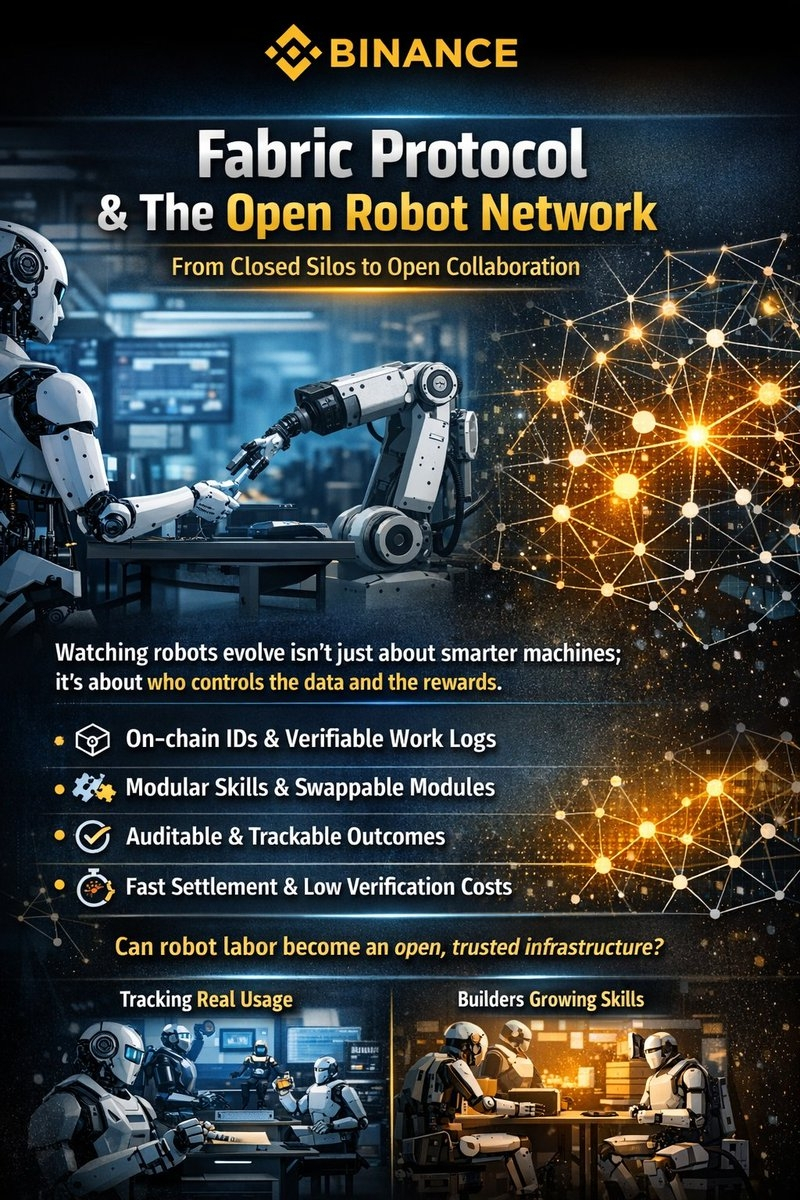
The core premise is simple enough. Fabric creates a shared coordination layer where robots, software agents, and human operators interact through verifiable computation recorded on a public ledger. Instead of trusting the device or the company operating it, the protocol attempts to verify what work was done, what data was used, and how the result was produced. In theory, that turns robotic actions into auditable events. In practice, it introduces a new type of on-chain workload that behaves very differently from typical financial transactions.
What I watch first in systems like this is the boundary between physical activity and cryptographic verification. Robots operate in messy environments. Sensors fail, data can be incomplete, and the real world does not behave deterministically. Verifiable computing tries to compress that messy process into proofs that the network can validate. That compression step becomes the most fragile part of the architecture. If generating those proofs is expensive or slow, the network risks bottlenecks. If verification becomes too permissive, the system drifts back toward trust rather than verification.
This is where Fabric’s modular infrastructure matters more than the headline concept. Instead of assuming a single computation model, the protocol breaks the process into components: data ingestion, computation verification, and governance over how those processes evolve. From a market structure perspective, modularity tends to push complexity outward. Different participants specialize in different layers. Some actors provide compute resources, others verify outputs, others manage data availability. Over time, those roles form their own micro-economies within the protocol.
Watching validator behavior in that environment would probably reveal more about Fabric’s long-term viability than any roadmap. Validators or compute providers will naturally prioritize tasks that are predictable, easy to verify, and economically stable. Tasks tied to physical robotics may not always meet those conditions. A robot navigating a warehouse produces data that changes constantly, and the cost of verifying that activity may fluctuate depending on network load. That tension between unpredictable real-world inputs and deterministic verification is something most protocol designs gloss over, but it tends to shape usage patterns very quickly.
Another dynamic that becomes visible only after deployment is data gravity. Robots generate large volumes of sensor data—visual feeds, environmental readings, movement logs. Storing all of that on a blockchain is unrealistic, so the protocol inevitably relies on layered storage strategies. Some data stays off-chain, some is compressed into commitments, and only small pieces become verifiable proofs. Over time, that structure determines which information remains accessible and which disappears into off-chain archives. In other words, the architecture quietly decides what kind of transparency the system actually delivers.
From a market perspective, the interesting part is how incentives align around those data flows. If participants are rewarded for verifying computation, they will optimize around proof generation efficiency. If rewards depend on data availability, storage providers gain leverage. And if governance controls which computation standards are accepted, influence tends to accumulate among the actors capable of shaping those standards. None of these forces are inherently problematic, but they introduce subtle concentrations of power that only appear after the system has been running for a while.
One thing I tend to watch in protocols like Fabric is how quickly friction emerges between automation and governance. The protocol describes collaborative evolution of robotic systems through on-chain governance. In theory that sounds elegant: improvements are proposed, validated, and adopted transparently. In practice, governance tends to move slower than software development cycles. Robotics evolves quickly, especially when machine learning models are involved. If governance becomes a bottleneck for upgrades or safety changes, developers may start routing around it, which undermines the very coordination layer the protocol tries to create.
Settlement speed is another practical constraint that rarely shows up in high-level descriptions. When robotic systems interact with the network, timing matters. A warehouse robot cannot wait minutes for confirmation before adjusting its path. Most real-world deployments would likely operate through asynchronous settlement—robots act locally, while the network records and verifies the results afterward. That architecture works, but it shifts the protocol’s role from real-time control to post-fact verification. The distinction seems small on paper, yet it significantly changes how the system is actually used.
Liquidity patterns around the protocol’s token, assuming one exists within the system’s incentive layer, will probably reflect that operational rhythm. Unlike financial protocols where activity spikes during market volatility, Fabric’s demand would be tied to computational workloads. If robots perform more tasks, more verification occurs. That creates a usage curve shaped by industrial activity rather than trading behavior. For traders watching on-chain metrics, the signal would likely appear in compute request volumes, proof generation frequency, and validator participation rather than simple transaction counts.
There’s also an overlooked psychological factor that tends to shape adoption in systems dealing with automation. People are comfortable trusting machines inside controlled environments but far less comfortable when those machines interact across open networks. Fabric attempts to solve that trust gap through verifiable computation, which is a technically sound approach. But technical guarantees do not automatically translate into user confidence. The real test will be whether the verification process feels reliable enough for operators to depend on it without constantly checking the underlying proofs themselves.
The more I look at the architecture, the more it resembles infrastructure that may take a long time to reveal its real value. Systems designed for machine coordination rarely produce immediate visible activity because integration with physical hardware is slow and expensive. Early usage may look quiet on-chain, even if the underlying framework is sound. That tends to confuse market participants who expect constant growth metrics, but infrastructure tied to robotics operates on a different timeline.
What matters more is whether the incentives remain balanced as usage grows. If verification becomes too expensive, participants will avoid complex tasks. If data storage becomes a bottleneck, transparency erodes. If governance drifts toward a small group of specialized operators, the collaborative premise weakens. None of those outcomes are guaranteed, but they are the kinds of pressures that inevitably shape a protocol once it moves beyond theory.
When I step back and look at Fabric purely as a coordination system, the interesting part isn’t the robotics narrative. It’s the attempt to formalize interactions between autonomous agents, physical machines, and human oversight within a verifiable economic framework. That is a difficult environment for any protocol because the system must bridge deterministic computation with unpredictable real-world activity.
Over time, the signals that matter will probably appear quietly in the data: the ratio of computation requests to successful proofs, how validator participation evolves as workloads grow, whether storage providers cluster around certain types of datasets, and how governance decisions influence which robotic tasks actually get verified. Those are the patterns that reveal whether the architecture holds together under pressure or slowly bends around its own complexity.
Most protocol discussions stop at the design stage. But once people start building on top of a network like this, the system develops its own behavior. Incentives shift, actors specialize, and the ledger becomes less of a technology and more of an economic environment. Watching that transition is usually where the real story begins to appear.
@Fabric Foundation #ROBO $ROBO #robo