
I remember the moment this clicked for me because it was annoyingly ordinary.
No big announcement. No flashy product demo. No dramatic “future of robotics” moment.
I was just staring at the setup and feeling that familiar kind of market discomfort, the one where everybody keeps using soft words for something that is actually hard and finite. Participation. Alignment. Early supporters. Community access. It all sounded polite. Then I pictured the real scene underneath it.
A robot goes live.
Its first real task windows open.
More than 1 serious participant wants the same working time.
That was the moment the language changed for me.
This was not community anymore. This was capacity planning.
That is when ROBO stopped reading like a token story and started reading like a queue policy.
I think people miss how fast these systems become real once the thing being allocated is no longer abstract. If the scarce thing is just dashboard attention or speculative upside, you can get away with vague language for a while. But if the scarce thing is actual machine time, then somebody has to decide who gets first access when the machine starts doing useful work.
That decision is the market structure.
And once I saw it that way, I could not unsee it.
The part that matters to me is not generic utility talk. It is much narrower than that. It is the question of who gets first touch on scarce task flow when a newly activated robot starts working for real.
That sounds small until you sit with it.
A robot has uptime limits. Physical constraints. Maintenance reality. Handoff costs. Real windows where useful work can happen and real windows where it cannot. So when people talk about “priority access” in a system like this, I do not hear a perk anymore. I hear the protocol deciding how early demand gets sorted against finite machine capacity.
The scarce asset is not the robot.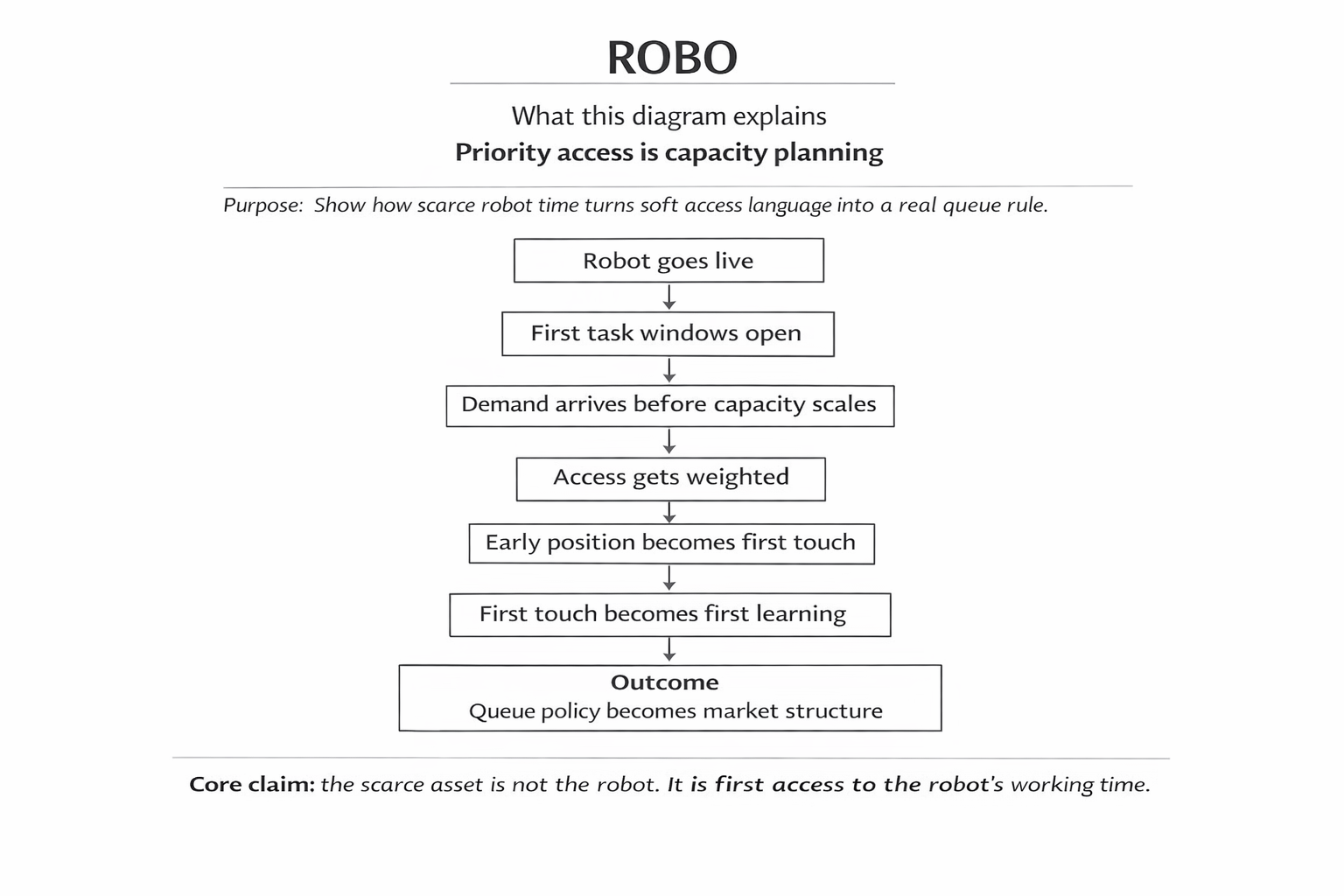
It is first access to the robot’s working time.
That one sentence changed the whole project for me.
Because once you say it out loud, the design gets much more honest.
Access weighting stops sounding cosmetic. It starts sounding like what it really is, a rule for allocating early capacity. And capacity rules are never just technical details. They become governance surfaces immediately, whether the project wants to speak that way or not.
Why?
Because the second access is weighted, the system is deciding whose timing matters first when demand shows up before capacity has scaled. It is not just rewarding participation in some soft social sense. It is sorting who stands closest to first use.
That is a much harder thing. And a much more interesting thing.
I think that is why this subject kept bothering me in a good way. A lot of token systems still try to hide their real job behind broad language. They want to be incentive layers, governance layers, community layers, utility layers, all at once. ROBO gets more legible the moment you stop asking “what does the token do” and start asking “what exactly is the protocol allocating first.”
Then the answer sharpens.
It is allocating early position in scarce task flow.
That is not branding. That is scheduling.
And scheduling is where serious users start behaving very differently from casual ones.
A casual participant might hear access weighting and think of upside. A serious one hears it and starts thinking like an operator. Which activations will matter first. Which robots are likely to attract the best downstream usage. Which early queues are worth paying attention to before the crowd starts calling them obvious. Which placement today becomes better learning tomorrow.
Because first access is not only about getting work first.
It is also about learning first.
That is the part people usually underprice.
Whoever touches early task flow first does not just touch revenue first. They touch reality first. They see the failure modes first. They learn what uptime feels like instead of what uptime was promised to be. They see whether demand is sticky or just cosmetic. They see whether the protocol’s allocation logic survives contact with live usage or starts leaking around the edges.
That kind of signal compounds very fast.
So priority is not just a front of queue advantage. It is a front of knowledge advantage.
That is why capacity planning is never neutral.
Who gets first access also gets first truth.
And honestly, I respect the design more when I read it that way. It is less flattering, but more serious. Instead of pretending every qualified participant will meet a newly activated robot on equal terms the minute it wakes up, the system is effectively admitting that early capacity is scarce and needs a visible allocation rule.
That is healthier than the usual fantasy.
Equal access is a slogan. Weighted access is a policy.
Policies are harder. They create friction. They create people who arrive late and feel screened out. They create the uncomfortable but necessary moment where a protocol has to admit that somebody will be first and somebody will not.
There is no clean way around that once machine time becomes economically meaningful.
And there is a cost here, obviously. Any mechanism that weights early access is going to make some users feel like they arrived one layer too late, even if the rule is explicit. The system may call it coordination reward. The person behind the line may experience it as walking into a market whose best windows have already been claimed.
That tension is real.
But I would still rather see an explicit allocation rule than a fake openness story that hides the same sorting process under softer words.
At least a visible rule gives people something real to plan around.
That is also why ROBO makes most sense to me late in the story, not early. I do not find it interesting here as a generic utility asset. I find it interesting as operating capital tied to access weighting in a capacity constrained system. That is a narrower role than most token language likes to promise, but it is also a much cleaner one.
Clean roles age better.
The cold test for me is simple.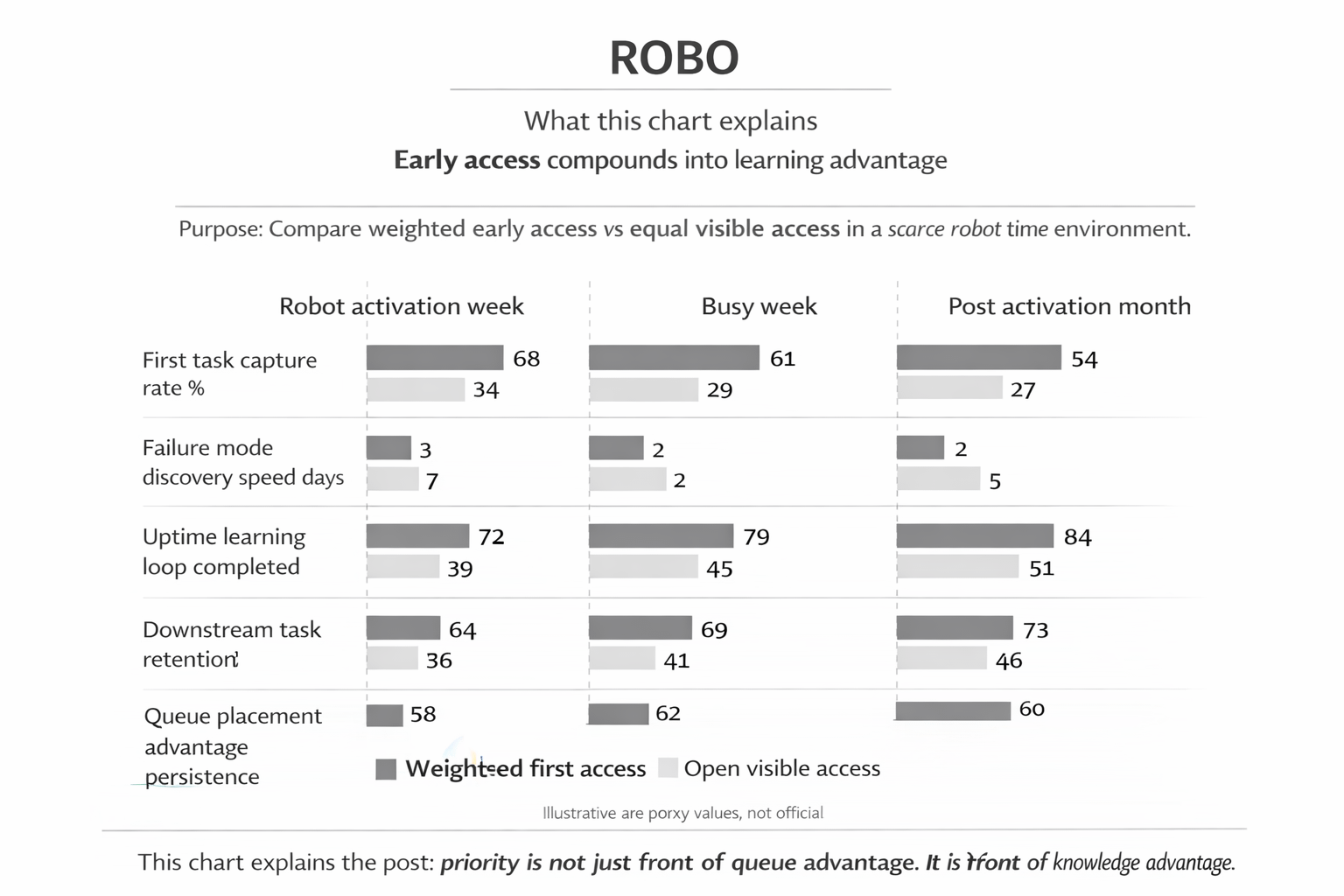
When 1 robot goes live and 5 serious participants want the same early task flow, does the weighting rule produce access that feels operationally real, or just politically neat.
When demand gets there before fresh capacity does, do early coordinators get actual first contact, or only symbolic preference.
And when busy weeks arrive, does ROBO start behaving like real placement capital.
Because once the machine is live, the question is no longer whether the robot exists.
The question is who gets to touch its first useful hour before everyone else.