There is a moment that happens in robotics labs that rarely makes it into public discussions. It usually comes late in the evening, after a long day of debugging. The robot is technically working. The sensors respond, the motors move, the AI system makes decisions that look intelligent enough. But the engineer watching it from across the room still feels uneasy.
Not because the robot is broken.
Because it might be wrong.
That uneasy feeling sits at the center of modern robotics. Machines have become impressively capable, but the systems behind them are often held together by layers of assumptions. Data is trusted because it came from a familiar source. Models are trusted because they performed well in testing. Decisions are trusted because the system that produced them was designed by people who seemed to know what they were doing.
And sometimes that works. Until it doesn’t.
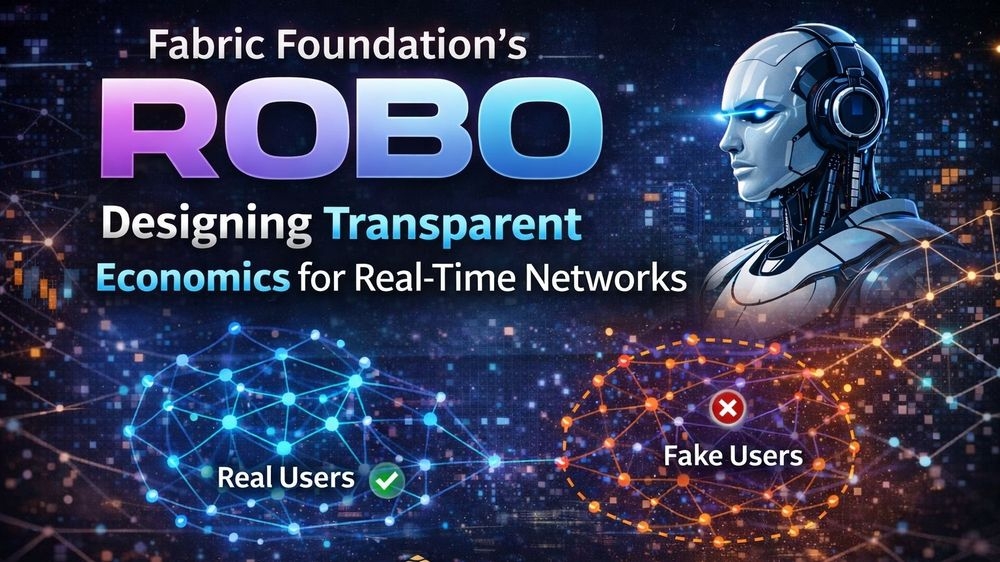
Fabric Protocol enters the conversation at precisely that fragile point. It’s easy to describe it as an open network supported by the Fabric Foundation, focused on verifiable computing and infrastructure for robotic agents. But that description misses the deeper tension the project is trying to address. Fabric is not really about robots themselves. It is about the invisible architecture that determines whether robots can cooperate safely at scale.
Most robotic systems today exist inside sealed ecosystems. A company builds the hardware, trains the AI models, controls the data pipeline, and updates the software. Everything functions within that bubble. If the machine makes a decision, the surrounding system simply assumes it was computed correctly.
But once robots begin interacting with systems they don’t fully control, that assumption becomes uncomfortable.
Picture a distribution warehouse that operates twenty four hours a day. Autonomous carts carry inventory between shelves while robotic arms sort packages for outgoing shipments. Some machines were built by one vendor. Others came from different companies entirely. Their software stacks are not identical. Their training data is different. Even their definitions of “safe behavior” might not match perfectly.
Now imagine two of those machines approaching the same intersection between aisles.
It sounds trivial. Just stop one robot and let the other pass. Simple traffic logic.
Except it isn’t always simple. One robot might rely on a predictive navigation model that calculates future paths. Another might follow a reactive avoidance system that adjusts in real time. Both systems are intelligent. Both systems are confident. Both systems might interpret the situation differently.
This is where coordination becomes fragile.
Fabric Protocol attempts to address that fragility by introducing something robotics has rarely used at scale: verifiable computation. Instead of assuming that an AI model’s output is correct because it ran on a trusted device, Fabric allows the underlying computation to be proven cryptographically. The network can confirm that a result actually came from a defined process.
That idea quietly changes the relationship between machines.
When one robot shares data with another, the receiving system no longer needs to blindly trust the source. It can verify the computational steps that produced the information. Not perfectly, of course. Verification always operates within certain boundaries. But it shifts trust from reputation to evidence.
The protocol also treats robots as agents within a distributed environment rather than isolated machines. That design choice sounds technical, but its implications are surprisingly philosophical.
For decades robotics research has focused on individual intelligence. How do we build a machine that sees well, navigates well, manipulates objects well? Fabric leans in a slightly different direction. It assumes that robots will increasingly operate as participants in networks of agents machines that exchange knowledge, coordinate decisions, and occasionally disagree.
Disagreement among machines is an interesting concept, by the way. Humans do it constantly. We question each other’s conclusions, challenge assumptions, verify evidence. Machines traditionally don’t do that. They follow instructions.
Fabric nudges robotics toward something more collaborative.
Imagine agricultural robots operating across several farms. One machine encounters an unusual soil condition and adapts its irrigation model accordingly. Another robot in a completely different region faces a similar anomaly months later. Through Fabric’s network infrastructure, the second machine could access verified insights from the firstwithout needing to trust the original system blindly.
Knowledge becomes portable. Verified. Shareable.
And yet this is where skepticism creeps in.
Open coordination layers sound elegant when described on whiteboards. In the real world, distributed systems tend to develop quirks. Governance mechanisms become messy. Consensus processes slow things down. Sometimes a centralized authority simply moves faster.
Fabric attempts to handle governance through a public ledger that coordinates data, computation, and policy enforcement. Actions performed by robotic agents can be recorded and verified. Rules governing behavior can evolve through network participation rather than unilateral control.
The idea resembles the way blockchain infrastructure coordinates financial systems. But robotics introduces a new dimension: physical consequences.
A flawed smart contract might lock funds temporarily. A flawed robotic policy might cause a machine to behave unpredictably in a crowded environment.
This tension is not a flaw in the concept. If anything, it is the reason infrastructure like Fabric might be necessary. As robots become more autonomous, relying on opaque decision systems will eventually feel reckless.
There is another subtle shift happening here as well. One that people rarely talk about.
Historically, robotics companies guarded their data fiercely. Every dataset collected by machines navigation maps, sensor recordings, behavioral models was treated as proprietary advantage. Fabric quietly challenges that culture by creating an environment where verified knowledge can circulate across systems.
Some engineers will resist that idea. Understandably. Competitive advantage matters.
But the contrarian thought is this: the real advantage in robotics may not come from hoarding data forever. It might come from building the networks that allow machines to learn collectively while maintaining verifiable trust.
The internet followed a similar path. Early computer networks were closed environments controlled by individual institutions. The moment they began interconnecting openly, the scale of innovation changed.
Fabric is exploring whether robotics might experience a comparable shift.
Maybe it will work. Maybe it will struggle under the weight of its own complexity. Infrastructure experiments rarely follow a predictable path.
Still, the underlying problem it addresses feels real.
We are slowly filling the world with autonomous machines. Delivery robots navigating sidewalks. Agricultural machines managing crops. Service robots assisting in hospitals and logistics centers. Each one makes decisions constantly. Each one interacts with environments that humans care deeply about.
If those machines are going to coexist with us and with each other the systems coordinating their behavior cannot remain invisible and unquestioned.
Trust built on assumption eventually breaks.
Fabric Protocol is, in many ways, an attempt to replace assumption with verification. Not perfectly. Nothing ever is. But enough to make the future of autonomous machines slightly less fragile than it currently feels.
#ROBO @Fabric Foundation $ROBO