Everyone is talking about AI right now.
Smarter models.
More capable robots.
Automation that keeps improving every year.
But almost no one is asking the harder question.
What happens when millions of intelligent machines start working in the real world?
Not in labs.
Not in demos.
In environments where they must interact with people, money, tasks, and accountability.
Because intelligence alone isn’t enough.
For machines to operate at scale, they need structure:
• Identity
• Task coordination
• Proof of completed work
• Transparent contribution tracking
• Economic incentives
Without these systems, robotics and AI remain locked inside closed platforms controlled by a single company.
That limits collaboration and trust.
Where Fabric Protocol Comes In
Fabric Protocol approaches the problem from a different angle.
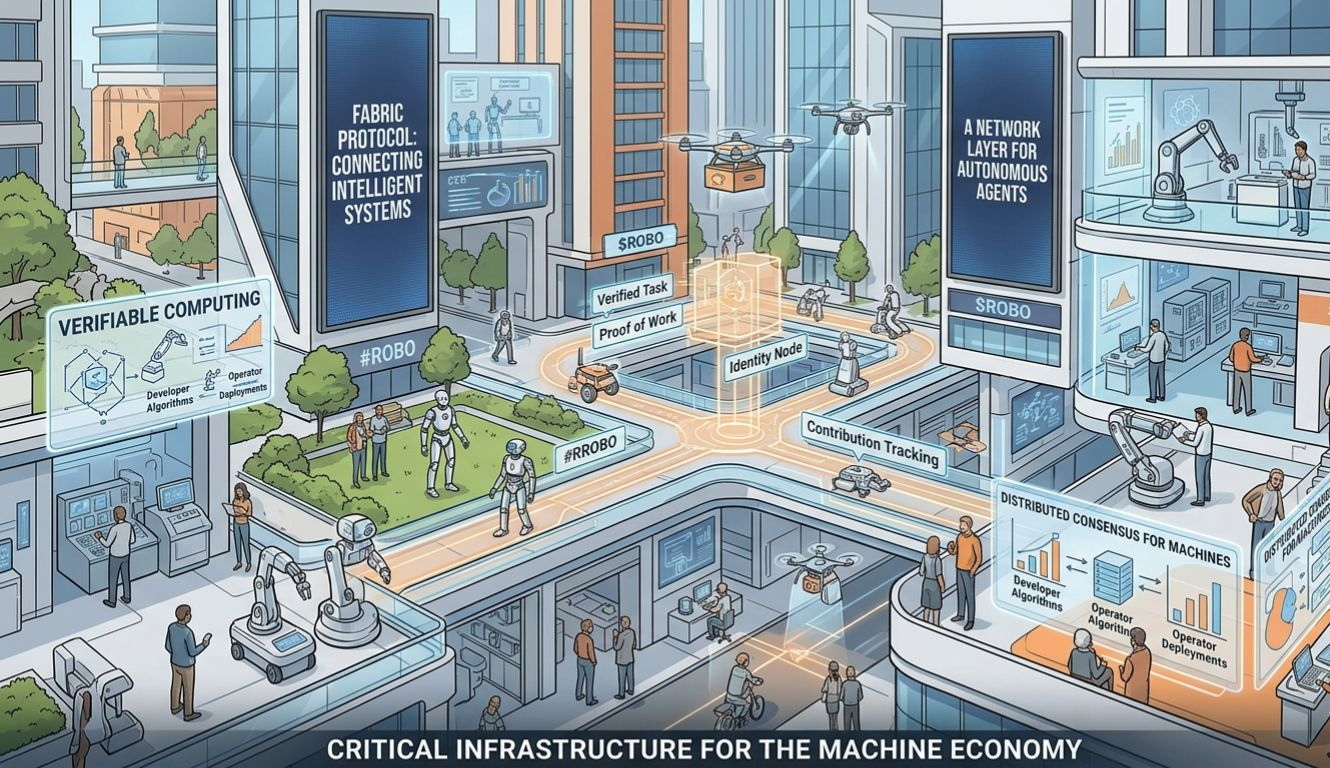
Instead of focusing only on building smarter machines, it explores the idea of creating a network layer for autonomous systems.
A system where robots and software agents can:
✔ Receive tasks
✔ Execute work
✔ Prove outcomes
✔ Interact with humans and other systems
✔ Operate inside transparent economic logic
At the core of this design is verifiable computing.
This technology allows machine actions and computational processes to be cryptographically verified, meaning robots can prove they performed the work they claim.
No blind trust.
No hidden processes.
Just transparent execution.
From Tools to Network Participants
Fabric introduces an interesting shift in perspective.
Traditionally, robots are treated purely as tools controlled by operators.
Fabric imagines something broader — machines functioning as participants in a distributed network.
Developers contribute algorithms.
Operators deploy machines.
Data providers supply information.
Robots perform tasks and generate measurable outcomes.
All of this activity can be coordinated and verified inside a shared system.
If it works, the result isn’t just a robotics platform.
It’s a collaborative ecosystem of intelligent agents interacting across an open infrastructure.
The Bigger Picture
Most projects focus on the visible side of AI: intelligence and performance.
Fabric focuses on something less glamorous but potentially more important:
the coordination layer.
Because when intelligent machines scale globally, the real challenge won’t just be capability.
It will be trust, verification, and coordination between different participants.
Whoever solves that layer could become critical infrastructure for the next generation of machine-driven systems.
Why It’s Worth Watching
Fabric Protocol is not presenting a simple or easy vision.
Building infrastructure for intelligent systems is complex and requires real-world adoption to succeed.
But the question it raises is important:
If machines become active participants in the global economy
what kind of network will coordinate their activity?
That answer doesn’t exist yet.
Which is exactly why projects exploring it are worth paying attention to.