
A lot of people are looking at ROBO the way the market usually looks at a new asset: fresh attention, trading activity, early volatility, and the possibility of a strong narrative run. I understand that. Crypto trains us to react fast. But the more I read Fabric Foundation’s official material, the more I feel that this is one of those cases where the token alone is not the full story. Fabric Foundation describes itself as a non-profit focused on open robotics and AGI, and its mission is not small. It says it wants to build the governance, economic, and coordination infrastructure that allows humans and intelligent machines to work together safely and productively. That immediately pushes the conversation beyond a normal launch narrative.
What really changed my view was understanding how Fabric frames the problem. Their argument is simple but important: the systems we use today were built for humans, not for autonomous machines. Humans can open bank accounts, hold IDs, sign contracts, and interact with existing institutions. Robots cannot do that in the same way. Fabric’s official thesis is that if intelligent machines are going to become real economic participants, they will need persistent identity, wallet-based payment rails, and transparent coordination systems. That is why the phrase “Own the Robot Economy” matters. It is not just branding. It is the core thesis behind the network.
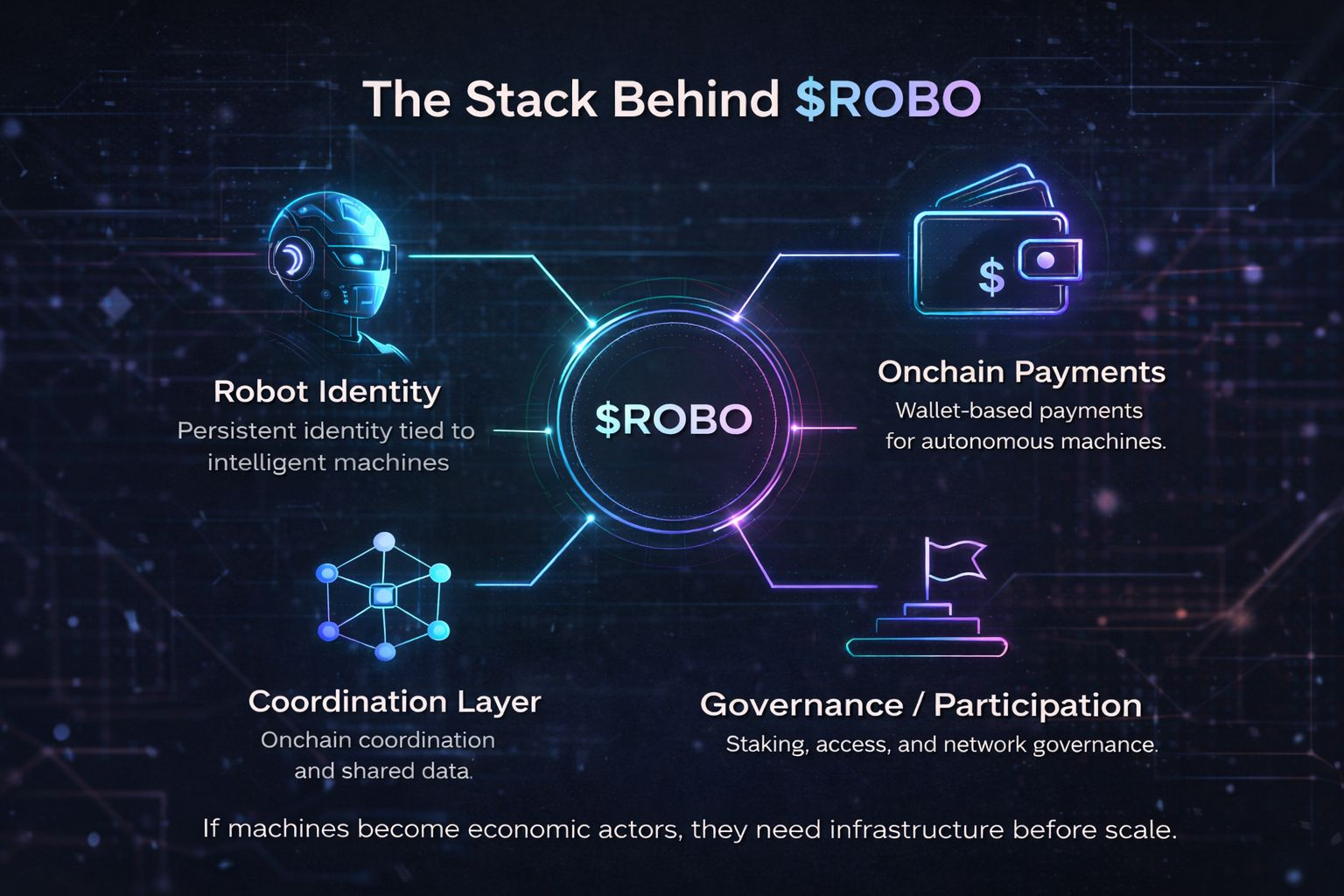
That is also why I think the market may still be underpricing the bigger idea. According to Fabric’s official token introduction, ROBO is the project’s core utility and governance asset. The stated use cases are wide enough to matter: network fees for payments, identity, and verification; staking and participation for coordination; builder access into the ecosystem; and governance over parts of the network’s operation. Fabric also says the network will launch on Base first and may later migrate to its own L1 as adoption grows. When I put those pieces together, I do not see a token that exists only for attention. I see a token designed to sit inside the economic logic of a machine network.
As a trader, I always come back to one question: am I looking at something built for velocity, or something built for long-term value capture? Velocity is easy to find in crypto. A token can move because it is new, because liquidity is flowing, or because the market is chasing a theme. But value capture is harder. It only becomes real when a token is tied to actual network behavior. Fabric’s material suggests that this is exactly what it wants to build: a system where robotic activity, payments, verification, coordination, and participation all connect back to the network. If that vision starts becoming tangible, then ROBO stops looking like a short-term narrative chip and starts looking more like economic infrastructure.
Another reason I’m taking this seriously is that Fabric is not pretending everything is already solved. Their own writing is clear that the project is still early, and that large-scale robotic fleets will still require deployment partnerships, operational maturity, insurance frameworks, and reliable service contracts. I actually like that realism. It is more credible when a project acknowledges what still needs to happen. At the same time, Fabric’s broader argument is that the world is moving toward a moment where AI systems are becoming more useful in physical environments, hardware is getting cheaper and more reliable, and labor shortages are creating pressure for automation. If that trend continues, then the need for machine-native identity, payment, and coordination infrastructure stops sounding theoretical and starts sounding necessary.
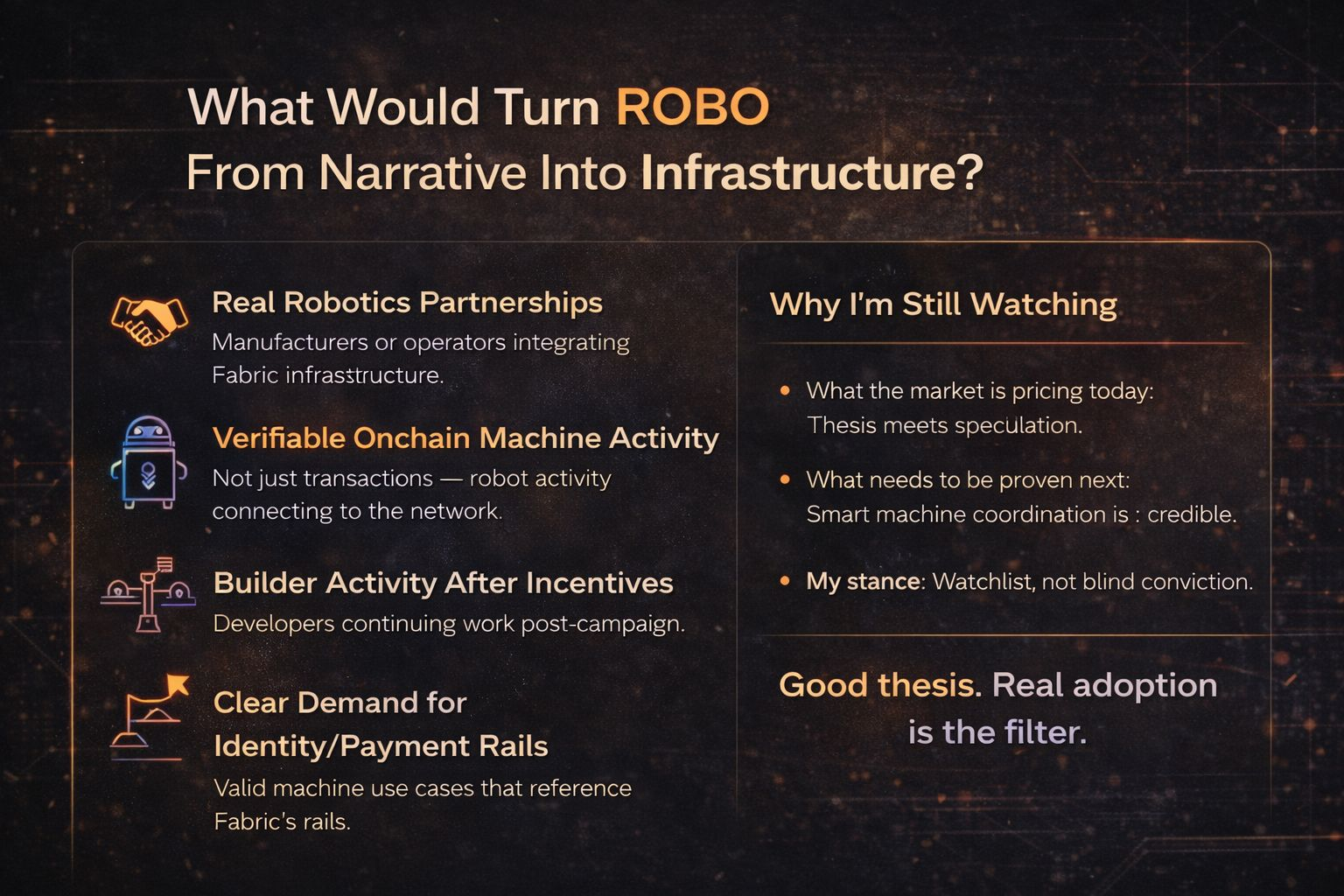
I also think there is an important psychological gap in how the market reads projects like this. Most people are comfortable pricing software narratives. Fewer people know how to price infrastructure for embodied AI and robotics. That gap creates confusion, but it also creates opportunity. When a market does not fully understand the category yet, it tends to reduce everything to price action. That is why I think many people are still watching $ROBO mainly as a chart. I’m not ignoring the chart, but I think the bigger question is whether Fabric can become a credible coordination layer for intelligent machines over time. If the answer starts becoming yes, then the upside in attention may not come from hype alone. It may come from the market finally realizing that the token was attached to a much larger system all along.
For me, that is the real reason to keep $ROBO on the radar. Not because every new token deserves excitement, but because some launches carry a deeper thesis underneath them. Fabric Foundation is trying to build open infrastructure for a future where robots need identity, payments, verification, and coordination just like any other serious economic actor. That is a much bigger frame than a short-term campaign. The market may still be treating $ROBO like a token story. I think the more interesting possibility is that it is an early infrastructure story instead.