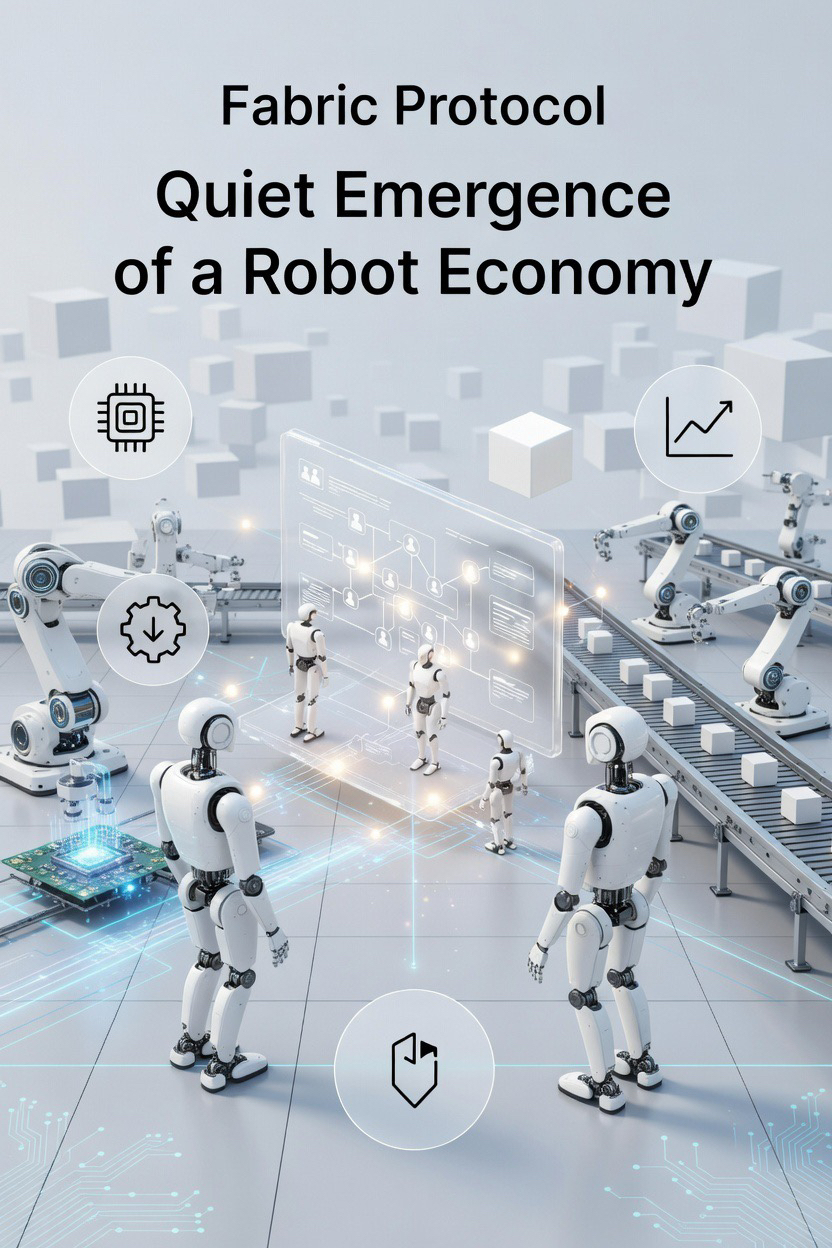
For a long time, robots have existed at the edges of human activity. They built cars in factory lines, sorted packages in warehouses, and occasionally appeared in research labs performing delicate experiments. Most of the time they worked quietly behind the scenes, controlled by tightly managed software systems and corporate infrastructure. But the landscape of robotics is slowly shifting. Machines are becoming more intelligent, more mobile, and more capable of operating in messy real-world environments. As that shift happens, a new question begins to surface—where exactly do these machines belong within the systems humans have built to organize work, trust, and value?
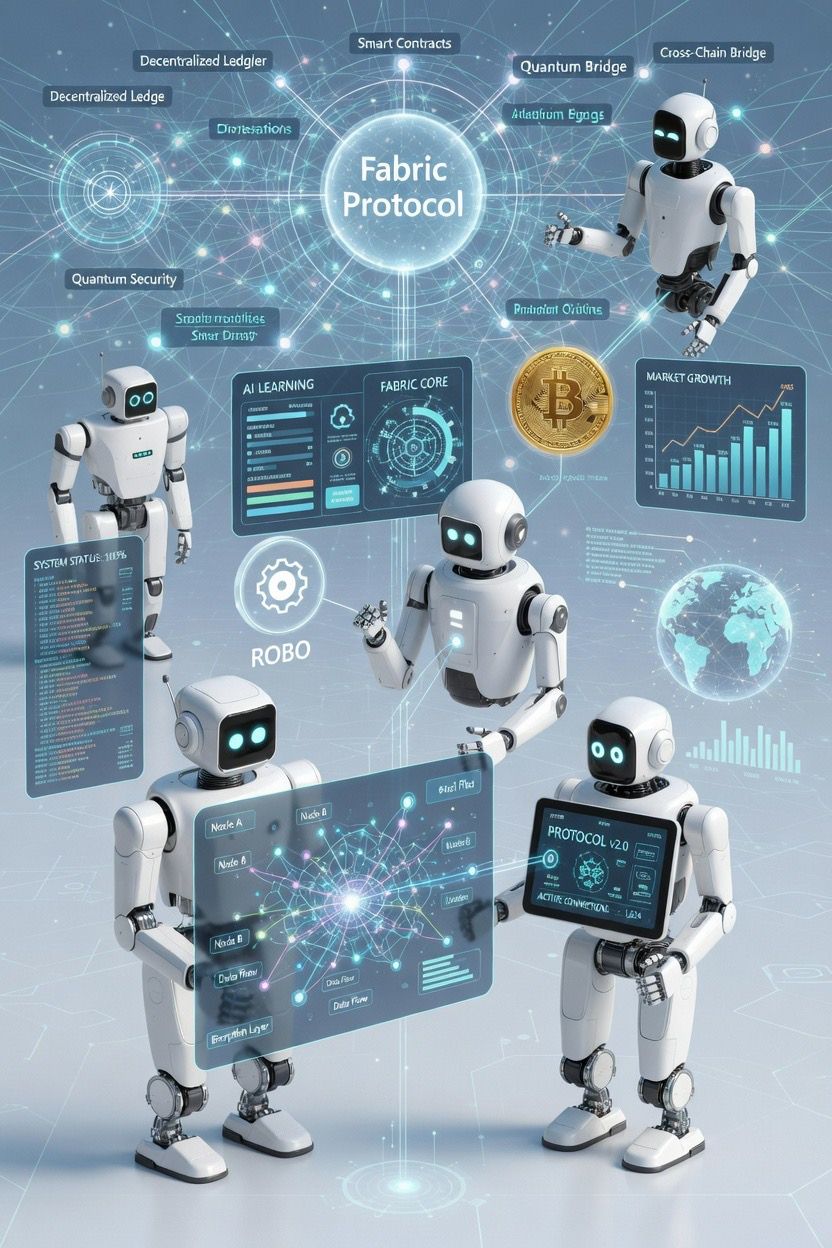
Fabric Protocol is an attempt to answer that question, though not in the way most people might expect. It does not focus on designing a particular robot or building a specific type of AI. Instead, it asks something more foundational: if millions of autonomous machines begin to operate across cities, industries, and homes, what kind of infrastructure will allow them to interact safely with people and with each other? The idea behind Fabric is to create a shared network where robots, humans, and intelligent agents can coordinate activity in a transparent and verifiable way.
At first glance the concept feels almost abstract, but the motivation behind it is quite practical. Today, robots usually operate inside closed systems. A warehouse robot works within the infrastructure of a single company. A delivery robot belongs to one platform. A medical robot is controlled by the software stack of a specific manufacturer. Each of these machines exists inside its own technological silo. Fabric Protocol imagines a different world—one where robots are connected to an open network that allows them to interact across systems, much like computers communicate across the internet.
In that environment, a robot would not simply be a device executing instructions from a central server. Instead, it would function as a participant in a broader network. The protocol gives machines a form of digital identity that allows them to record their activities, communicate with other machines, and participate in structured tasks. These interactions are anchored to a public ledger that acts like a shared record of what the network is doing. For humans observing the system, this record becomes a window into machine behavior. It makes the actions of autonomous systems visible rather than hidden behind proprietary software layers.
Transparency is an important part of the story because robots are increasingly stepping into spaces where trust matters. When machines assist in hospitals, operate in public infrastructure, or interact with people in daily environments, their decisions cannot remain mysterious. Fabric approaches this challenge through verifiable computing, a framework that allows the operations of machines to be checked and recorded in a reliable way. Instead of simply trusting that a robot followed its instructions, participants on the network can verify what actually happened.
Another intriguing aspect of the protocol lies in how it treats robotic capabilities. Traditionally, robots are built for specific purposes. A machine designed for logistics is unlikely to perform agricultural tasks, and a robot trained for inspection cannot easily shift into another role. Fabric encourages a more flexible model by allowing developers to contribute modular capabilities that machines can adopt. In simple terms, robots connected to the network can gain new skills over time. The hardware remains the same, but the abilities evolve as new software components become available.
This modular structure opens the door to something that resembles an ecosystem. Engineers, researchers, and developers can build tools and algorithms that expand what robots can do, while operators connect real machines to the network. The result is a growing library of capabilities that any compatible robot might eventually access. Instead of isolated machines performing static functions, the system begins to resemble a living technological environment where abilities circulate and improve collectively.
Of course, coordination at this scale requires an economic layer. Fabric introduces a digital token known as ROBO that helps the network manage payments, incentives, and governance decisions. When robots perform tasks or when developers contribute useful components, value can move through the system in a programmable way. This mechanism allows the network to reward contributions and organize the work being done by machines.
The idea of robots earning or transferring value may sound unusual, but it reflects a broader shift in how technology interacts with economic systems. If machines are carrying out services—delivering goods, inspecting infrastructure, assisting in manufacturing—there must be some way to account for that work. Fabric attempts to create a financial structure designed specifically for machine activity, rather than forcing robots to rely entirely on human-managed institutions.
Behind the protocol is the Fabric Foundation, a nonprofit organization focused on guiding the development of the network. Its role is less about controlling the technology and more about ensuring that the system evolves responsibly. As robotics becomes more deeply embedded in society, questions about governance, safety, and alignment become unavoidable. The foundation acts as a steward for these discussions while supporting research and development around the protocol.
Recent developments suggest that the project is beginning to move from concept to implementation. The introduction of the ROBO token has started to establish the economic layer of the network, and early participants are exploring how robots and developers might interact within the system. Venture capital interest in robotics infrastructure has also grown, reflecting a wider belief that autonomous machines will soon become an important part of the global economy.
Still, Fabric Protocol is best understood not as a finished solution but as an experiment in how the future might work. The number of robots operating in the world is expected to grow dramatically over the coming decades. They will build things, move goods, maintain infrastructure, and assist people in countless ways. As that happens, the systems that coordinate human work may no longer be enough.
Fabric’s proposal is simple in spirit, even if it is technically ambitious: build a network where humans and machines can collaborate openly, where robot behavior can be verified, and where the value created by autonomous systems can circulate transparently. If the experiment succeeds, it could quietly reshape how societies think about machines—not just as tools that perform tasks, but as participants in a shared technological environment that humans and robots build together.
$ROBO #ROBO @Fabric Foundation