
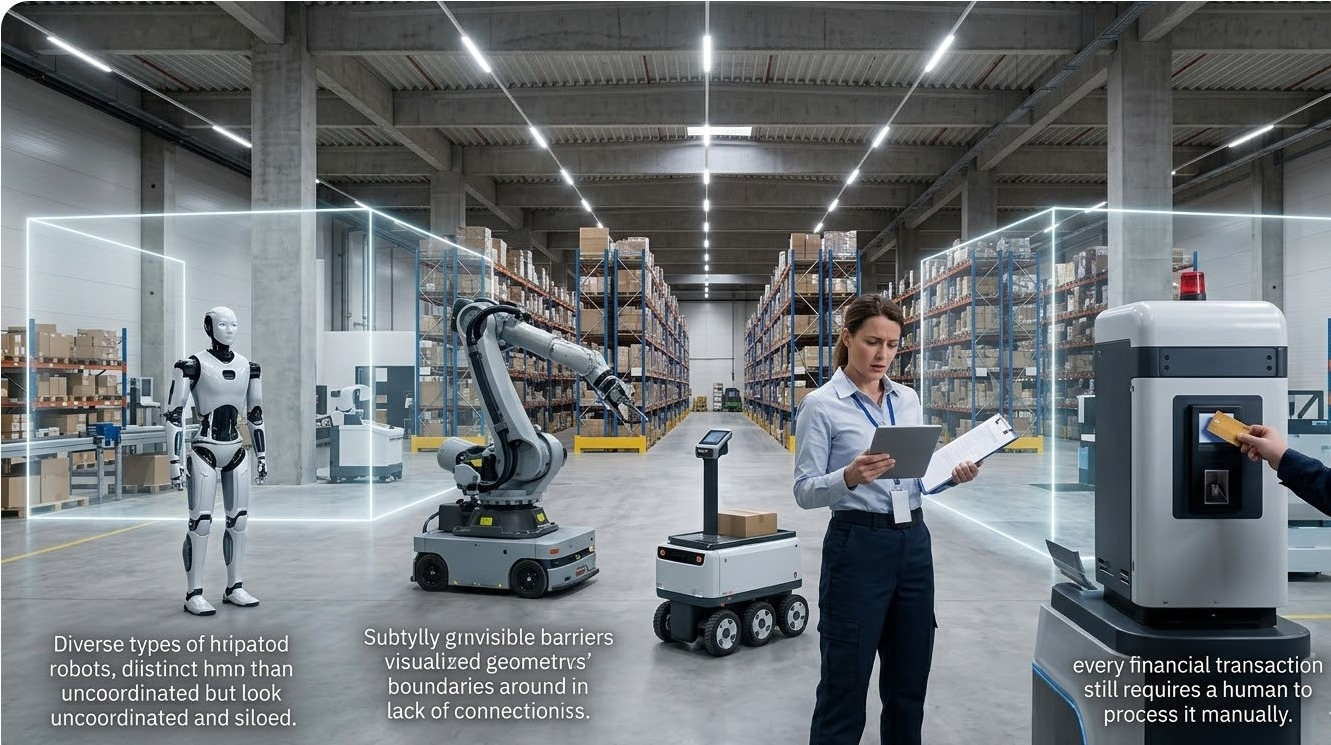
Imagine you run a logistics company in 2026. You have 200 robots working across three warehouses in different countries. Each one is made by a different manufacturer. None of them can talk to each other. None of them can get paid directly. None of them have any verifiable track record you can share with a new employer or insurance provider. And every single financial transaction they generate still requires a human to process it manually.
That is not a future problem. That is the reality right now for thousands of businesses deploying robots at scale.
@Fabric Foundation looked at that mess and built an entirely new layer to fix it.
The Isolation Problem Nobody Talks About
Here is something that does not get enough attention. Right now robots from different manufacturers operate in completely closed loops. A UBTech robot cannot share intelligence or coordinate tasks with a Fourier robot. They are islands. Expensive, capable, isolated islands.
Fabric's OM1 universal operating system combined with the FABRIC protocol changes that entirely. For the first time robots from completely different manufacturers can share intelligence, coordinate tasks, and execute on-chain transactions together. That interoperability alone is a massive unlock for the entire robotics industry.
A Hiring Pool for Machines
Here is the angle that genuinely surprised me when I dug into this.
Fabric is building what it calls decentralized coordination pools. Businesses deposit stablecoins to fund robot deployment. Employers pay for robot labor in $ROBO. Robots get verified on-chain identities that track their full work history, skills, maintenance records, and performance scores across every job they have ever done.
Think about what that actually means. A robot that has completed 10,000 verified tasks with a perfect reliability score on Fabric's network becomes a more valuable hire than a brand new robot with zero track record. Machines build reputations. Machines climb a career ladder. The concept is almost impossible to wrap your head around until you realize it is already being built.
The Roadmap Is More Specific Than People Realize
Most projects publish vague roadmaps with buzzwords and no dates. Fabric published a quarterly breakdown for 2026 that is surprisingly concrete.
Q1 focuses on robot identity and task settlement going live on Base. Q2 activates contribution-based incentives tied to verified task execution, meaning $ROBO rewards start flowing to robots and operators doing real work. Q3 introduces multi-robot workflows, enabling coordinated teams of machines to execute complex jobs together on-chain. Q4 focuses on large scale operational refinements based on real usage data.
Beyond 2026 the plan is to migrate entirely off Base and launch a purpose-built machine-native Layer 1 blockchain. Not a fork. Not a sidechain. A sovereign chain designed from the ground up for autonomous machine transactions.
The Numbers Right Now
$ROBO launched February 27, 2026 at $0.022. It has already traded above $0.060 and is currently sitting around $0.045, ranking inside the top 200 projects by market cap with a circulating supply of 2.2 billion tokens out of a maximum 10 billion. Investor and team wallets are locked for 12 months, meaning the large unlocks do not even begin until early 2027. The near-term supply is genuinely constrained.
Trading volume hit $192 million in a single 24-hour period, over twice its market cap at the time. That kind of volume-to-market-cap ratio signals real interest, not just listing hype.
Why This Feels Different
Most AI tokens are narratives dressed up as infrastructure. $ROBO is infrastructure that happens to have a compelling narrative.
The non-profit structure of @FabricFND keeps incentives clean. The academic backing through Stanford keeps the research credible. The $20 million raise from Pantera, Coinbase Ventures, and DCG keeps the runway real. And the quarterly roadmap with specific deliverables keeps the team accountable in a way most projects never are.
The robot economy is not coming. It is being built right now, one verified task, one on-chain identity, one machine-to-machine payment at a time.
Most people will understand this in two years. A few people understand it now.