
I started taking verifier routing seriously on a day when nothing looked controversial at all.
The claim closed. The receipt looked normal. No obvious dispute. No noisy failure. But when I replayed the path, what bothered me was not the verdict. It was the route the claim had taken before the verdict ever had a chance to appear.
That was when routing stopped looking like plumbing.
It started looking like quiet policy.
Mira gets described in a clean way for good reason. Break output into claims. Send those claims to independent verifiers. Let consensus settle what stands. That is already sharper than most vague AI reliability language. But the part that matters here comes earlier than consensus. Before a claim is agreed on, it has already been sent somewhere. Through a certain domain mix. Through a certain verifier path. Through a certain context surface.
And that choice is not neutral.
The same claim can look very different depending on where it lands first.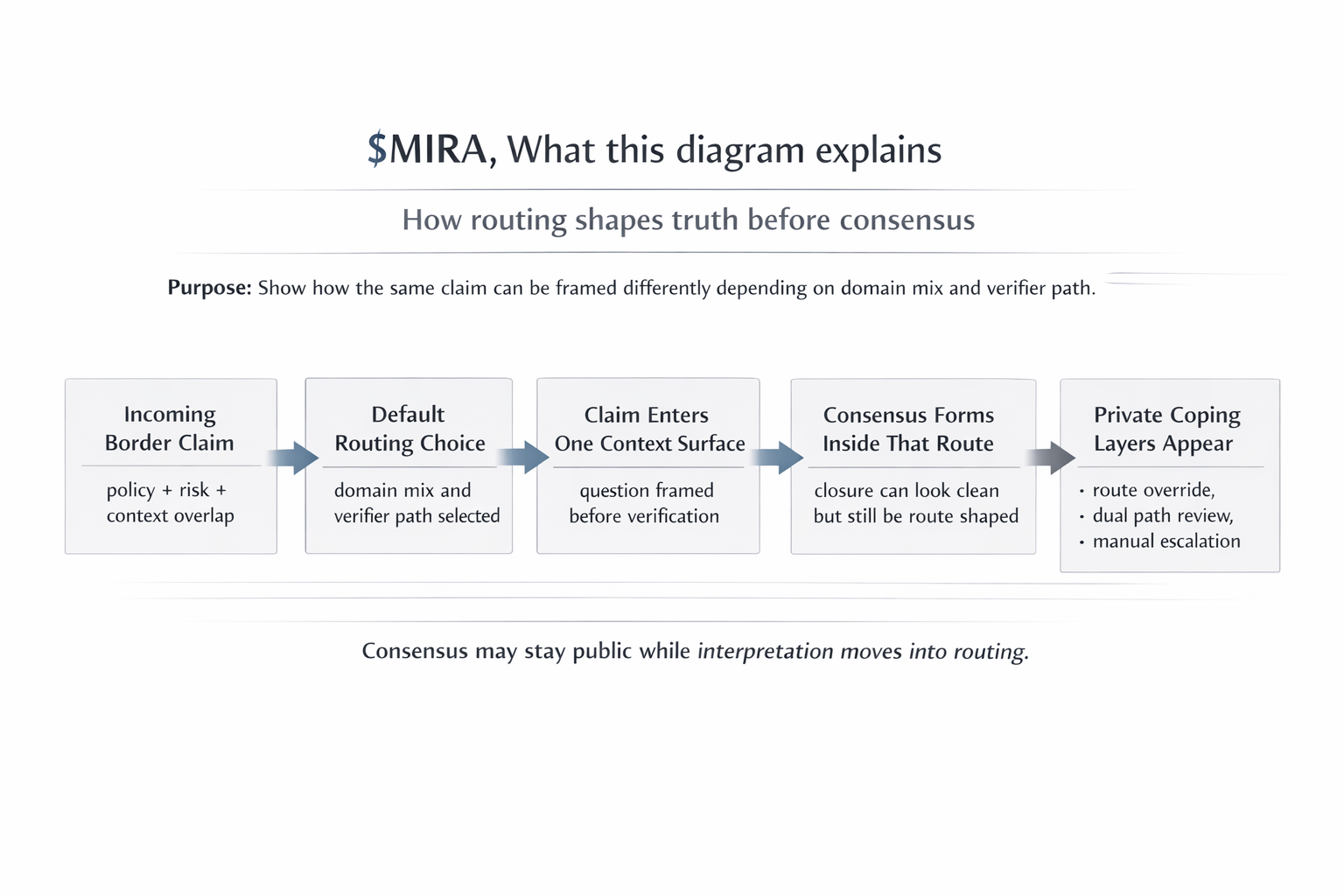
Not because the final vote failed.
Because the question was framed earlier.
You see it most clearly on border claims. Not the easy ones. The ones that sit between categories. A claim that touches policy and risk at the same time. A claim that reads factual on the surface but carries domain interpretation underneath. A claim that looks ordinary if it goes one way, and high consequence if it goes another.
That is where the path starts showing its hand.
Routing does more than distribute load.
It frames the question.
A verifier network can look broad on the surface while routing quietly decides which kind of truth gets a chance to win.
That matters more on Mira than it first seems. Mira is not a single model product pretending to be rigorous after the fact. It is a verification architecture. Once you take that seriously, the path into verification stops looking like infrastructure and starts looking like epistemic policy. If a claim is sent through a narrow domain mix, the closure you get may still be internally coherent. That does not mean it was exposed to the right tension. It may only mean the system chose a cleaner surface before consensus began.
Teams notice fast when that starts happening.
First comes a private route override. Sensitive claims get sent through a second path before anyone trusts the first receipt. Then comes dual route review. One lane for ordinary closure, another for claims whose meaning changes with domain context. After that, someone builds a route registry, an internal map of which claims are too sharp to trust on the default path. It starts as a safety patch. It ends as local law.
That is when the shared layer stops being the whole story.
The receipt still matters.
The route matters more.
You can feel the drift before you can always see it in the dashboard. Throughput may look fine. Disputes may stay low. Closure rates may still look healthy. What changes is quieter than that. More teams begin treating the default path as a first pass instead of a final decision surface. They stop trusting a clean close unless they know what domain mix and verifier path produced it.
Once that happens, decentralization splits in 2.
Consensus stays public.
Interpretation moves private.
And private interpretation is where quiet centralization grows. Better teams build better routing discipline. They maintain cross domain checks. They know when a default lane is too flattering. Smaller teams often do not have that luxury. They inherit the badge, trust the surface, and only learn the difference when a border claim behaves badly enough to trigger a review nobody planned to need.
That is not a small operational gap.
It is the difference between a network that verifies claims and a network that also preserves the conditions under which those claims deserved to be verified that way.
The hard part is that routing always wants to look innocent. It sounds like efficiency. It sounds like flow control. It sounds like one of those boring implementation details nobody writes about. But if the path changes which context gets to frame the claim, then routing is no longer only about speed. It is helping decide what counts as a valid surface for truth in the first place.
So I would not test this by disagreement alone.
I would test it by route sensitivity.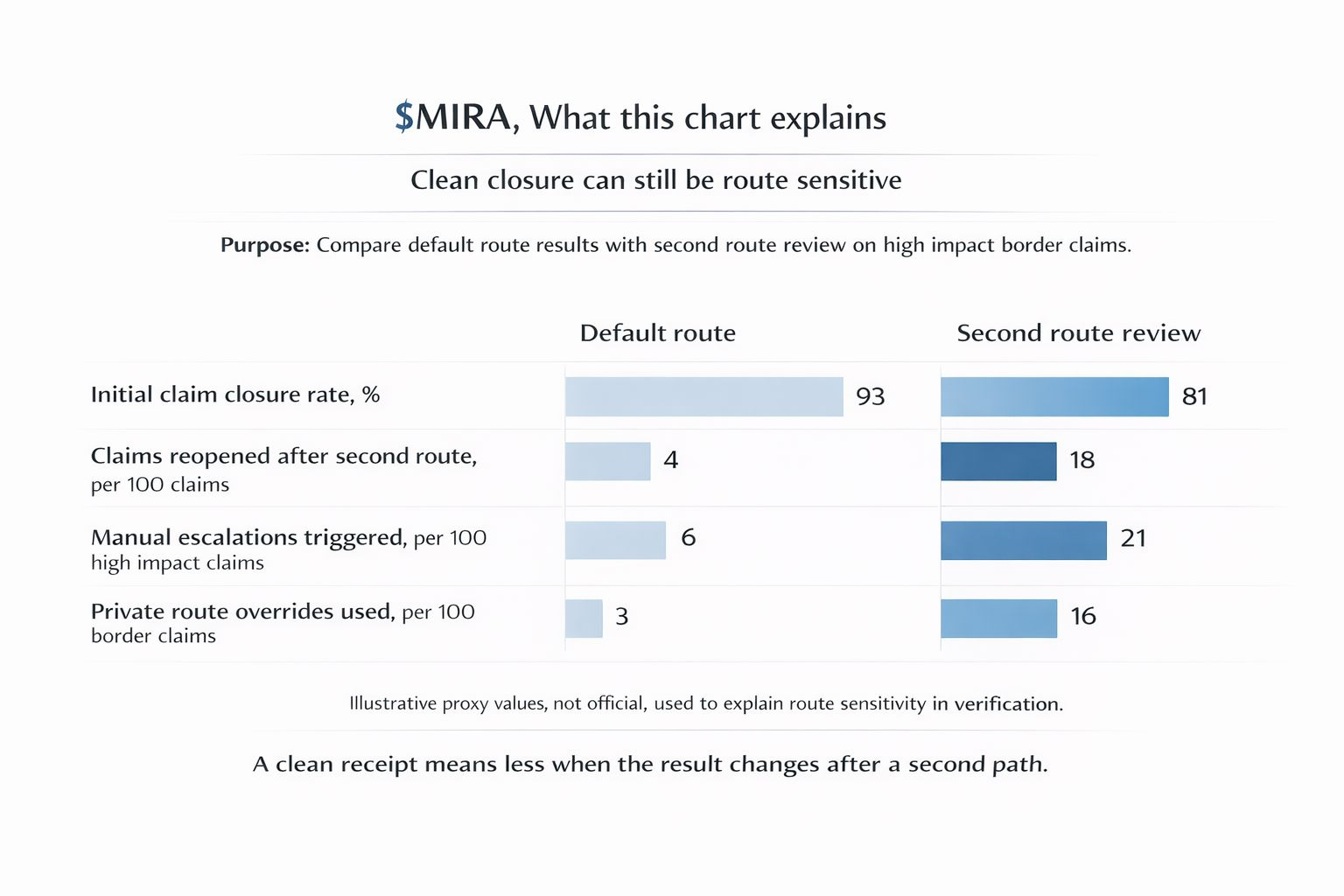
If a claim changes character when it crosses domain boundaries, does Mira make that visible. Or does the network still return a clean closure that hides how much the path shaped the outcome before consensus ever touched it.
That is where the coping layers multiply. Cross domain escalations. Manual review for border claims. Dual path verification on high impact actions. Private allowlists for trusted verifier mixes. Product rules that say a claim can only close automatically if it survives more than 1 path.
Teams call this reliability work.
It is.
It is also the ecosystem admitting that routing has already become part of the truth model.
Fixing that honestly will not look pretty. A system that exposes route sensitivity more clearly will look less clean. More claims will reopen. More receipts will carry path context teams cannot ignore. More border cases will refuse to close quickly on the default lane. Builders will complain that the network got slower and noisier. Some of that criticism will be fair.
But the alternative is worse.
You end up with a verifier network that looks decentralized at the verdict layer while policy quietly relocates into routing choices no one wants to call policy.
That is not neutral infrastructure.
That is hidden governance with better UI.
The token matters only if it pays for that burden in practice. If $MIRA matters here, it should help fund the discipline that keeps routing from collapsing into private truth management. Cross domain verification where needed. Path transparency. More expensive handling for claims whose meaning depends on where they were sent. Incentives that make it costly to let the default path quietly flatten a claim that should have been exposed to more tension before it closed.
If that coupling is weak, the pattern is easy to predict. The network will keep returning clean receipts. Serious teams will keep building private route intelligence behind them. The public surface will stay simple. The real decision logic will move inward.
The real test shows up when a sharp claim takes a second path. Does closure stay stable for the right reason, or only because the system keeps flattening the context. Do sensitive claims survive a second domain path, or does the second route reveal that the first one was too narrow. Do private route overrides shrink over time, or do they become permanent product law. And when a claim sits on the border between 2 truth surfaces, does Mira make that tension legible, or does routing quietly decide the answer before consensus even begins.