
Artificial Intelligence is transforming industries at an unprecedented pace. From healthcare and finance to education and research, AI systems are becoming essential tools for decision-making and automation. However, one critical challenge continues to limit the full potential of AI: reliability.
Many modern AI systems generate answers that sound convincing but may contain incorrect information, bias, or fabricated facts. These issues, commonly known as AI hallucinations, make it risky to rely on AI in high-stakes environments where accuracy matters. This is the exact problem that Mira Network aims to solve.
The Core Idea Behind Mira Network
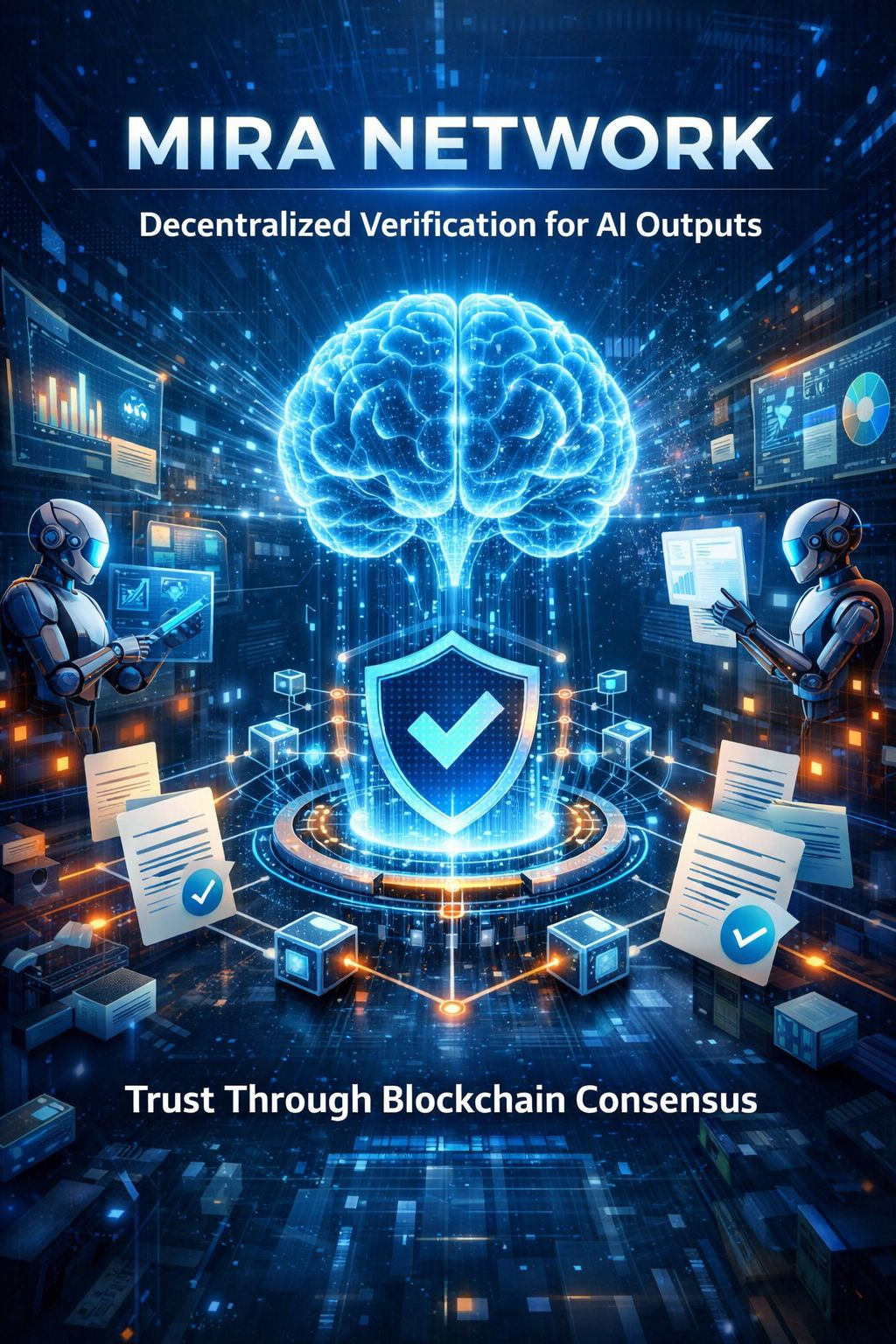
Mira Network is a decentralized verification protocol designed to create a trust layer for artificial intelligence. Instead of blindly accepting the output of a single AI model, Mira verifies information through a decentralized system powered by blockchain technology.
CoinMarketCap
The network transforms AI-generated responses into verifiable claims, which are then evaluated by multiple independent AI models. These models analyze the claims separately and reach a consensus on whether the information is accurate.
CoinMarketCap +1
By combining decentralized infrastructure with multi-model validation, Mira ensures that AI results are checked, verified, and trustworthy before they are used in real-world applications.
How the Verification Process Works
The Mira protocol follows a structured process to validate AI outputs:
1. Claim Extraction
Complex AI responses are broken down into smaller factual claims that can be independently verified.
2. Distributed Verification
These claims are distributed across a network of validator nodes running different AI models. Each model analyzes the claim separately.
3. Consensus Mechanism
The network reaches a consensus based on the collective evaluation of the models. Only claims that achieve a strong agreement are accepted as verified.
4. Cryptographic Proof
Verified outputs receive cryptographic certificates that provide transparency and auditability.
This decentralized verification model significantly improves reliability and helps reduce AI hallucination rates while increasing factual accuracy.
The Role of the MIRA Token
The ecosystem is powered by the MIRA token, which plays a key role in securing and operating the network.
The token enables:
Staking: Node operators stake tokens to participate in verification.
Network Security: Honest validators are rewarded while dishonest actors face penalties.
Payment for Verification Services: Developers pay in $MIRA to access the verification infrastructure.
Governance: Token holders can participate in protocol decisions.
This economic system ensures that participants are incentivized to maintain the accuracy and integrity of the network.
CoinMarketCap +1
Why Mira Matters for the Future of AI
As AI becomes more integrated into critical sectors, trust becomes the most important factor. Applications in healthcare, law, finance, and autonomous systems require reliable information that can be verified independently.
Mira Network addresses this challenge by introducing decentralized truth verification for AI systems. Instead of relying on a single company or model, the network uses distributed consensus and cryptographic proofs to validate information.
This approach transforms AI from a probabilistic tool into a verifiable intelligence infrastructure.
The Bigger Vision
The long-term vision of Mira Network is to build a global infrastructure where AI outputs are not just generated but cryptographically verified and economically secured. By combining blockchain technology with artificial intelligence, Mira is laying the foundation for trustworthy autonomous systems.
In a world where AI-generated information is growing exponentially, verification will become as important as creation itself.
Mira Network is not just improving AI accuracy — it is building the future trust layer for intelligent machines.
#Mira $MIRA @Mira - Trust Layer of AI
