
In the era of Industry 4.0, AI and blockchain are becoming the most innovative and promising fields. Combining these two technologies, Mira Network has emerged as a pioneering platform in building decentralized AI verification systems. Mira not only emphasizes transparency and trustworthiness but also provides strong support for developers in building and deploying AI applications. So what makes Mira Network special?
What is Mira Network?
Mira Network is a decentralized network designed to ensure that artificial intelligence (AI) outputs are reliable and accurate. Instead of relying on a central system, Mira uses a consensus mechanism among multiple AI models to verify information. Complex content is broken down into individual statements, which the AI models then collectively examine and reach a consensus on their validity.

Specifically, Mira combines both Proof-of-Work (PoW) and Proof-of-Stake (PoS) mechanisms, creating economic incentives for verifying honesty and penalizing fraudulent behavior. The network is also designed to protect privacy by distributing information randomly and keeping responses confidential. With the goal of providing a reliable platform for AI applications, Mira not only addresses the issues of illusion and bias but also opens the door to a more transparent and secure AI ecosystem.
The Unique Feature of Mira Network
The unique feature of Mira Network is its dynamic nature as a decentralized AI verification platform, focused on ensuring the reliability of AI-generated results. Upon receiving content from users, the system transforms this content into small, independent, and easily verifiable claims, reducing complexity and increasing accuracy.
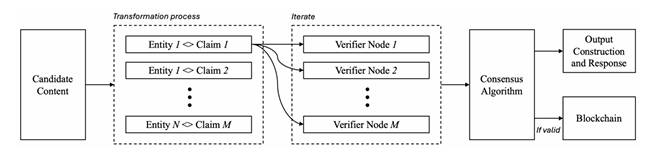
These statements are then randomly distributed to nodes in the network, which are servers running specialized AI models to perform the verification. Mira employs a consensus mechanism that combines Proof of Work (PoW) and Proof of Stake (PoS), where PoW transforms the verification process into meaningful mathematical problems, while PoS ensures nodes operate honestly by requiring them to stake
assets and incur penalties for fraud.
After the nodes complete the verification, the results are aggregated to reach a consensus and create a cryptographic certificate acknowledging the accuracy of the content. The entire process is designed to protect user privacy by fragmenting the content, distributing it randomly, and keeping the responses confidential until a consensus is reached. With this approach, Mira offers an efficient and secure solution, helping to build trust in AI applications in a decentralized environment.
Features of Mira Network:
- Decentralized AI infrastructure: Provides a ready-to-use library of tools and processes, supporting developers in building AI applications, with transparent ownership of the AI stream.
- Decentralized AI verification: Breaks down complex content into verifiable statements by a diverse network of AI models, ensuring objectivity and preventing manipulation.
- PoW-PoS consensus mechanism: Combines Proof-of-Work to create verification questions and Proof-of-Stake to reward or penalize nodes based on accuracy.
- Transparency and value distribution: Payments and value allocation within the network are clearly documented, ensuring benefits for participants.
- Security and privacy: Data is fragmented, randomly distributed, and verification responses are secure until consensus is reached.
- Diversity and scalability: Utilizes multiple AI models to reduce bias and improve the efficiency of big data processing. - Verified economy: Creating value by providing verified AI outputs, with service fees shared among network participants.
Mira Network Project Development Team

- Karan Sirdesai (Co-Founder, CEO): Experienced in investing in crypto, AI, and software at Accel, previously worked at BCG.
- Sid Doddipalli (Co-Founder, CTO): Former CTO of Stader Labs, formerly Chief Architect at FreeWheel, with educational backgrounds from Columbia and IIT Madras.
- Ninad Naik (Head of Research and Product): Formerly Global Marketplace Director at Uber Eats, GM at Amazon AI, with degrees from Columbia University and the University of Michigan.
- Stone Gettings (Head of Growth): Invested in technology at Accel and formerly a professional basketball player, graduated from Cornell University.
- Hamid Raza (Head of Engineering): Former engineer at Disney+ Asia and Swiggy, with experience in large-scale digital product development.
- Pragun Dua (Head of Design): He has built and sold numerous AI applications and rebranded the largest web3 community in Southeast Asia (Superteam).
Investors in the Mira Network project
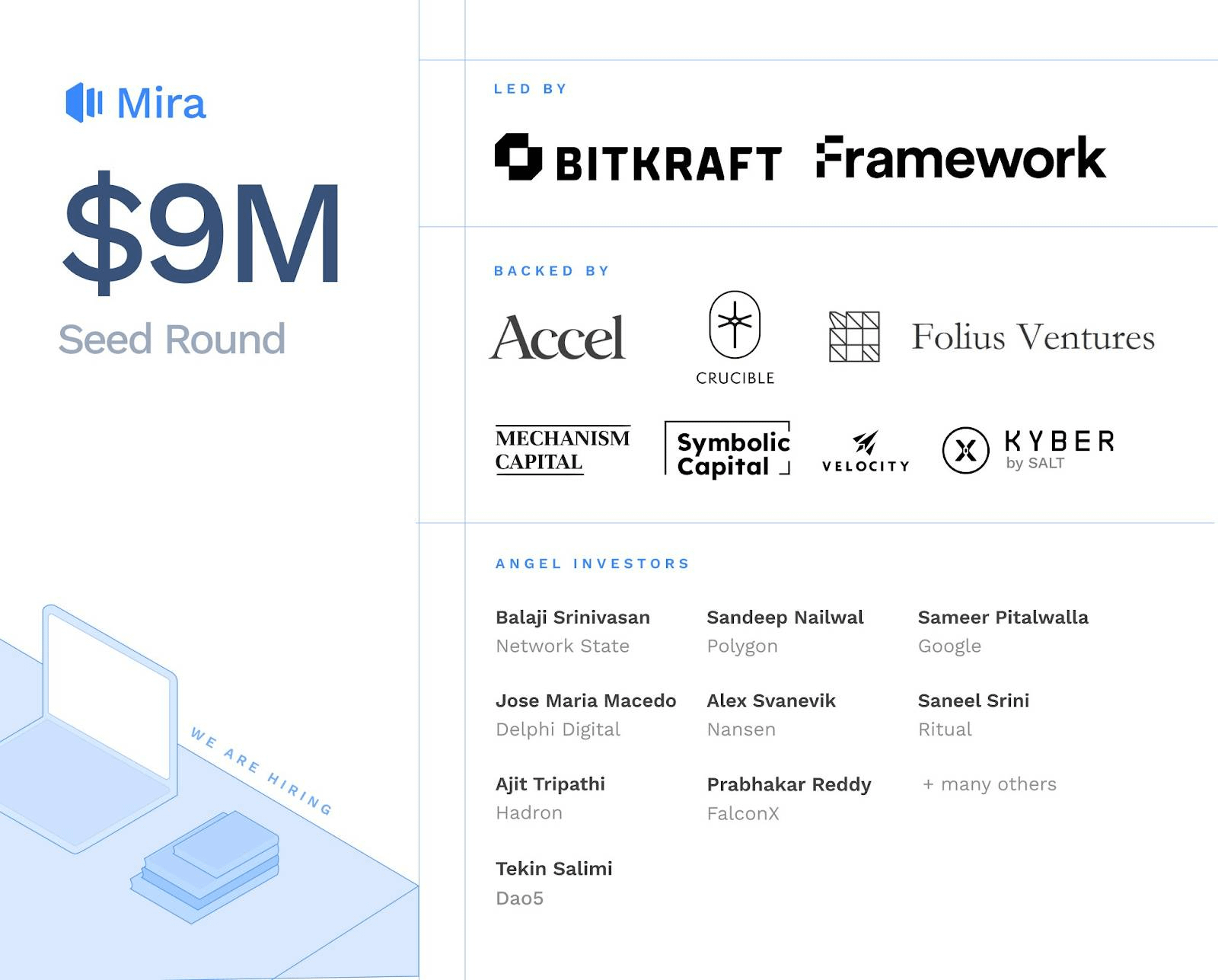
The Mira project successfully raised $9 million in its Seed funding round, led by Bitkraft Ventures and Framework Ventures, with participation from major investors such as Accel, Mechanism Capital, Folius Ventures, and SALT Fund managed by AJ Scaramucci.
$MIRA @Mira - Trust Layer of AI
