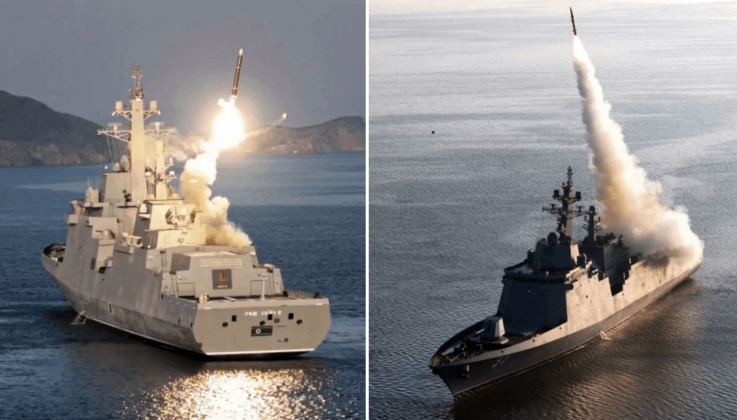
The geopolitical landscape of the Asia-Pacific is shifting rapidly. Chairman Kim Jong Un has officially announced a revolutionary schedule for destroyer production, aiming to transform the Korean People’s Army Navy into a formidable blue-water force. 🌊
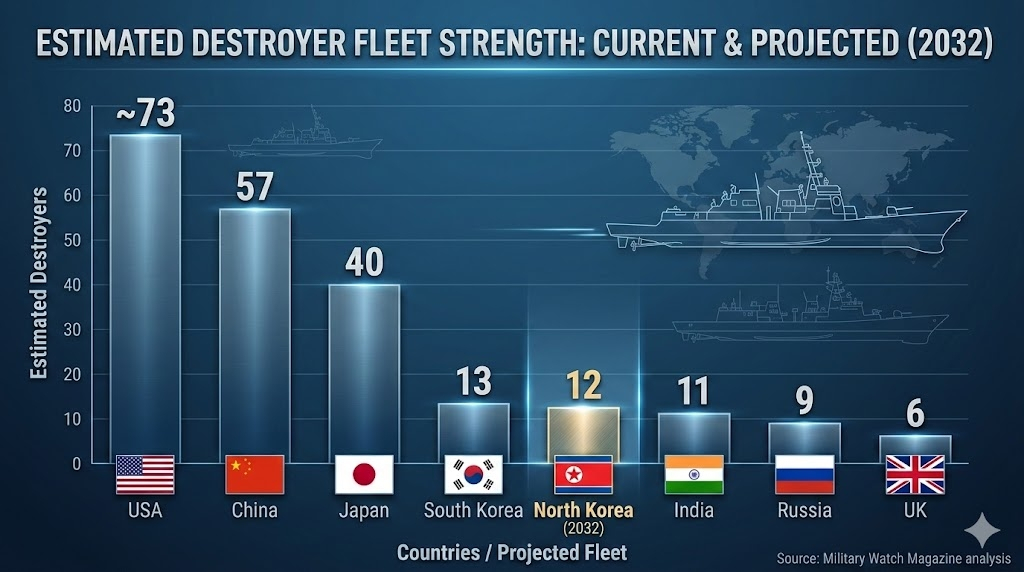
According to recent reports, North Korea is on track to field 12 destroyers by 2032, a move that would see it overtake established naval powers like Russia, France, and the United Kingdom. 🇰🇵⚓
🔹 Key Highlights of the "Choe Hyon" Class:
Massive Firepower: Each vessel integrates 74 vertical launch cells, outclassing many European counterparts. 🚀
Advanced Weaponry: The fleet is expected to carry Hwasong-11 ballistic missiles, Hwasal-2 cruise missiles, and potentially even hypersonic cruise missiles similar to the Russian Zircon. ⚡
Rapid Production: With two ships already in the water—the Choe Hyon and the Kang Kon—the DPRK plans to launch two surface combatants every year.
🔹 Global Comparison (Estimated Destroyer Counts):
🇺🇸 United States: ~73 Destroyers
🇨🇳 China: 57 Destroyers
🇯🇵 Japan: 40 Destroyers
🇰🇷 South Korea: 13 Destroyers
🇰🇵 North Korea (by 2032): 12 Destroyers
🇮🇳 India: 11 Destroyers
🇷🇺 Russia: 9 Destroyers
🇫🇷 France: 10 Destroyers
🇬🇧 United Kingdom: 6 Destroyers
While Western analysts previously doubted the ambitious timeline—especially following a launch accident with the Kang Kon in 2025—the vessel was remarkably relaunched just 22 days later, signaling a high level of industrial resilience. 🛠️
As these nuclear-capable destroyers begin pre-commissioning trials and live-fire exercises, the U.S. Department of War and global observers are watching closely. The emergence of North Korea as a leading ocean-going force marks a significant turning point in international naval dynamics. 🌏🛰️
#MilitaryWatch #NavalPower #NorthKorea #Geopolitics #DefenseNews