
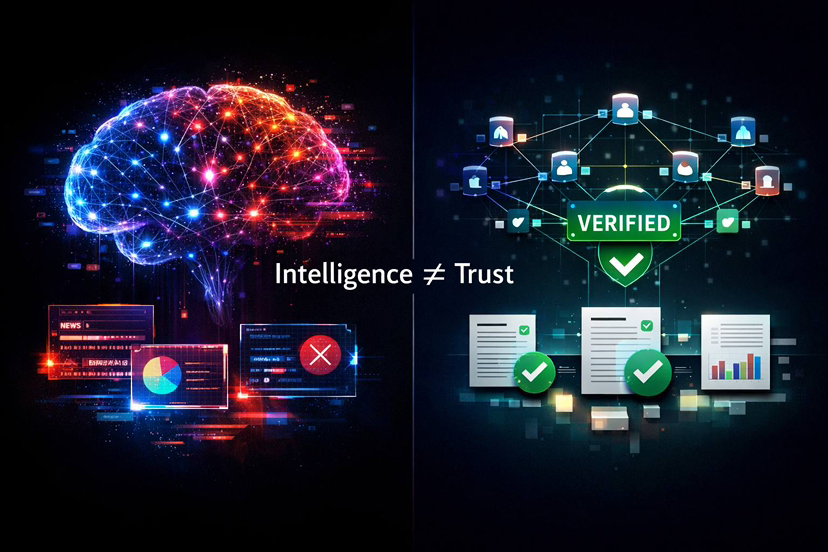
In aviation, every commercial aircraft carries a device that passengers rarely think about but regulators consider indispensable: the flight recorder, more commonly known as the “black box.” It quietly records the aircraft’s decisions, telemetry, and communications. When something goes wrong, investigators turn to this device to reconstruct events and establish accountability.
As artificial intelligence evolves from passive software into autonomous decision-makers, a similar mechanism is becoming increasingly necessary. The question is no longer whether AI can generate answers, but whether those answers can be trusted—and more importantly, verified.
This is the conceptual territory where Mira Network enters the conversation. Positioned at the intersection of AI infrastructure and decentralized verification, Mira proposes a framework for treating AI outputs not as final truths but as claims—claims that can be independently verified by a distributed network of nodes.
In this sense, Mira attempts to build a “black box” for autonomous intelligence: a system that records, evaluates, and verifies the reasoning behind machine-generated decisions.
The emergence of such infrastructure reflects a deeper shift in the architecture of digital trust.
The Expanding Power—and Risk—of Autonomous AI
Artificial intelligence has rapidly transitioned from a specialized analytical tool to a ubiquitous cognitive interface. Large language models now summarize financial reports, provide medical explanations, write code, and assist in legal research. Autonomous agents are beginning to schedule tasks, interact with software systems, and execute transactions on behalf of users.
Yet the same generative capabilities that make AI powerful also introduce a structural vulnerability. Modern models produce outputs through probabilistic inference rather than deterministic reasoning. When they are uncertain, they often respond with confidence regardless.
This phenomenon—commonly called “hallucination”—is not merely a technical glitch. It is a systemic property of generative models.
For casual use, the consequences are trivial. A misquoted statistic or incorrect historical detail might go unnoticed. But in domains involving financial decisions, healthcare advice, or automated contracts, the stakes are far higher.
As AI systems move closer to autonomy—making decisions without human supervision—the traditional model of trust begins to erode. Users must ask a difficult question: if a machine acts independently, who verifies its judgment?
Historically, trust in digital systems has relied on centralized institutions. Banks audit financial transactions, governments regulate aviation safety, and technology companies maintain internal oversight of algorithms.
But autonomous AI challenges this paradigm. When thousands or millions of agents operate simultaneously across decentralized networks, traditional verification methods struggle to scale.
The infrastructure of trust must evolve.
From Output to Claim: Reframing AI Information
The core insight behind Mira’s architecture is deceptively simple. Instead of treating AI outputs as definitive answers, the system reframes them as verifiable claims.
In practical terms, when an AI model produces an answer—whether a financial prediction, a factual statement, or a piece of code—that output becomes a claim submitted to the network. Independent verifier nodes evaluate the claim using additional models, data sources, or reasoning processes.
Consensus among these verifiers determines whether the claim is accepted, disputed, or rejected.
The mechanism resembles the validation process used in blockchain networks. Just as distributed nodes verify transactions before adding them to a ledger, Mira proposes a mesh of verification layers that examine AI-generated information before it becomes actionable.
This approach does not eliminate uncertainty, but it transforms uncertainty into a measurable property.
Rather than asking whether an answer is “true,” the system asks a more nuanced question: how strongly does the network agree with the claim?
Confidence becomes a quantifiable metric rather than a vague impression.
In effect, Mira attempts to embed epistemology—the study of knowledge itself—into digital infrastructure.
The Architecture of Verification
Behind this philosophical shift lies a practical system design. Mira’s network organizes verification as a decentralized market of reasoning.
Nodes participate by evaluating claims submitted by AI systems. Each verifier contributes computational analysis, whether through alternative models, statistical checks, or domain-specific knowledge. Their responses form a consensus layer that determines the credibility of the claim.
This process creates a distributed audit trail for AI outputs. Each step—from the initial claim to the final consensus—is recorded on-chain, forming a transparent history of verification.
The analogy to aviation’s black box becomes clearer here. Just as flight recorders preserve the sequence of events during a flight, Mira’s infrastructure preserves the reasoning trail behind AI-generated information.
When an answer is disputed or challenged, investigators can retrace the network’s evaluation process.
In theory, this system could enable a new class of applications. Financial AI agents could verify market data before executing trades. Healthcare models could cross-check diagnoses across multiple systems. Autonomous robots might validate environmental interpretations before acting in the physical world.
In all cases, verification becomes a shared responsibility distributed across the network.
AI, Blockchains, and the Convergence of Trust Systems
The emergence of verification layers like Mira reflects a broader convergence between artificial intelligence and decentralized infrastructure.
Blockchains were originally designed to solve a specific problem: how to achieve consensus among parties that do not trust one another. By combining cryptography, economic incentives, and distributed validation, blockchain networks created a new model of coordination without central authority.
AI faces a similar challenge today.
Machine intelligence is powerful but opaque. Models generate conclusions through complex neural processes that humans struggle to interpret. Without transparency, trust becomes fragile.
By integrating verification mechanisms inspired by blockchain systems, AI infrastructure can potentially inherit some of the trust properties that made decentralized finance possible.
In this vision, intelligence becomes modular and composable.
Different AI models produce claims. Verification networks evaluate those claims. Blockchain systems record the outcomes. Applications then consume the verified results.
The architecture begins to resemble a layered mesh of chains and computation—an emerging blueprint for what some technologists describe as the “internet of value and intelligence.”
Skepticism and Structural Limits
Yet optimism about verification networks should be tempered with skepticism. Building a decentralized trust layer for AI raises complex technical and economic challenges.
One concern is latency. Verification takes time. In systems where decisions must occur in milliseconds—such as algorithmic trading or autonomous driving—waiting for distributed consensus could introduce unacceptable delays.
Another issue involves cost. Running multiple verification models requires significant computational resources. If each AI claim must be validated by numerous nodes, the economic model must ensure that verification remains affordable.
There is also a philosophical problem: verification itself may not be absolute.
Different models trained on different data can reach different conclusions about the same claim. Consensus among verifiers may reflect statistical agreement rather than objective truth.
In other words, the system might verify confidence rather than correctness.
Critics may argue that such networks simply distribute the uncertainty inherent in AI rather than resolving it.
Furthermore, decentralization introduces governance questions. Who determines which verification models are trustworthy? How are disputes resolved when verifiers disagree? And what prevents coordinated manipulation of the network?
These are not trivial concerns. The history of blockchain systems demonstrates that decentralized governance is both powerful and fragile.
Verification layers must balance openness with resilience.
The Economics of Truth
Despite these challenges, the concept of verifiable AI introduces an intriguing economic dimension.
If AI claims become verifiable units of information, they can also become economically incentivized.
Participants in verification networks might earn rewards for correctly evaluating claims. Incorrect or dishonest evaluations could incur penalties. Over time, this dynamic creates a market for accurate reasoning.
Such a market could reshape the economics of information itself.
Today, online platforms reward engagement rather than accuracy. Viral content spreads regardless of its factual reliability. The result is an information ecosystem where truth competes poorly against attention.
Verification networks propose a different model: one where economic incentives align with epistemic integrity.
If successful, this shift could influence not only AI infrastructure but the broader architecture of digital knowledge.
Truth would no longer rely solely on institutional authority or social consensus. Instead, it could emerge from a distributed process of verification backed by cryptographic transparency.
Whether such a system can scale to the complexity of the internet remains an open question.
Autonomous Agents and the Need for Accountability
The urgency of verification becomes clearer when considering the rise of autonomous agents.
AI systems are increasingly capable of interacting with financial markets, negotiating contracts, and managing digital assets. These agents may soon operate continuously, executing tasks and decisions without direct human oversight.
In such environments, accountability becomes essential.
If an autonomous trading agent makes a costly error, investigators must understand why. If a medical AI produces a flawed diagnosis, practitioners need a clear audit trail.
Without transparent records of decision-making processes, assigning responsibility becomes impossible.
This is where the metaphor of the black box becomes particularly powerful.
Aviation safety improved dramatically once flight recorders became mandatory. Investigators could reconstruct accidents, identify systemic failures, and implement design improvements.
Similarly, a verification layer for AI could transform how societies manage machine intelligence.
Instead of blindly trusting algorithms, institutions could analyze the reasoning paths behind their conclusions.
Autonomy would no longer mean opacity.
Toward a Verifiable Intelligence Layer
The broader significance of networks like Mira lies not only in their technical architecture but in the philosophical questions they raise.
Human civilization has always relied on systems of trust. Courts establish legal truth. Scientific institutions validate knowledge. Financial regulators oversee economic transactions.
As intelligence itself becomes programmable, these trust systems must evolve.
AI does not simply generate information; it generates interpretations of reality. When millions of machines participate in this process, society must decide how those interpretations are validated.
Verification networks represent one possible answer.
They propose that trust in machine intelligence should not be granted automatically. Instead, it should emerge from transparent processes of evaluation and consensus.
In this sense, Mira’s architecture can be viewed as an experiment in digital epistemology—a protocol for determining what machines know and how humans can believe them.
@Mira - Trust Layer of AI $MIRA #Mira