

The network is the first robot you meet in a modern facility, even if you don’t notice it. It’s in the ceiling, where access points hang from steel trusses. It’s under the floor, where fiber runs through trays and disappears behind locked panels. It’s in the cabinet by the loading dock with a switch that’s warmer than it should be, and a label maker’s best attempt at order. When the network is healthy, the robots feel smooth—quiet turns, clean stops, routes that adjust without drama.

A conveyor hums. A barcode scanner chirps. A forklift’s backup alarm punctuates everything, like a metronome for risk. The robots don’t just need maps and motors. They need a shared reality, updated constantly, and that reality is delivered as packets.
That’s the open network story: robots that can live inside a mixed environment, talking to equipment that wasn’t designed by the same company, owned by the same team, or deployed at the same time. It’s not one vendor’s closed loop, tuned in a lab and sealed. It’s a messy, interoperable space where a navigation stack might depend on an open middleware standard, a camera feed might pass through a third-party gateway, and a safety controller might have rules written by someone who never touches code. The network connects all of it, and the connection is where both power and responsibility accumulate.

“Open” sounds like a philosophy until you’re the person trying to keep it running. In practice it means the robot is speaking in protocols and data formats that other systems can understand. It means time synchronization that doesn’t assume every device shares the same clock. It means telemetry that can be collected and analyzed without a proprietary dashboard being the only window into what happened. And it means you can swap parts—sensors, controllers, fleet managers—without rewriting the entire world.
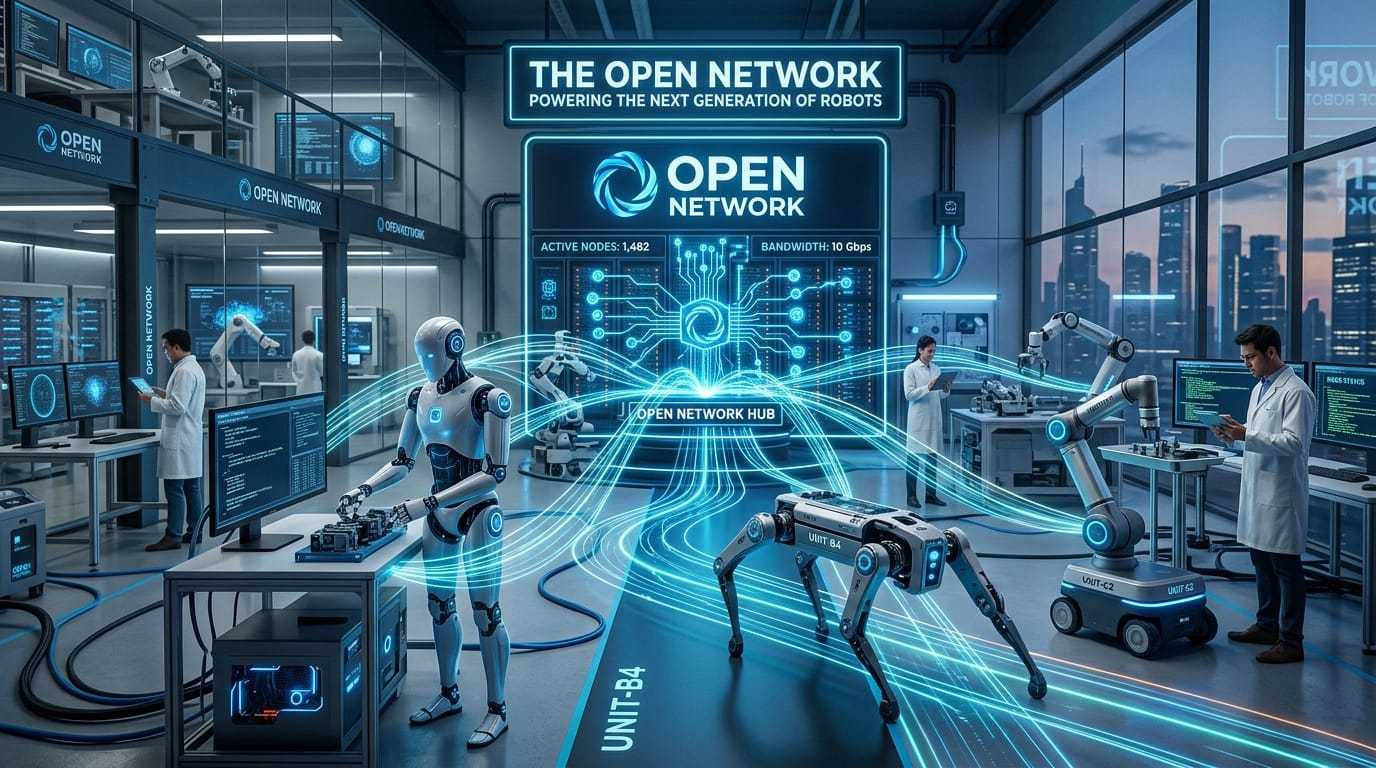
The benefit is obvious. You don’t want a warehouse where every robot, every door sensor, every camera, and every safety relay must come from the same catalog forever. That’s not resilience. That’s dependency with better branding. Open networks let operators mix and match, grow gradually, and avoid betting the business on a single vendor’s roadmap.
The cost is also obvious, once you’ve lived it. Interoperability creates seams, and seams are where systems tear.
A robot’s “decision” to stop can be triggered by a dozen upstream events: a person detected by vision, a proximity sensor reading a reflective surface, a new map tile that marks an area as temporarily blocked, a fleet manager revoking a route to prevent congestion, a network timeout that makes the robot switch into a conservative mode. If the components are loosely coupled—and open systems usually are—then the only way to understand behavior is to trace it across those boundaries.
That tracing begins with time. In a multi-vendor, multi-network environment, clocks drift. Not dramatically, but enough to turn an incident into an argument. A robot reports it stopped at 14:03:12. A door sensor reports it opened at 14:03:09. A camera gateway timestamps frames at 14:03:08 because it’s still set to local time and nobody noticed. In post-incident reviews, people will debate what happened first as if it’s a matter of interpretation. It isn’t. It’s an infrastructure problem, and it’s one of the first places open robotics networks either grow up or fail.
The next pressure point is roaming and reliability. Wi‑Fi is often enough, until it isn’t. Private 5G can help, until coverage has holes or handoffs introduce their own jitter. Some operators run dual networks because redundancy feels responsible, then discover redundancy doubles the number of things that can be misconfigured.
The robots respond to that reality in ways that are designed, not intelligent. If connectivity drops, many systems choose to fail safe and stop. That’s a reasonable default. It’s also disruptive. A stopped robot becomes a physical obstacle that changes how humans move, and humans under pressure don’t always move carefully. If connectivity drops often enough, people begin to bypass safety practices out of frustration. They push robots by hand. They step into lanes they shouldn’t. They treat warnings as noise. The network, in other words, doesn’t just affect uptime. It affects behavior.
Open networks also bring security into the foreground. A robot fleet is a distributed computer system with wheels. It has credentials. It has management interfaces. It receives updates. It might offer vendor remote access. In a closed environment, those things are still risks, but they’re risks contained by obscurity and physical limits. In an open environment, they are exposed by design. The robot has to connect. The fleet manager has to coordinate. Telemetry has to travel. If you don’t set boundaries—segmentation, least privilege access, certificate rotation, time-limited vendor sessions—you end up with a system that is easy to integrate and equally easy to abuse.
The hard part is that security controls can become operational hazards if they’re brittle. A certificate that expires at midnight doesn’t care that the night shift is short-staffed. A firewall rule that blocks an unknown endpoint doesn’t care that the “unknown” endpoint is where the new sensor firmware reports health metrics. When controls are deployed without empathy for operations, people work around them. They share credentials. They leave tunnels open. They grant broad access “temporarily.” That’s how an open network drifts from transparent to porous.
What makes the next generation of robot networks different isn’t a single breakthrough. It’s the willingness to treat coordination as first-class engineering. That means making changes observable. If a switch is replaced, the port configuration is validated and recorded. If an access point is updated, roaming behavior is tested with a real robot, not just a laptop speed test. If a model used for perception is updated, the rollout is staged and the failure modes are described in plain language: “This will reduce false positives near reflective tape, but may miss low-contrast obstacles under sodium lights.”
It also means adopting a culture where the network and the robots are not separate domains. In many organizations, IT owns the network and operations owns the robots, and the two groups meet only during incidents. That division is comfortable until a network change stops a fleet. Then everyone learns, quickly, that the boundary was imaginary. The organizations that do well create shared routines: weekly reviews of network health and robot behavior, joint postmortems, a shared on-call escalation path, and a common vocabulary for what “degraded” means.
The open network powering robots has to do more than stay quiet. It has to leave evidence. It has to make it possible to say, later, what happened and why, without guessing and without blame.
That’s what “next generation” really means in robotics right now. Not just smarter machines, but systems that can be operated, secured, audited, and repaired in the real world—by teams with shift schedules, budgets, vendor contracts, and human limits. The open network isn’t the backdrop. It’s the backbone. And if you build it carelessly, the robots will tell on you.$ROBO #robo @Fabric Foundation #ROBO