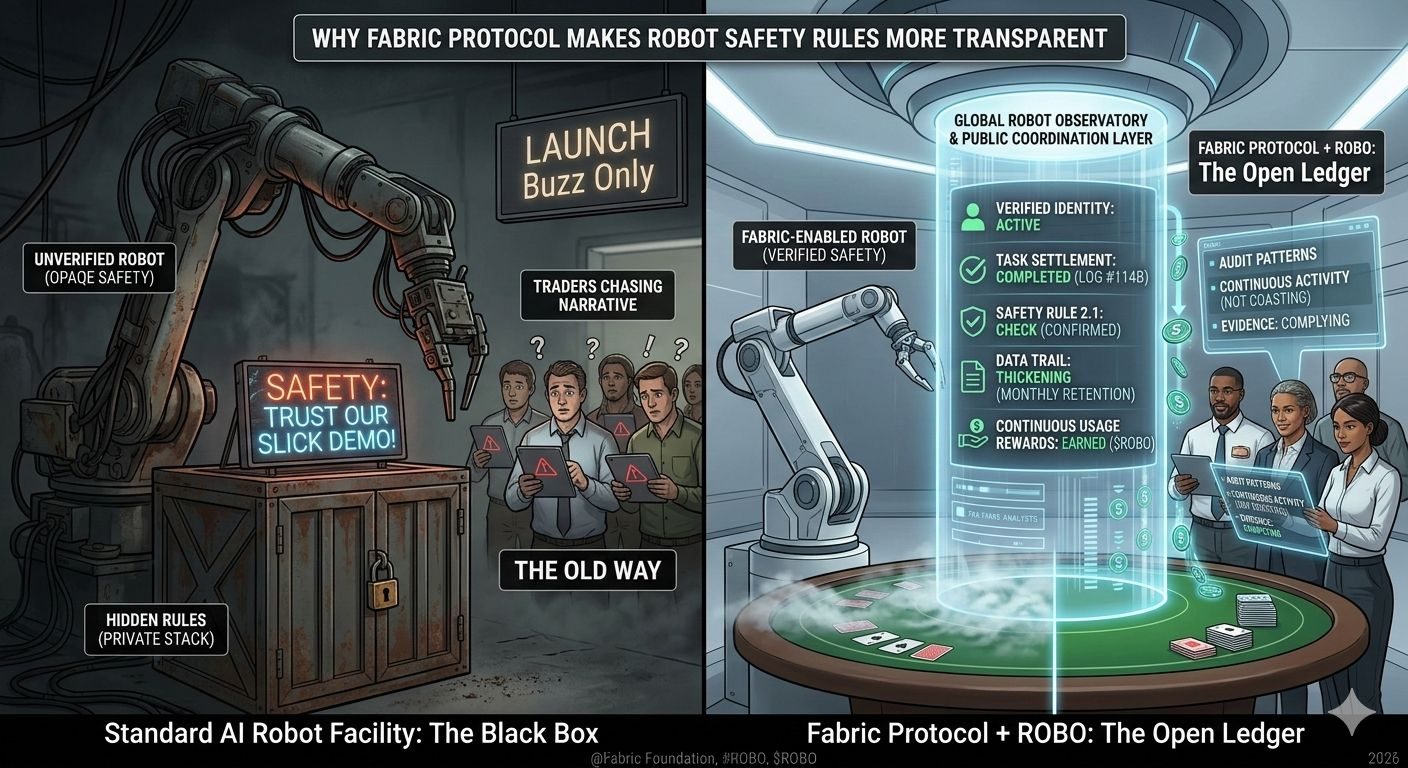
You learn the hard way in crypto that “safety” usually gets marketed long before it actually gets measured. You’ve likely chased a robotics-adjacent listing in past cycles because the story sounded clean, the volume looked real, and everyone acted like trust was a solved equation just because a dashboard existed. Then the attention faded, retention vanished, and what initially looked like groundbreaking infrastructure turned out to be nothing more than launch-week motion.
That is the exact filter you need to apply to Fabric Protocol right now.
The Market Reality Check
As of March 2026, ROBO is still early, highly volatile, and priced exactly like a market that wants the future delivered immediately. Look at the tape: roughly 2.2 billion tokens are circulating against a 10 billion maximum supply. With a market cap hovering in the mid $90 million range, daily volume has been violently swinging from $36 million to well over $170 million in a single week.
That is not a calm discovery process. It is a highly charged setup where narrative can outrun actual proof in a matter of hours.
The True Value Proposition: Escaping the Black Box
The reason you keep watching ROBO anyway comes down to one narrow, critical point: Fabric is attempting to make robot safety rules fully legible instead of leaving them buried inside a private, corporate stack.
The protocol acts as a public coordination layer for robot identity, task settlement, data collection, and governance. By establishing a “Global Robot Observatory,” humans can actually observe and critique machine behavior. For a trader or operator, this matters infinitely more than a generic “AI plus robots” pitch. In markets, hidden rules are always where the real risk sits. When the rules for identity, verification, penalties, and evaluation are visible on a public ledger, you finally have something harder to fake than a slick promotional demo.
The Tokenomics Catch
However, recognizing the tech doesn't mean the investment case is completely clean. Fabric’s own disclosures are blunt: $ROBO is a pure utility token. It holds no ownership claim, offers no rights to profits, guarantees zero value, and carries the explicit warning that it can fall to zero.
On top of that, you have to account for the insider allocation. It is not trivial:
* Investors: 24.3%
* Team and Advisors: 20%
* Vesting: Both groups are on a 12-month cliff followed by 36-month linear vesting.
Even if you love the network design, you still have a massive supply overhang risk sitting quietly in the background. You have to acknowledge token structure because the market is still actively trying to decide if it is buying a revolutionary coordination rail or just renting a temporary theme for the quarter.
The Retention Problem: Why the Evidence Trail Matters
Here is the mechanism most market participants miss: transparency in robot safety is not just about publishing standards. It is about retaining the evidence trail long enough for those standards to actually mean something.
Anyone can fake one clean verification event or showcase one polished robot action. What is infinitely harder is keeping the stream of verified actions, data submissions, feedback loops, and repeated usage alive month after month once the launch buzz dies.
Fabric’s 2026 roadmap directly targets this pressure point:
* Q1: Supporting structured data collection and gathering real-world operational data.
* Q2: Implementing incentives tied directly to verified task execution and data submission.
* Q3: Scaling data pipelines to ensure "sustained, repeated usage."
This progression proves the real battle isn't the first proof of concept. It’s whether that proof compounds. Think of it like a poker table where the house rules are strictly enforced, but the cards disappear after every single hand. You can’t audit patterns, you can’t accurately price trust, and you definitely can’t tell if edge cases are being fixed or just ignored. Fabric prevents this by tying rewards to continuous, verified contributions—using decay mechanisms so early participants cannot front-load their work and coast forever. If network usage drops, the weakness will show up on-chain immediately.
The Final Trade Setup
The idea is currently sharper than the existing evidence base. The architecture is strong on mechanism design, heavily prioritizing immutable ground truth and human critique loops, but the network is still too early to prove these loops at a massive, real-world scale.
You can deeply respect the architecture without overpaying for certainty that does not exist yet.
If the chain starts showing durable, compounding demand tied to actual identity settlement and repeated data contribution, you lean in. If the volume stays overwhelmingly loud but retention remains thin, the elegance of the theory won't matter.
Don’t get hypnotized by the price action alone. Watch whether the verified activity repeats. Watch whether the evidence trail actually thickens. Take risk here only if you know the distinct difference between a temporary launch narrative and a durable machine economy.