
There’s something about seeing numbers on a screen that makes you trust them almost instantly.
I noticed that the first time I started paying attention to my own cycle data. Numbers feel clean. They look precise. They don’t seem emotional or confused. And when you’ve spent months guessing about your cycle, second-guessing every symptom, and staring at calendars trying to make sense of things, that kind of clarity can feel like a lifeline. It feels better than guessing. Better than hoping. Better than convincing yourself that maybe this month will somehow be different.
That’s honestly what first drew me toward Mira.
Instead of vague predictions based on dates, it actually shows hormone readings. You can see patterns building over time. And when you’ve felt disconnected from what your body is doing, watching those patterns appear can feel surprisingly reassuring. For me it almost felt like the fog was lifting a little.
And to be fair, that comfort isn’t fake.
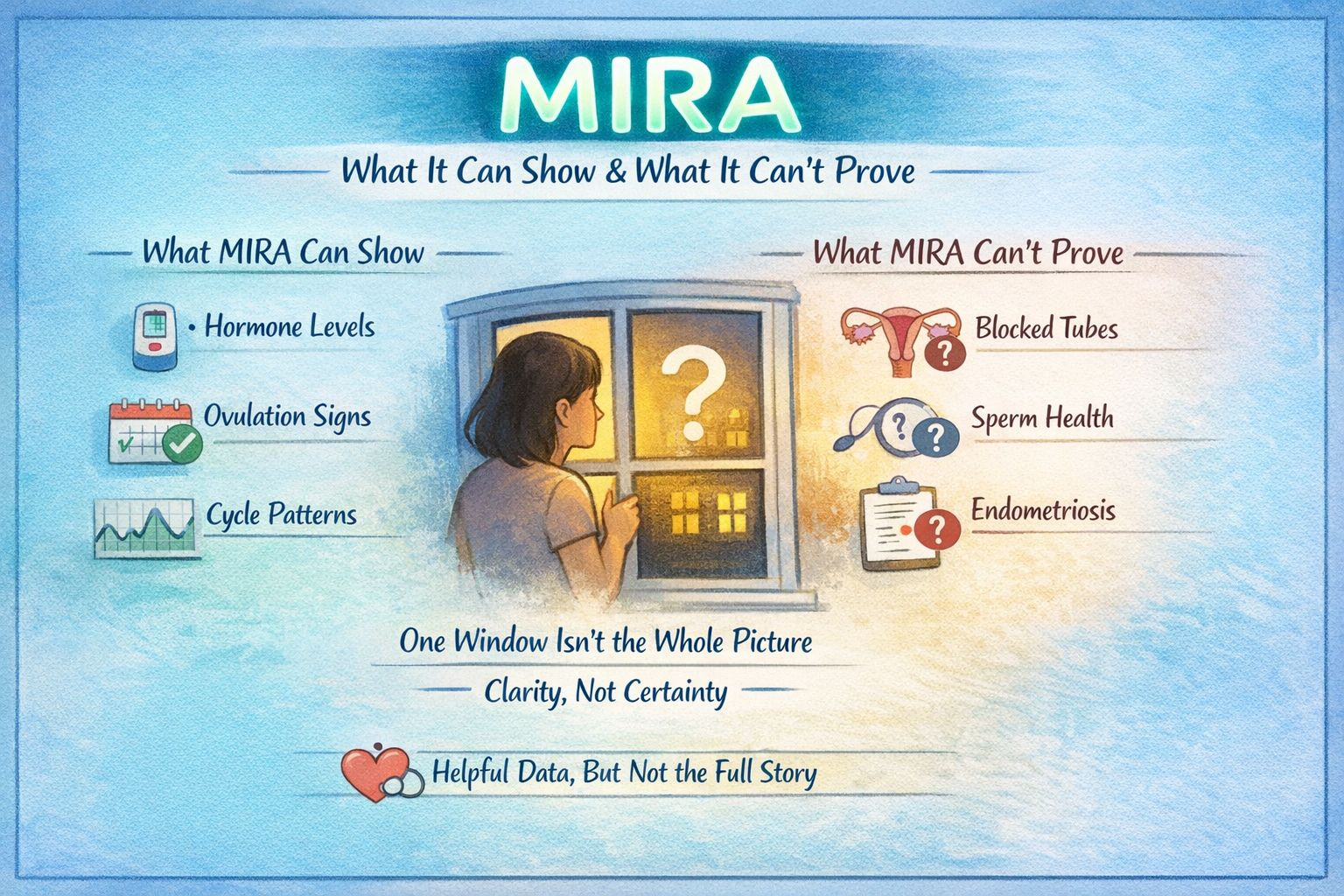
Mira can genuinely help. It can show hormone shifts that hint when ovulation might be approaching and whether it probably happened afterward. That kind of information is useful. It can help with timing. It can reduce some of the monthly confusion. It can make the whole process feel a little less like wandering in the dark.
But I also noticed something else while using it.
It’s very easy to start expecting more from the data than it can actually give.
The problem isn’t that the information is useless. The problem is that useful information can sometimes look bigger than it really is. When you see a pattern that looks clean and reassuring, it’s natural to build hope around it. You start thinking maybe everything is fine. If ovulation seems to be happening, maybe nothing is wrong. Maybe it’s just a matter of time.
I caught myself thinking that too.
And that’s the moment where things can quietly become misleading.
Because a tool can confirm one piece of the story without being able to rule out the rest.
That difference might sound small, but it’s actually huge. Seeing signs that ovulation likely happened doesn’t mean it can rule out fertility problems. It doesn’t mean there aren’t other issues in the background. And it definitely doesn’t mean pregnancy is guaranteed if you just wait long enough.
Real life rarely works that neatly.
Someone can ovulate and still have trouble getting pregnant. Hormone patterns can look perfectly normal while other problems exist that hormone tracking can’t see. Blocked tubes. Endometriosis. Sperm issues. Things happening quietly outside the scope of a chart.
That’s something I had to remind myself of more than once.
Because charts feel personal. They feel like proof. And in a way they are proof, just not complete proof.
It’s a bit like standing outside a house at night and looking through one lit window. You can see the kitchen light is on. That tells you something real. But it doesn’t show what’s happening in the other rooms. Maybe everything else is fine. Maybe something upstairs is broken. Maybe another part of the house is completely dark.
One window can tell you something without telling you everything.
That’s what fertility tracking feels like sometimes.
It gives clues. It shows signals. But it doesn’t give the full answer.
And honestly, when you’re trying to conceive, clues rarely feel like enough. What people really want is certainty.
I noticed how quickly emotions get tied to the numbers. Every reading starts to matter more than it probably should. One good number can lift your mood for the whole day. One strange number can make you uneasy before the morning is even finished.
The data stops feeling like information and starts feeling like a verdict.
That’s where things can become exhausting.
The problem isn’t misinformation. The problem is emotional overinvestment. It’s very easy to begin treating each chart like it’s telling you something final about your future. That’s a lot of pressure to put on a device that was never meant to provide certainty.
Over time I realized Mira works best when it’s treated as a guide, not a judge.
It can show patterns. It can help with timing. It can point out when something looks unusual. It can even help you walk into a doctor’s appointment with better information than you had before. In that sense it can be incredibly useful.
But it can’t check fallopian tubes.
It can’t evaluate sperm health.
It can’t detect endometriosis.
It can’t explain every reason pregnancy hasn’t happened.
And it definitely can’t turn a “probably” into a guarantee.
That was the biggest mental shift for me. Once I stopped expecting it to answer everything, it actually became easier to appreciate what it does well.
Because Mira does have real strengths.
It can make the fertile window clearer.
It can help confirm that ovulation likely occurred.
It can reveal patterns many people never noticed before.
Those things matter.
But they don’t cancel out everything the device cannot measure.
And maybe that’s the most honest way to look at it.
A clearer window is still just a window.
It helps you see inside. It shows movement that was invisible before. It offers useful signs. But it can’t reveal every room, every corner, or every hidden issue that might exist beyond that view.
That doesn’t make the tool useless.
It just means it shouldn’t be asked to carry more certainty than it was ever designed to hold.
In the end I started thinking about Mira less as an answer and more as a companion piece of information. Something that can support the journey without defining it completely.
And honestly, that feels like a much more human way to understand it.
@Mira - Trust Layer of AI #Mira $MIRA
