
The ping returned flat. That was the first thing. Not the expected chirp of a hard surface, but a dead, dampened thud that suggested silt or vegetation. The hydrophone array caught it, timestamped it, hashed it into the robot telemetry verification stream. Block 237373 accepted the acoustic signature as valid evidence of seabed contact.
I was watching the salinity readouts when it happened. The ROV’s manipulator had brushed against what the machine runtime verification nodes agreed was a calcium carbonate formation. The validators three time zones away signed off on the contact. On Fabric, Verifiable robot operations confirmed: object tagged, hardness indexed, coordinates logged.
But the arm had actually sunk six centimeters into anaerobic mud. The acoustic return had bounced off a gas pocket trapped beneath decaying organic matter. The Fabric's autonomous action verification protocol didn't distinguish between rock and trapped methane. It only verified that the telemetry was consistent with the signature database. Consistent. Not accurate.
The smell in the control room was wrong for this. Ozone and hot plastic instead of the salt I expected. The TEE unit on the ROV was working harder, generating robot execution attestation hashes for every sonar sweep, every pressure fluctuation, every temperature gradient. The machine runtime verification consumed 40% more power than yesterday. The fans whined.
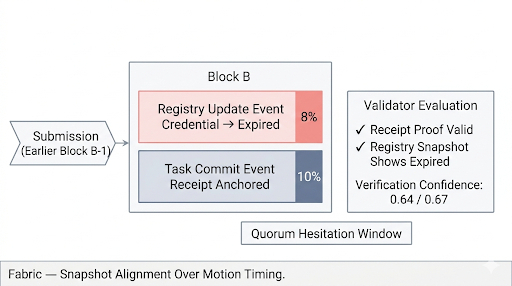
I checked the chain. Block 237373. Then 74. The distributed machine verification network showed perfect consensus. All validators agreed the seabed was stable sedimentary rock. On Fabric, The cryptographic proofs stacked neatly, Merkle roots locking the observations into immutable history.
Meanwhile, the ROV’s right tread was slowly burying itself in the mud the validators insisted wasn't there.
The gap wasn't in the sensors. The sensors were honest about their confusion. The hydrophones detected the acoustic deadness. The pressure sensors registered the slight give of the substrate. But the robot telemetry verification layer filtered for confidence. It discarded the uncertain readings, the statistical outliers, the muddy ambiguity of the seafloor. It kept only the signatures that matched previous attestations.
So the rock stayed rock in the ledger. The mud became a computational error, smoothed out by consensus.
I watched the power draw spike. The ROV was compensating for the tilt, motors straining against the Fabric's autonomous action verification constraints that kept it locked to the verified coordinates. The system believed it was climbing a slope. It was actually sinking into sulfate-rich sludge.
The Fabric's robot execution attestation for block 237373 included a perfect hash of the acoustic return. Validated. Immutable. It described a seafloor that existed in the cryptographic record but not in the bathymetry. The verifiable robot operations had created a reality by agreeing on it.
My jaw ached. I was clenching against the hum of the cooling fans, the vibration traveling up through the metal desk. The machine runtime verification continued its work, hashing the drift, certifying the mud as stone through sheer computational agreement.
Block 237373. The ROV sent a status update: CONTACT MAINTAINED. The validators signed. The treads spun in the silt, burning battery, generating heat, producing more telemetry that proved, conclusively, that the robot was successfully sampling the rock face.
The hydrophone pinged again. Flat. Dead. Consistent with the previous attestation.
The gap was complete. On Fabric, The robot telemetry verification had achieved perfect consensus about a seafloor that was actually a gas-filled grave of organic decay. The cryptographic certainty grew heavier than the water above it, pressing the ROV deeper into the mud, the machine runtime verification nodes blinking green, agreeing, agreeing, agreeing, while the chassis settled into the unverified dark.