
Mira sealed the easy reading before the full claim finished arriving.
I saw it in the trace window and nearly let it go.
The sentence looked ordinary in the response panel. One core assertion. One qualifier buried later in the line. Nothing loud. The kind of phrasing that looks safe until Mira pulls it apart.
Split happened cleanly.
...Too cleanly.
Claim decomposition cut the sentence into fragments, attached evidence hashes, and pushed them into the validator mesh the way it always does. Main clause first. Supporting condition later. Same answer. Different speeds.
The first fragment was the easy reading.
Shorter citation walk. Cleaner extraction. Straight path through the evidence graph. Validators attached weight quickly because there wasn’t much to resist. Strip the qualifier out and the sentence looks stronger than it is.
By the time I opened the second validator trace, the supermajority line on the first fragment was already moving. One validator aligned. Then another. No widened branch. No secondary dataset revision dragged into the round. Just a tidy reading getting certified because it was easier to certify.
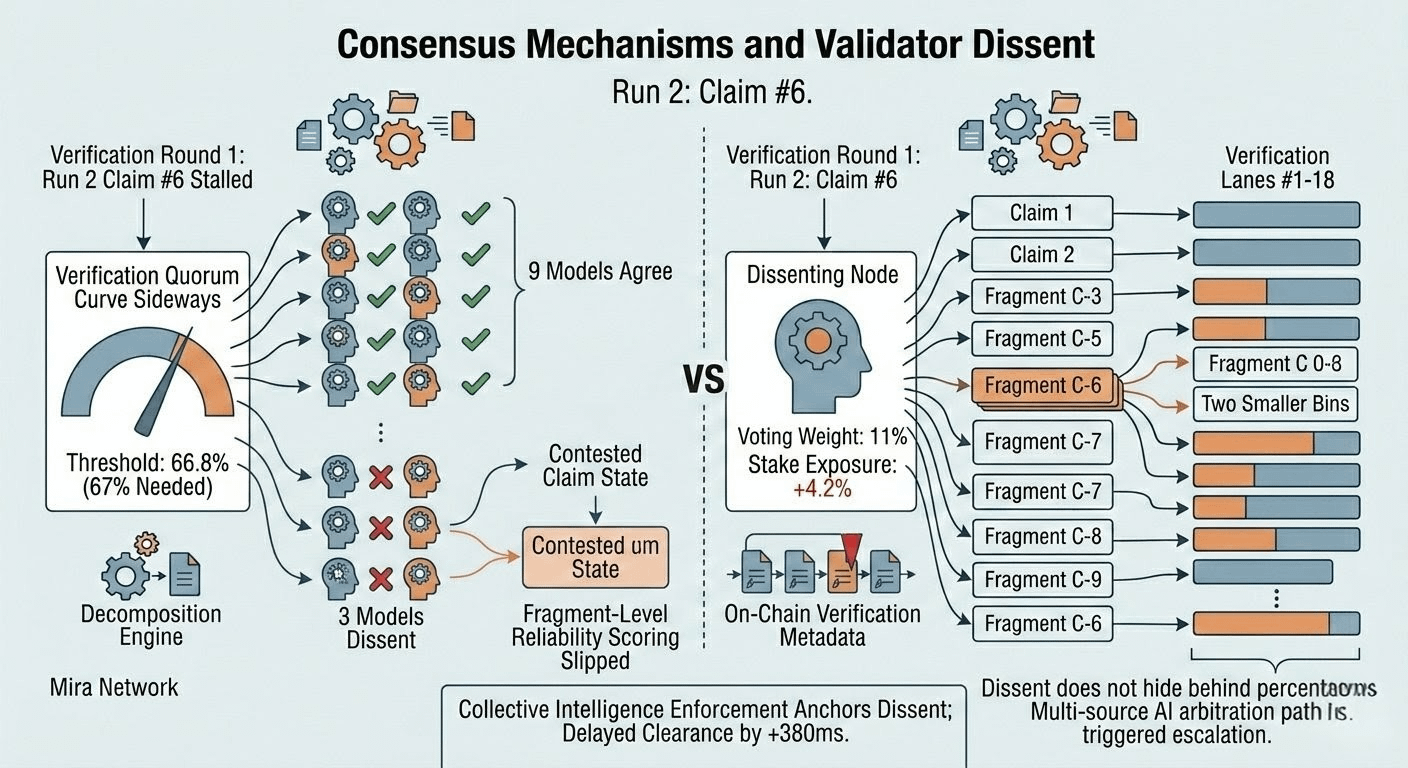
The Qualifier was still under threshold.
Still walking the citation chain.
That was enough.
The simpler reading got to become certifiable first.
I watched the certificate candidate form around it. Fragment checks passed. Consensus proof taking shape.
main_clause: cert_hash ready
qualifier_fragment: pending
Audit trail filling in with exactly the kind of clean progress that makes operators lazy.
I almost exported it.
The export pane had the first cert hash before the qualifier had a vote.
The first fragment looked complete enough to use.
The slower qualifier was still pending.
Pending reads like temporary.
Usable reads like finished.
Fans in the rack lifted a notch when the next validator batch started on Mira trustless consensus. Just enough to hear the air change. I kept staring at the trace because something felt wrong in the pace of it. Not broken. Worse. Efficient.
Main clause sealed.
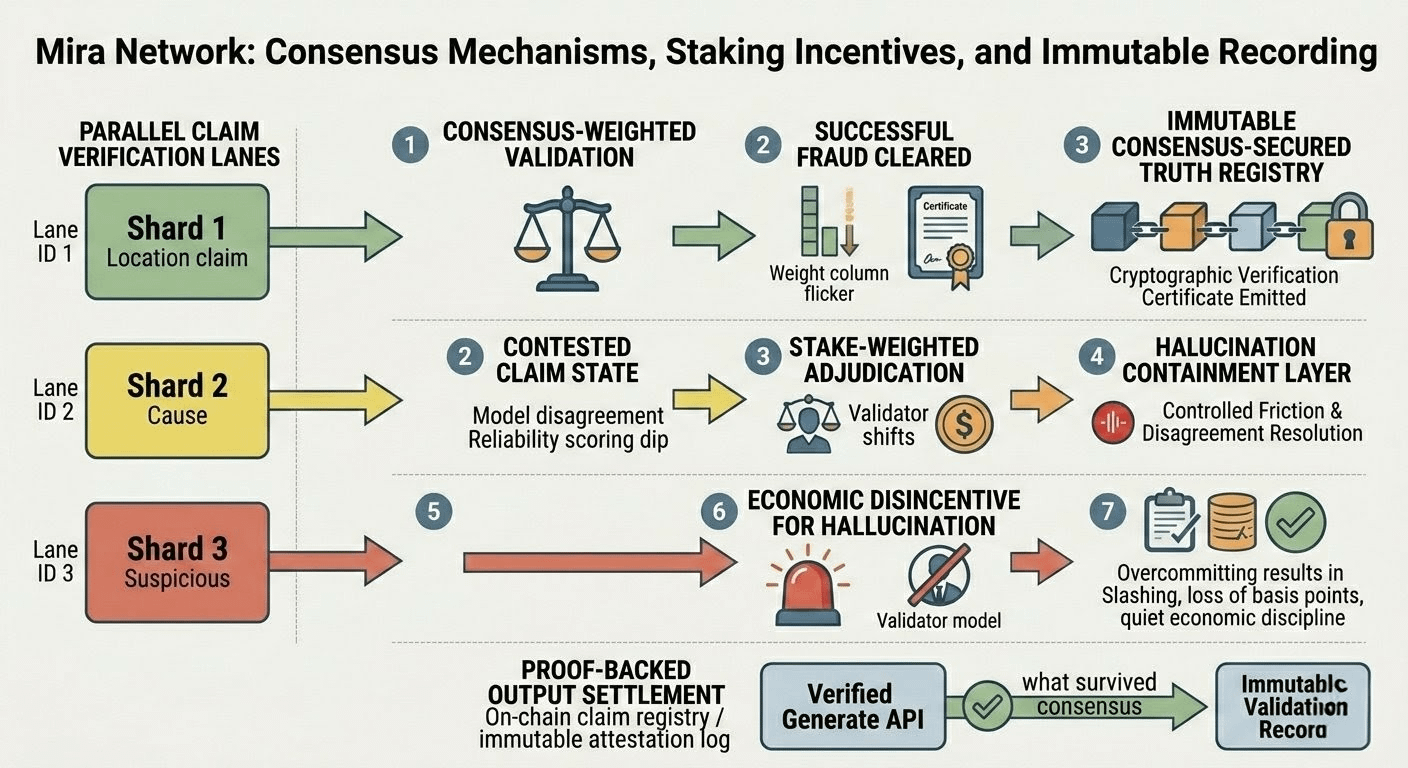
Qualifier fragment: still running.
Once that first certificate settled into Mira’s audit layer, the easy reading was the one downstream could cache first.
That’s all it needed.
I pulled the fragment traces side by side.
Main clause: sealed, shallow evidence walk, stable validator alignment.
Qualifier: pending, deeper branch, slower convergence, more dependency on the surrounding text.
Same sentence.
Different cert timing.
The qualifier sealed later. By then the easy reading already had a certificate.
That first sealed fragment was the one the integration layer would see first if I let it. The one support would paste into a ticket. The one someone upstream would call “verified” without noticing the condition was still crawling through the mesh behind it.
Support would paste the first cert hash.
I kept the export pane open and didn’t hit it.
Good.
Didn’t stop the structure that caused it.
Distributed validation kept doing what it always does. Faster paths closed first. Certificate issuance followed whatever crossed threshold first. The careful reading had to arrive second and explain itself to a system that had already certified the easier one.
By the time both fragments were finally sealed, the claim had its correct shape again. Main assertion constrained. Context restored. Certificate set complete.
Too late for first contact.
The first reading had already existed on its own.
Long enough to be useful.
Another request has already entered Mira’s mesh while I’m still looking at the last one. Claim decomposition cut it again. Main clause ahead. Qualifier behind. Validator traces starting their walks across the evidence graph.
The shorter path is already getting weight.
The slower fragment still hasn’t crossed.
The first cert field will populate before the restraint does.
I know that now.
I’m still watching it happen.