
Most people watching ROBO right now are focused on the price. The 4H candles, the volume step-down, the compression after a loud launch week. That's reasonable. It's just not the most important thing happening with this token right now.
What actually deserves attention is a race that's already started — quietly, without much discussion — between two timelines that will determine what ROBO is worth when they finally collide. One is the vesting schedule. The other is Fabric Protocol's real-world adoption curve. The gap between them is the only number that matters right now, and almost nobody is modeling it seriously.
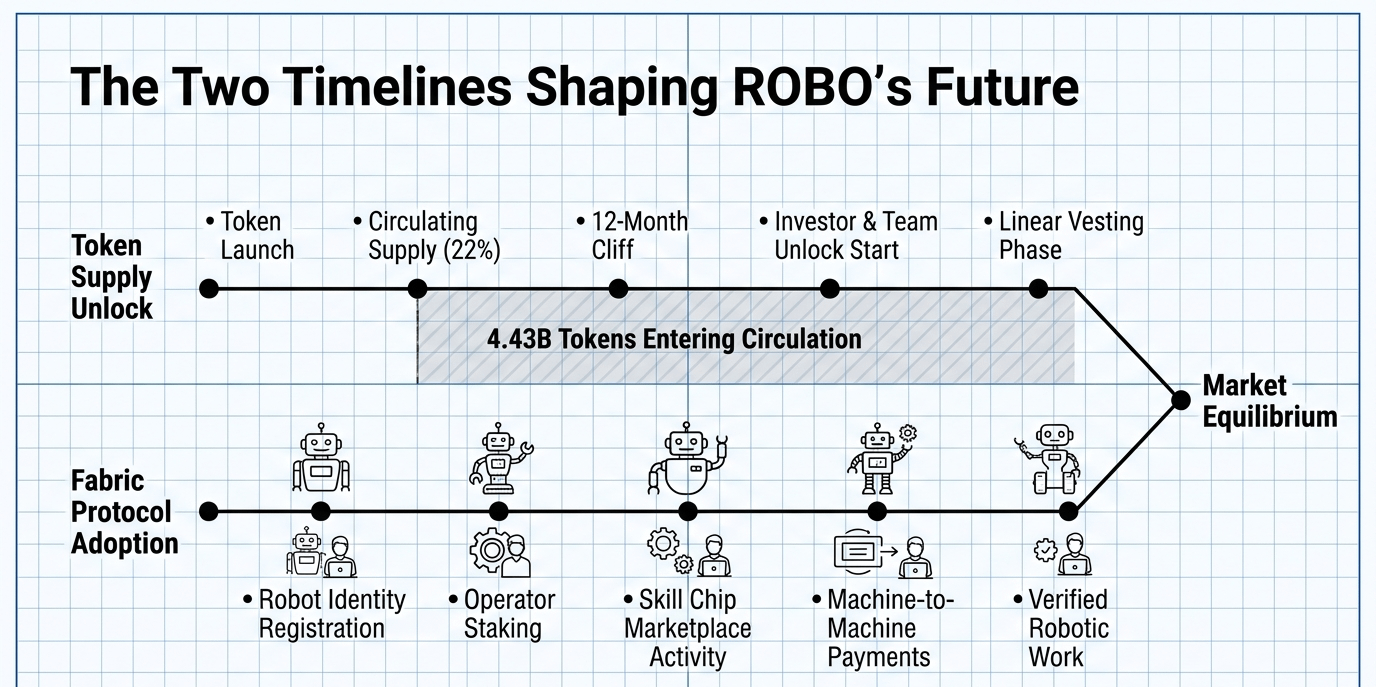
Here's why that gap exists and why it's specific to how the Fabric Foundation built this.
Fabric Protocol isn't a simple token with a staking dashboard bolted on. It's a coordination layer for physical robots — on-chain identity, machine-to-machine payments, task verification, and a skill chip marketplace where developers build modular capabilities that any compatible robot running OM1 can download and deploy. The ROBO token runs through every layer of this. Operators stake ROBO as a work bond before hardware registers on the Fabric network. Developers stake ROBO to list and access the skill chip ecosystem. Protocol fees generate burns. Proof-of-Robotic-Work distributes rewards only to verified contributors — operators running real hardware, developers shipping real skills, validators confirming real outputs.
That demand structure is genuinely different from most protocol tokens. It's operational, not speculative. The people consuming ROBO inside Fabric Protocol aren't trading sentiment. They're paying to participate in a network that requires the token to function.
But here's the tension nobody is naming.
The Fabric Foundation issued ROBO with a fixed total supply of 10 billion tokens. Approximately 2.23 billion are circulating right now — 22% of the total. The remaining 78% sits locked across investor, team, ecosystem, and foundation allocations. Investor and team buckets together represent 44.3% of total supply, both carrying a 12-month cliff followed by 36 months of linear vesting. Twelve months from now, those wallets start unlocking simultaneously.
That's 4.43 billion tokens beginning to move at the same moment — more than double the current circulating supply — entering a market whose price at that point will be determined almost entirely by one question: how much of Fabric Protocol's demand infrastructure is actually running at scale by then?
If Fabric's coordination layer has real operators staking ROBO against real robot deployments, real developers earning through the skill chip marketplace, and real fee burns reducing supply meaningfully — then the demand mechanics the Fabric Foundation designed absorb that unlock pressure. The network consuming tokens and the vesting schedule releasing tokens find equilibrium somewhere.
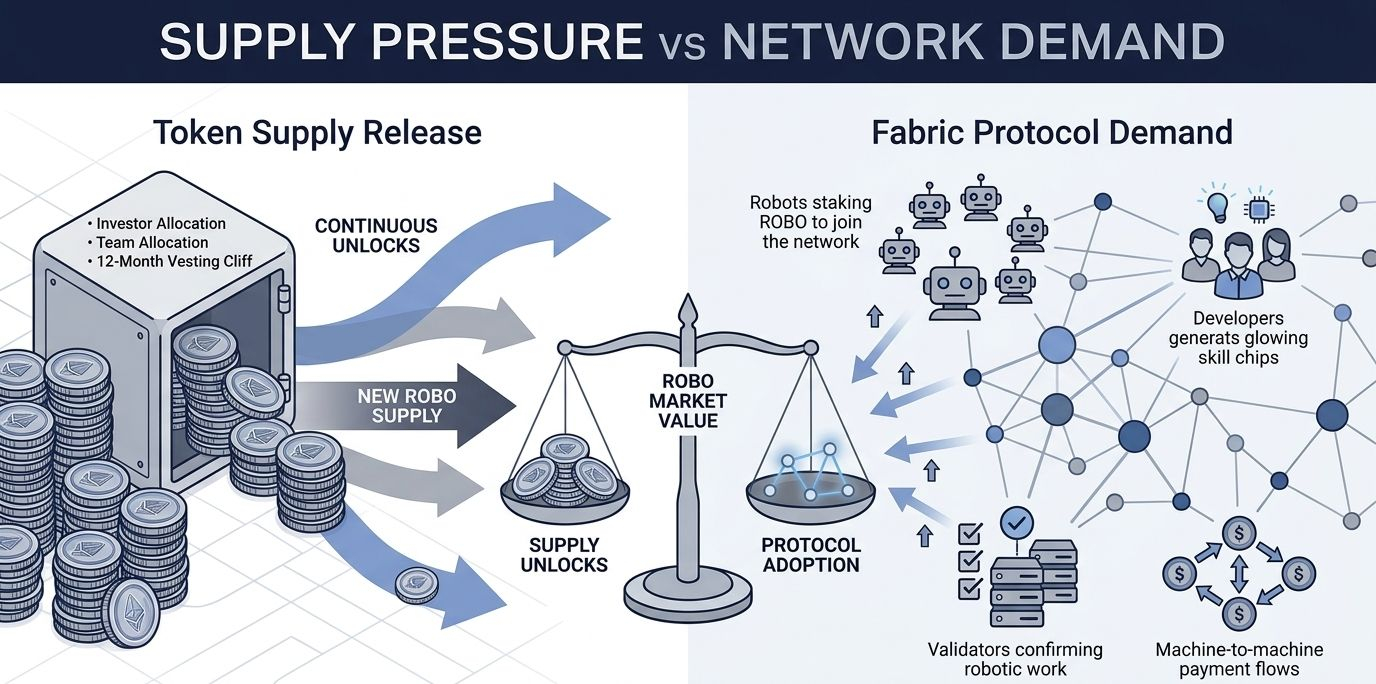
If Fabric Protocol is still early at that 12-month mark — still measured in small operator counts, modest skill chip transactions, thin fee volume — then the supply side of that equation wins by default. Not because the project failed. Because the adoption timeline and the vesting timeline weren't synchronized.
This is the race.
What makes it more interesting than a standard supply overhang is the Proof-of-Robotic-Work model sitting underneath Fabric Protocol's reward distribution. ROBO doesn't flow to passive wallets. It flows to participants doing verified work on the network. That means the token supply being earned through contribution behaves differently from the supply being released through vesting. A developer who earned ROBO by shipping skill chips that robots are actively using has a different relationship to their tokens than an investor who received an allocation at launch and has been waiting 12 months. Their incentive to sell, their attachment to the network, their read on the protocol's trajectory — all different.
That layered supply dynamic is something Fabric Protocol's design created intentionally. The Fabric Foundation understood that infrastructure tokens don't work if the only demand is speculative. Proof-of-Robotic-Work forces real skin in the game from real participants. But it only functions as a counterweight to vesting pressure if the network is generating enough verified work to matter.
The OM1 operating system is the variable that determines how fast that verified work scales. OM1 runs across humanoids, quadrupeds, and robotic arms without modification — the same application on fundamentally different hardware bodies. Every robot that deploys on OM1 and registers identity on Fabric Protocol becomes a potential fee source, a potential skill chip buyer, a potential staking wallet. The network doesn't need millions of robots. It needs enough of them doing enough real commercial work to make the burn rate and staking demand visible on-chain.
That visibility is what changes the market's conversation about ROBO from "interesting early protocol" to "network with measurable revenue."
The Fabric Foundation has Pantera Capital, Coinbase Ventures, Ribbit Capital, and Digital Currency Group behind the infrastructure. Those firms have 36-month vesting schedules. Their tokens don't unlock for a year. Which means their incentive for the next 12 months is identical to every person who bought ROBO at launch — they need Fabric Protocol to grow fast enough that its demand mechanics are running at real scale before the unlock cliff arrives.
That alignment is structural and it's real. It doesn't guarantee the race gets won. But it does mean the people with the largest locked allocations are pointing in exactly the same direction as everyone else right now.
The daily candle isn't the story. The race between Fabric Protocol's adoption curve and its own vesting schedule is.
Watch the network activity metrics. Watch operator count. Watch skill chip transaction volume. Those numbers will tell you how the race is going long before the price does.
#ROBO $ROBO @Fabric Foundation #robo
