
I’ve learned the hard way that a crypto project can look incredibly healthy right up until the moment it doesn't. We've all watched tokens print massive volume, dominate our feeds, and rack up confident predictions in a matter of hours—only to completely fade once the attention moves elsewhere.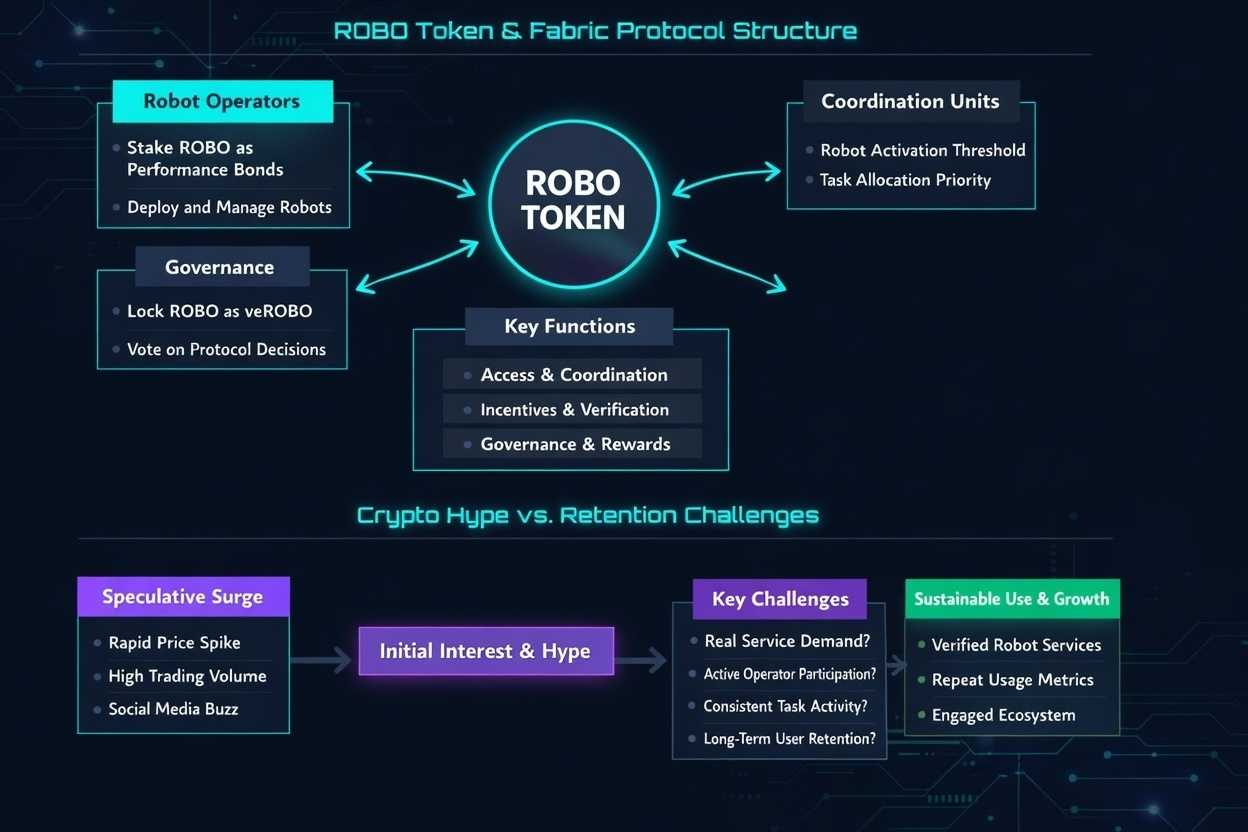
That’s exactly the lens I’m applying to Fabric Protocol and its $ROBO token. If you’re just looking at the price action, it’s easy to write this off as another fleeting market narrative. But if you dig into the whitepaper, they are actually trying to build something highly specific: a decentralized way to build, govern, and evolve general-purpose robots, with ROBO sitting right at the center of it all.
What catches my eye is that Fabric isn’t just treating ROBO as a shiny branding asset. The protocol actually gives it real jobs to do. Operators have to stake ROBO as refundable performance bonds, holders can lock it up for veROBO governance, and the network uses coordination units to bootstrap robot deployment. To be clear, participating isn't about owning the physical robot hardware—it's about getting access to the protocol's underlying engine.
This structure matters. If the "robot economy" is actually going to happen in any meaningful way, it won’t be won by whoever has the best pitch deck. It’s going to need identity layers, task settlement, verification, and incentive structures that aren't trapped inside a single company’s closed ecosystem. Fabric’s bet is that blockchain can provide those open rails. In their model, early participants help coordinate robot activation, and if a threshold isn't met, contributions are fully refunded. If it works out, those early backers get operational perks like priority task allocation and governance weight.
But here's the reality check: the biggest hurdle isn't imagination—it's retention. Attracting speculators for a week is easy in crypto. Retaining actual builders, operators, and real-world demand after the initial listing hype cools off? That’s the hard part. Fabric will only survive if robots are genuinely performing services, users are consistently requesting them, and operators find the economics worth sticking around for. I respect that their whitepaper explicitly ties rewards to verified work rather than passive holding, but eventually, they have to prove repeated usage, not just one-time excitement.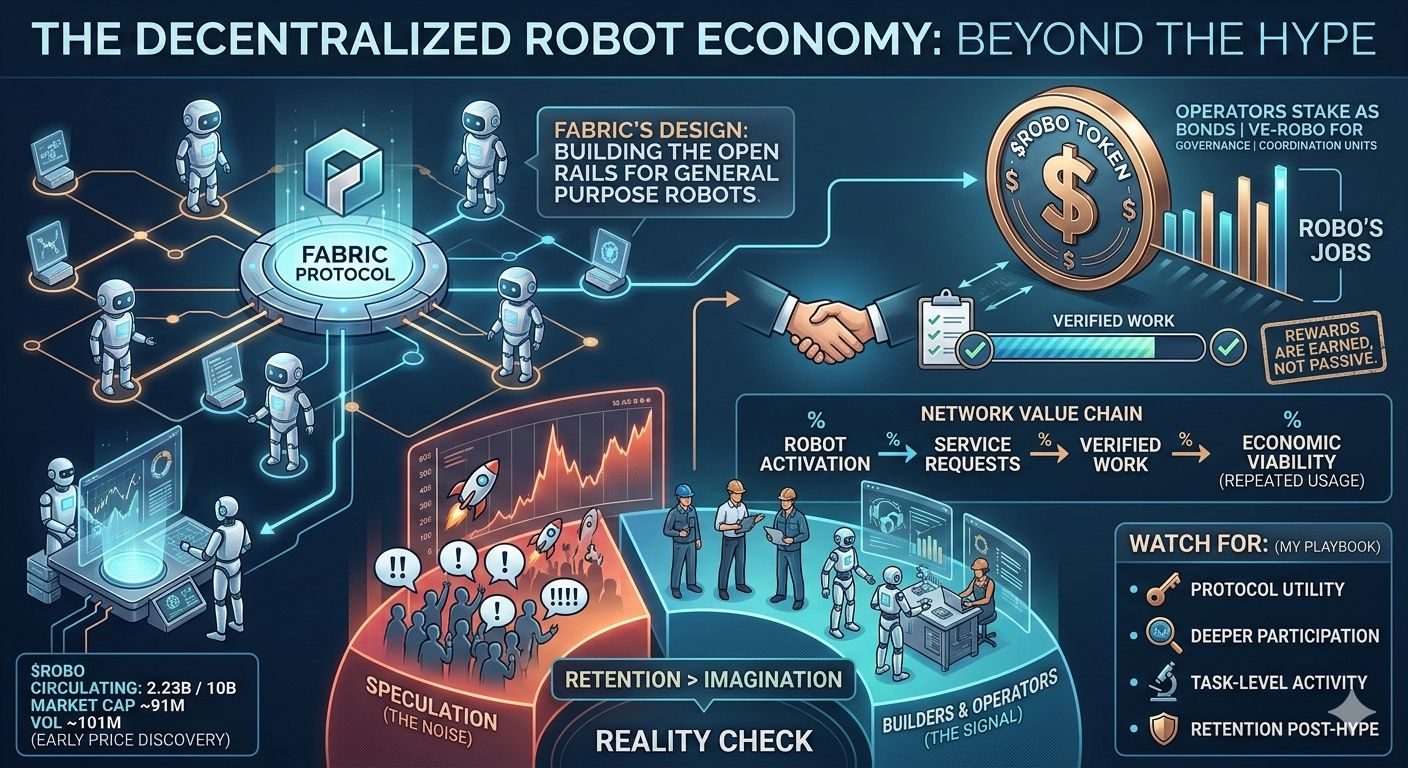
That’s why I’m taking current market signals with a grain of salt. $ROBO is very much in early price discovery. With a circulating supply of 2.23B (out of 10B max), daily volume around $101M, and a market cap sitting near $91M, the attention is definitely real—but speculation is clearly doing the heavy lifting right now.
The bear case is pretty straightforward: real-world demand for robots might arrive much slower than token demand. We could see active governance but a ghost town for actual service usage. Yes, the protocol's staking and slashing mechanics make fraud harder, but security only matters if there's real activity worth securing in the first place.
So, here’s my playbook. I’m watching to see if $ROBO translates into actual protocol utility. I want to see operator participation deepen, task-level activity become visible, and retention hold up once the speculative crowd inevitably gets bored. If you’re looking at Fabric Protocol, don’t just stare at the candles. Watch to see if the network actually earns its right to exist when the noise leaves the room. Because that’s where the fantasy ends, and real conviction begins.