
Most robot discussions focus on hardware specs or AI breakthroughs. But I think the real story is about money — specifically, how machines will earn, spend, and manage money on their own.
For me, the story surprisingly starts in 1995.
That was the year the web introduced HTTP status code 402 – “Payment Required.” The builders of the early internet clearly imagined a future where online services could automatically trigger payments. But the financial infrastructure wasn’t ready. Digital money wasn’t native to the web. So 402 just sat there for nearly thirty years — unused.
When I look at what Fabric Foundation is building, I see that old idea finally coming to life.
Reviving 402 Through x402
Fabric worked with Coinbase and Circle to build the x402 protocol, which essentially gives that old “Payment Required” concept real functionality.
Here’s how I understand it:
If a robot running OpenMinds OM1 needs to pay for electricity at a charging station, I don’t see a human approving a credit card transaction. Instead, the robot’s blockchain identity initiates the payment itself. The charging station verifies it. The payment settles in USDC. Done.
No human intervention. No manual processing.
To me, that’s not just an upgrade. That’s integration. Payments aren’t bolted on as an afterthought — they’re native to machine logic.
Why This Feels Bigger Than It Sounds
I think the shift from automation to autonomy is huge.
Automation means a robot follows instructions I give it.
Autonomy means it participates in an economy.
When I imagine a delivery drone finishing a route, I see it getting paid in USDC, covering its own tolls, paying for charging, setting aside funds for maintenance, and maybe even reinvesting into upgraded capabilities — all without me approving anything.
That changes the role of machines completely.
A warehouse robotic arm could rent out spare capacity, receive stablecoin payments, convert part of that into ROBO, and stake it in the network — all programmatically.
For the first time, I can realistically picture machines earning, spending, and saving.
Why ROBO Matters
From what I see, ROBO isn’t just a utility token floating around for speculation.
It’s required for:
Registering machine identities
Participating in governance
Accessing network services
Contributing to pooled ownership models
What stands out to me is the economic loop. If robots generate revenue through real work, part of that flow feeds back into buying ROBO on the open market. That means token demand could be tied to actual machine productivity — not just narratives.
I find that structure more compelling than pure hype cycles.
The Verification Problem — and the FC1000 VPU
If I’m honest, payments alone aren’t enough. Machines also need to prove they did the work.
That’s where the FC1000 VPU chip comes in.
It’s designed to accelerate zero-knowledge proof calculations — which allow a robot to prove it completed a task correctly without revealing all the raw data. On standard hardware, those proofs can be expensive and slow.
If verifying a robot’s task costs more than the task itself, I don’t see how a robot economy works.
Fabric claims the VPU is significantly faster for certain proof workloads. If that performance advantage holds at scale, I think it solves a fundamental bottleneck.
When I noticed that Polygon Labs committed major capital toward VPU server infrastructure, I saw that as validation that this isn’t just theory — it’s being treated like real infrastructure.
OpenMinds OM1: What I Think Is Underestimated
For me, OpenMinds OM1 might be the quiet engine behind all this.
It’s designed to be hardware-agnostic. Whether a robot walks on two legs, four legs, or rolls on wheels, it can use the same operating system and access the same marketplace of skills.
When I think about developers publishing robotic “skills” the way mobile developers publish apps, I see parallels to early Android. Standardization unlocks scale.
If that ecosystem grows, the payment layer and verification layer suddenly make even more sense — because there’s actual activity flowing through them.
Shared Ownership Changes the Game
One part I personally find interesting is the pooled ownership model.
Not everyone can afford to buy a robot outright. But contributing ROBO into a pool that purchases revenue-generating machines lowers the barrier. Contributors share in the income those robots produce.
That reframes robots as productive infrastructure assets — not just expensive hardware owned by large corporations.
What I’m Watching
Do I think everything will scale perfectly? I’m cautious.
Operating systems can be ready. Protocols can function. Tokens can trade.
But hardware manufacturing speed, regulatory clarity, and enterprise adoption timelines are variables no protocol can control.
For me, the real signal will be hardware delivery numbers — especially how many VPU chips actually ship in the coming months. That will tell me whether the verification layer can scale beyond whitepapers.
My Take
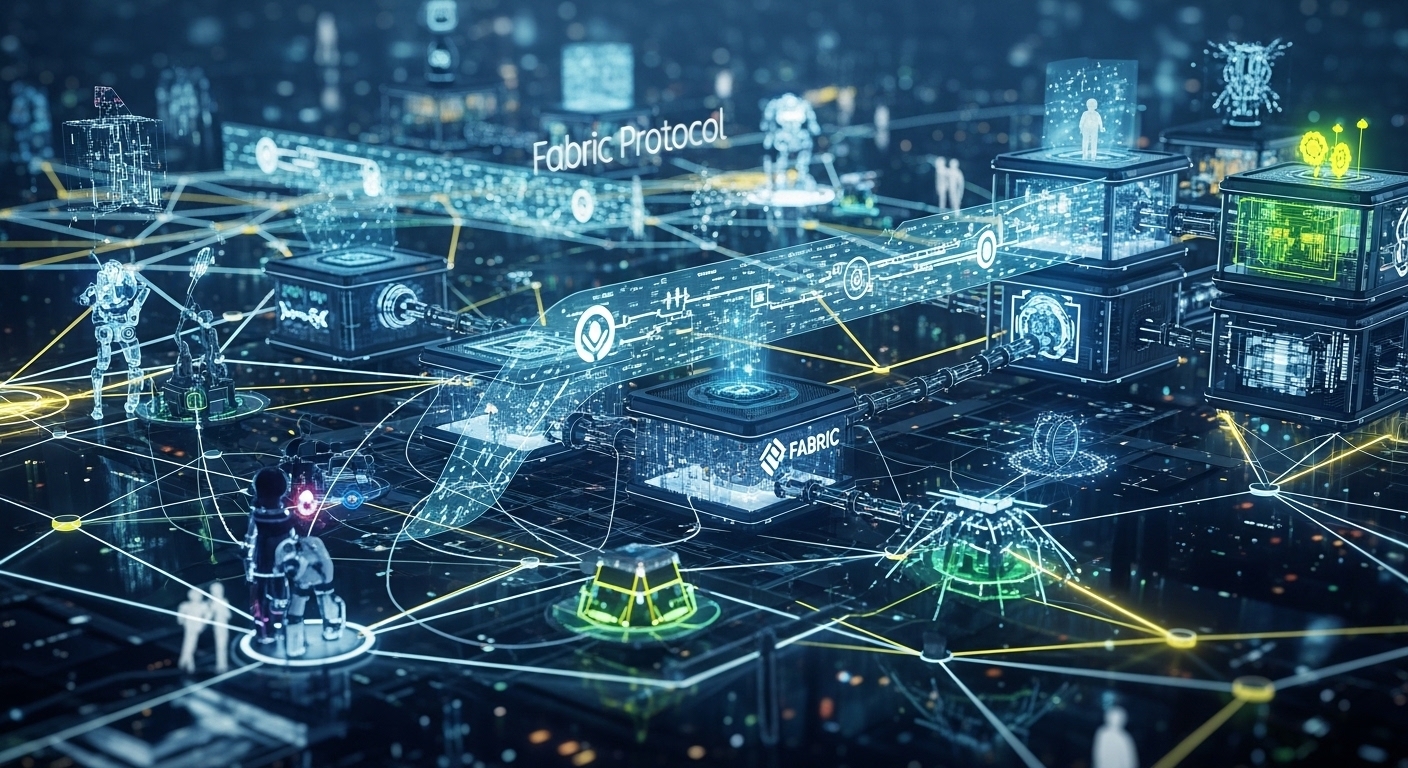
When I step back, I see Fabric building an integrated stack:
Autonomous payment rails (x402 + USDC)
On-chain machine identity and governance (ROBO)
Affordable verification through specialized hardware (FC1000 VPU)
A unified operating system (OM1)
Shared participation models
I think the key idea is simple but powerful: machines shouldn’t just execute tasks — they should participate economically.
HTTP 402 hinted at that future decades ago. For most of my life, it was just a dormant code. Now, I’m watching a serious attempt to turn that idea into real infrastructure.
$ROBO #ROBO @Fabric Foundation
