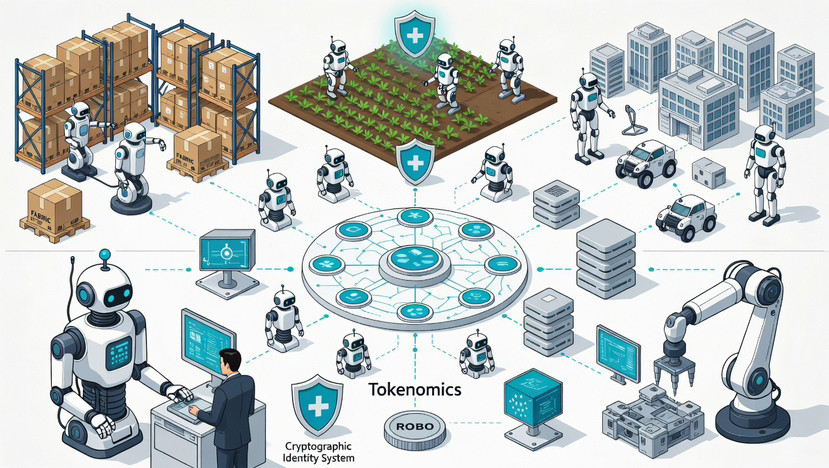
Robots are quietly stepping out of controlled environments and into the everyday world. They move through warehouses, assist surgeons, survey farmland, inspect bridges, and deliver packages across cities. Yet behind this rapid technological progress lies an unexpected problem: the systems that coordinate these machines are still fragmented. Each company runs its own robotic fleets, each machine operates within a private software ecosystem, and the data they generate rarely travels beyond those boundaries. In a world increasingly shaped by automation, the infrastructure connecting these machines remains surprisingly disconnected.
Fabric Protocol begins with a simple but ambitious idea—what if robots could exist within a shared digital environment instead of isolated corporate systems? Instead of thousands of machines operating behind separate walls, the protocol imagines a global network where robots, humans, and intelligent software agents can collaborate through open infrastructure. Supported by the non-profit Fabric Foundation, the project aims to build a public coordination layer where machines can prove their work, exchange data, and participate in a decentralized economy.
The motivation behind this idea comes from a growing realization. As robots become more capable, they start behaving less like passive tools and more like autonomous workers. A drone can map large areas of land without human guidance. A warehouse robot can navigate complex environments while making real-time decisions. Agricultural machines can monitor soil conditions and adjust planting strategies automatically. These machines generate enormous value, but the systems that organize them have not kept up with their capabilities.
Fabric approaches the problem by treating robots as participants in a digital network rather than just pieces of hardware. Each robot joining the protocol receives a cryptographic identity recorded on a public ledger. This identity acts almost like a passport, allowing the machine to prove who it is and what it has done. When a robot performs a task—whether delivering supplies, inspecting infrastructure, or collecting environmental data—the activity can be logged and verified within the network.
This idea of verifiable action is central to the protocol’s design. In many robotics systems today, trust depends entirely on the organization running the machines. If a company says its drone completed an inspection or its robots finished a delivery route, observers have little way to confirm it independently. Fabric introduces a different approach by using cryptographic verification and transparent records. Instead of simply trusting reports, the network can provide evidence that certain work actually happened.
Beyond transparency, the protocol also explores the economic side of automation. Robots are increasingly performing valuable tasks in the physical world, yet there are few systems that allow them to participate directly in digital marketplaces. Fabric creates an environment where machines can interact economically through programmable rules. In practice, this means a robot could receive payment after completing a verified task, purchase access to data services, or collaborate with other machines on complex operations.
At the center of this economic system sits the network’s native digital asset, known as ROBO. The token acts as the medium that enables transactions, governance participation, and network security. Robot operators can stake tokens when registering machines on the network, creating incentives for responsible behavior. If a robot fails to perform reliably or behaves dishonestly, that stake creates accountability. It’s a mechanism designed to encourage trust without relying on centralized oversight.
Governance within the ecosystem also reflects this collaborative philosophy. Rather than being controlled by a single company, the protocol allows participants to help shape its evolution. Token holders can vote on upgrades, policy changes, and network rules, while the Fabric Foundation works with researchers, engineers, and policymakers to ensure the technology develops responsibly. The goal is to build infrastructure that can grow alongside society rather than ahead of it.
The ecosystem around Fabric has been gradually expanding as interest in decentralized robotics grows. Investors and research groups are increasingly exploring how blockchain technology and artificial intelligence might work together to coordinate large numbers of autonomous machines. Projects connected to Fabric have attracted funding from venture firms that see potential in a future where robots collaborate through open networks instead of isolated systems.
Recent developments have pushed the vision further. The launch of the ROBO token marked an important step in building the protocol’s economic layer, allowing machines and operators to interact within a shared marketplace of tasks and services. Early implementations rely on existing blockchain infrastructure, but the long-term ambition is to develop specialized systems capable of handling the enormous volume of machine-to-machine interactions that a global robotic network could generate.
What makes Fabric Protocol intriguing is not just its technology but the perspective behind it. Instead of focusing solely on building smarter robots, the project asks a deeper question: how will millions of autonomous machines work together in the real world? The answer may require something similar to the institutions humans rely on—systems for identity, accountability, governance, and economic exchange.
If that future arrives, robots will no longer exist only as tools operated within corporate boundaries. They could become participants in a broader technological ecosystem where machines collaborate across organizations, share information securely, and contribute to decentralized networks of work. Humans would remain in control through governance and regulation, but the infrastructure itself would allow machines to coordinate at a scale that traditional systems struggle to support.
Fabric Protocol is still an experiment, and like many ambitious infrastructure projects, its path forward will unfold gradually. Yet its core idea feels increasingly relevant in a world where artificial intelligence and robotics are merging with digital networks. As machines become more capable of acting independently in the physical world, the challenge is no longer simply designing better hardware or smarter algorithms. The real task may be building the connective tissue that allows those machines to operate together safely, transparently, and productively.
In that sense, the name “Fabric” carries a quiet metaphor. Just as threads are woven together to form a strong and flexible material, the protocol aims to weave robots, data, and human governance into a shared technological fabric. If successful, that fabric could become part of the invisible infrastructure supporting the next chapter of human-machine collaboration.
$ROBO #ROBO @Fabric Foundation